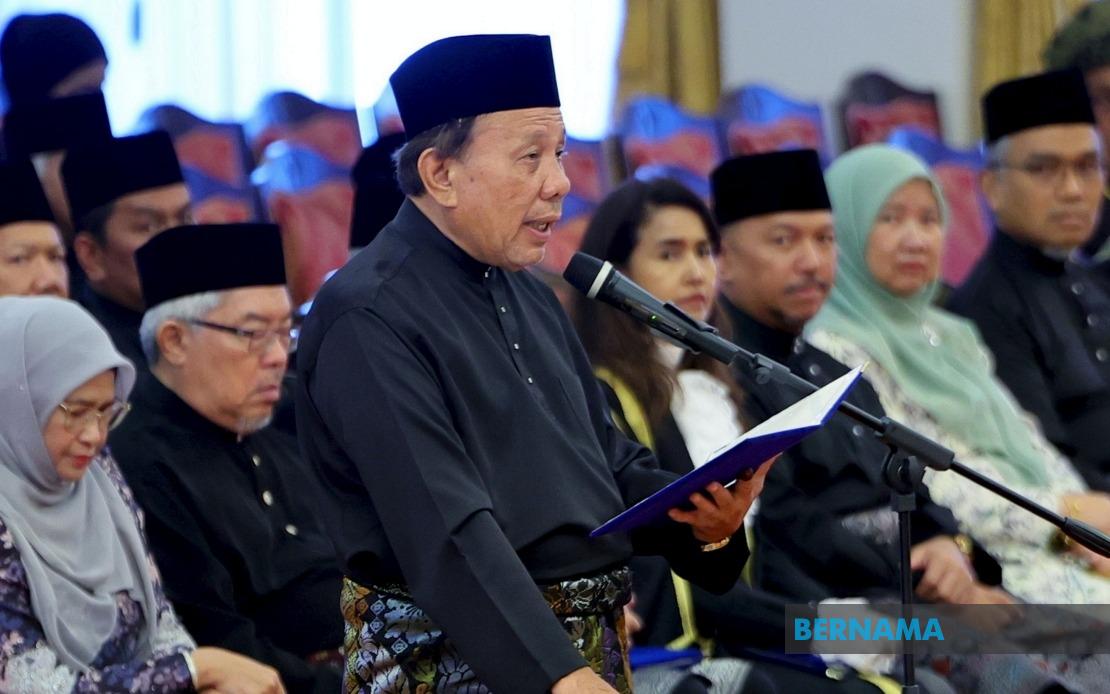
Negeri Sembilan has a new political leader at the helm. Datuk Ismail Lasim took his oath of office at Istana Besar Seri Menanti in Kuala Pilah before the Yang Dipertuan Besar Tuanku Muhriz Tuanku Munawir, formally assuming the role of Menteri Besar following the 16th state election results. In his inaugural address, Ismail outlined a governance philosophy centred on honouring public trust through equitable and transparent administration, signalling a fresh commitment to serving Negeri Sembilan's citizens with diligence and accountability.
The incoming chief minister framed his appointment as both privilege and responsibility. He emphasised that the electoral mandate received represented far more than ceremonial recognition—it embodied a solemn contract with the electorate to demonstrate that government operates with the people's interests foremost. Ismail stressed that earning and maintaining that confidence would require consistent proof of commitment through deliberate, measurable action rather than mere rhetoric. This framing suggests an administration intent on differentiating itself through concrete performance metrics and genuine responsiveness to constituent grievances, a strategic positioning particularly relevant given Malaysia's increasingly discerning voters who demand visible results.
A defining feature of Ismail's pledge involves anchoring his administration within Malaysia's constitutional framework and the principles of constitutional monarchy. He committed to upholding the sovereignty and dignity of the Yang Dipertuan Besar, respecting royal guidance on state matters, and adhering to both the Federal Constitution and Negeri Sembilan's state constitution. This emphasis reflects Malaysia's governance system where Malay rulers retain significant ceremonial and advisory authority, and Ismail's explicit deference to these conventions signals respect for institutional hierarchy—a prudent position for any state leader seeking to govern harmoniously within the federation's power structures.
Ismail also highlighted Negeri Sembilan's distinctive customary heritage, particularly the Adat Perpatih system, as foundational to his administrative vision. Unlike much of peninsular Malaysia, which follows Adat Temenggong, Negeri Sembilan's matrilineal customary law embodies principles of consensus-building, justice-oriented decision-making, and collective wisdom. By pledging to preserve and transmit these values to future generations, Ismail positioned his government as guardian of local cultural identity—a significant consideration in a state where traditional governance norms remain influential and where citizens take pride in their unique institutional inheritance. This tactic resonates with Negeri Sembilan's social fabric and distinguishes the state's administrative ethos from federal-level policies.
Economically, Ismail articulated a multi-pronged development strategy that extends beyond conventional infrastructure expansion. He committed to strengthening the state economy, attracting quality investments, and generating employment while simultaneously addressing education, healthcare, housing, agriculture, and social welfare improvements. This balanced approach acknowledges that modern governance must simultaneously pursue growth and equity—a recognition that resonates across Southeast Asia as nations grapple with widening inequality alongside development aspirations. For Negeri Sembilan specifically, this signals commitment to narrowing urban-rural disparities and ensuring peripheral communities benefit tangibly from progress.
Crucially, Ismail redefined what constitutes genuine progress beyond quantifiable infrastructure metrics. He asserted that true advancement encompasses social cohesion, institutional strength, and public confidence in government systems—intangible yet measurable elements that reflect governance quality. This perspective aligns with emerging development philosophies that challenge GDP-centric models and acknowledge that citizen satisfaction and institutional legitimacy are prerequisites for sustainable prosperity. For Malaysian policymakers and analysts, this statement reflects evolving expectations that leaders demonstrate sophistication beyond spreadsheet economics.
The new Menteri Besar placed considerable emphasis on civil service excellence, pledging to ensure that state administration operates with integrity, efficiency, and transparency while maintaining professional standards within the bureaucracy. He recognised that capable governance depends fundamentally on a motivated, accountable civil service operating according to clear ethical standards. This commitment addresses a perennial challenge in Malaysian administration—ensuring that institutional machinery responds to public needs rather than becoming entangled in political patronage or bureaucratic lethargy. Ismail's emphasis suggests awareness that electoral promises ultimately depend on administrative competence for implementation.
Ismail also underscored the importance of consensus-building and receptiveness to constructive criticism from diverse stakeholders. Rather than presenting governance as a top-down imposition, he positioned his administration as willing to listen across party lines, community groups, and economic sectors. This collaborative framing carries particular significance given Malaysia's multi-ethnic, multi-religious composition and the mounting expectations that leaders bridge societal divisions rather than exploit them. For Southeast Asia broadly, where populist polarisation threatens social cohesion, Ismail's emphasis on dialogue-based governance presents a counternarrative worth monitoring.
The ceremonial acknowledgement of his predecessor, Datuk Seri Aminuddin Harun, demonstrated political grace and institutional continuity. Ismail framed previous administration's development efforts as foundational rather than as failures to be reversed, suggesting commitment to gradual improvement rather than disruptive policy reversals. This approach preserves institutional knowledge and avoids demoralising departing officials, fostering smoother transitions. It also signals to foreign investors and civil society that Negeri Sembilan's policy direction enjoys cross-factional support, enhancing stability and predictability—factors crucial for attracting quality investments and maintaining social confidence.
Integration among key stakeholder groups—the royal institution, state and federal governments, bureaucracy, private sector, and community leaders—formed another cornerstone of Ismail's governance vision. This holistic institutional approach recognises that effective state administration requires coordinated effort across multiple domains. For Negeri Sembilan, situated within the broader Malaysian federation yet maintaining distinct governance traditions, such integration proves especially critical for balancing state autonomy with federal cooperation on matters ranging from economic policy to security.
Looking forward, Ismail's inaugural pledges establish benchmarks against which his administration will be evaluated. His emphasis on transparency, people-centric development, constitutional propriety, and civil service excellence projects an administration attuned to contemporary governance standards. However, the substantive test lies in implementation—whether promised fairness translates to equitable resource allocation, whether transparency materialises in accessible public information systems, and whether inclusive development reaches marginalised communities. For Negeri Sembilan's citizens and Malaysia's broader political ecosystem, this new leadership chapter warrants close observation as an indicator of whether regional state governments can operationalise the participatory, accountable governance increasingly demanded by Southeast Asian publics.

