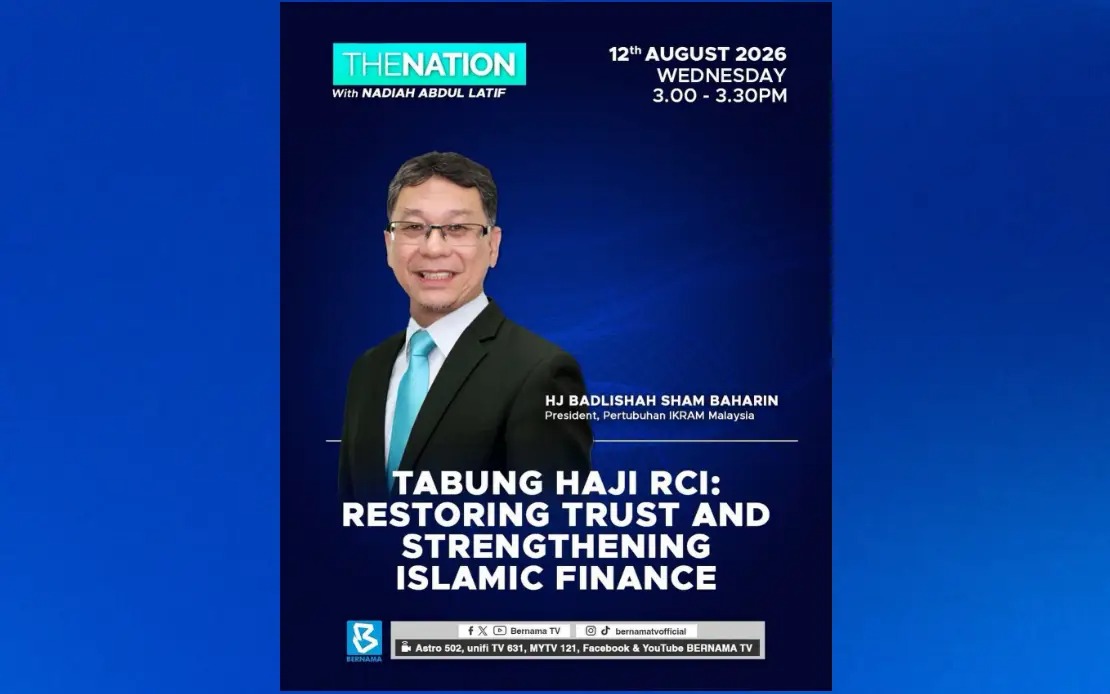
The case for a fresh Royal Commission of Inquiry into Tabung Haji (TH) lacks merit, according to Badlishah Sham Baharin, president of Pertubuhan IKRAM Malaysia, who has questioned whether establishing multiple inquiries serves the public interest or merely dilutes their effectiveness. Speaking after an appearance on Bernama TV's "The Nation" programme, which examined the restoration of confidence in Islamic finance, Badlishah Sham articulated concerns about the growing tendency to establish RCIs as a reflexive response to institutional failures, arguing instead that existing investigative mechanisms—particularly the Malaysian Anti-Corruption Commission (MACC)—possess sufficient resources and authority to examine irregularities at the pilgrimage fund.
The intervention comes amid renewed demands from both Barisan Nasional and Pakatan Harapan MPs for the government to commission a separate inquiry into TH's management covering the 2021 to 2025 period. The existing RCI, which was made public on July 29, confined its examination to operations between 2014 and 2020, leaving a significant gap that critics say obscures more recent developments. Finance Minister II Datuk Seri Amir Hamzah Azizan disclosed during a special Dewan Rakyat sitting that the institution had sustained losses approaching RM13 billion through 14 problematic investments, with seven resulting in complete write-offs.
The composition of these losses reveals the magnitude of mismanagement that unfolded over nearly a decade. Of the RM13 billion in aggregate losses, approximately RM10.2 billion was absorbed by Malaysian taxpayers through a 2018 government bailout executed via Urusharta Jamaah Sdn Bhd (UJSB). The remaining RM2.6 billion represents impairment charges that TH itself has had to carry between 2018 and 2025 for investments still under management. These figures underscore why calls for broader scrutiny persist, particularly among lawmakers concerned that restricting inquiry to the 2014-2020 period leaves questions unanswered about whether governance standards have genuinely improved or whether institutional weaknesses persist.
Among the most egregious losses documented is the Al-Rawda transaction, which consumed a single investment portfolio and exemplifies the risks inherent in TH's investment strategy during the period under review. Between 2015 and 2017, TH paid 1.4 billion Saudi riyals—approximately RM1.5 billion—to an intermediary entity for the right to lease four hotels in Makkah and Madinah intended to house Malaysian pilgrims. The arrangement proved catastrophic when Al-Rawda defaulted on rental payments commencing in the first quarter of 2019, ultimately compelling TH to recognise a full impairment loss of RM1 billion in 2024. This single investment encapsulates failures at multiple levels: inadequate due diligence on the counterparty, excessive reliance on intermediary arrangements that inflated costs, and insufficient risk management protocols.
Badlishah Sham's argument against an additional RCI rests partly on the premise that such inquiries should be reserved for cases of exceptional public importance, and that their overuse inevitably diminishes both their perceived significance and their political utility. He contends that establishing investigatory commissions for every institutional failure carries the risk of rendering them routine rather than extraordinary, thereby normalising their deployment and potentially inviting partisan manipulation. This perspective reflects broader concerns about the structural integrity of governance mechanisms, particularly in contexts where such inquiries can become vehicles for political point-scoring rather than genuine fact-finding.
However, IKRAM's position does acknowledge the necessity for enhanced scrutiny of investment practices moving forward. Badlishah Sham expressed support for the proposal to establish a multi-agency task force capable of evaluating investments bearing elevated default risk and implementing safeguards against recurrence of similar failures. He emphasised that rigorous due diligence protocols must precede all investment decisions, and that such assessments must encompass both technical financial analysis and ethical compliance with Islamic principles. This distinction is significant for Malaysian readers, given that TH's primary constituency comprises nearly 10 million depositors who are entitled to expect that their funds are deployed not merely profitably but in accordance with Shariah principles and fiduciary standards.
The existing RCI report, released on July 29, documented systematic weaknesses spanning governance, investment oversight, and risk management across TH's operations during the 2014-2020 period. The commission issued 25 recommendations for institutional reform, and TH has reportedly implemented approximately 75 per cent of these measures as of July 30. While this compliance rate suggests responsiveness to regulatory pressure, it simultaneously raises questions about why only three-quarters of recommended reforms have been adopted, and what barriers exist to full implementation of the commission's findings. For depositors and policymakers alike, incomplete adherence to RCI recommendations undermines confidence that the institution has fully reckoned with its shortcomings.
Badlishah Sham also addressed the decision by certain opposition MPs to walk out of the special Dewan Rakyat sitting, characterising the action as a dereliction of parliamentary duty. He argued that elected representatives possess an obligation to provide legislative checks and balances regardless of partisan disagreement with the government, and that abandoning the chamber represents an abdication of responsibility to the constituencies they represent. The criticism carries particular weight given that TH depositors—whose interests were ostensibly being debated—represent a substantial portion of Malaysia's Muslim population and extend across political and geographic boundaries. His remarks suggest frustration with what he perceives as performative activism on social media platforms like TikTok substituting for substantive parliamentary engagement.
The debate over whether a fresh RCI is warranted ultimately hinges on differing assessments of institutional capacity and political expediency. Advocates for a new inquiry argue that restricting scrutiny to 2014-2020 creates an accountability vacuum precisely when depositors and taxpayers require assurance that governance failures have not recurred. Opponents contend that MACC investigations, combined with TH's reported implementation of RCI recommendations, provide adequate oversight without incurring the expense and political drama inherent in establishing another royal commission. This disagreement reflects broader tensions within Malaysia's governance frameworks between the need for institutional accountability and concerns about the proliferation of time-consuming inquiries that may impede operational continuity.
From a regional perspective, TH's travails underscore vulnerabilities in Islamic financial institutions across Southeast Asia, where rapid expansion, competitive pressures, and inadequate governance frameworks have occasionally led to losses comparable to those experienced by Malaysian institutions. The Al-Rawda case, in particular, illustrates how intermediary-based arrangements—common in cross-border Islamic finance—can mask underlying credit risk and create opaque structures resistant to effective oversight. Malaysian policymakers and financial regulators monitoring TH's recovery trajectory are simultaneously watching for lessons applicable to other Islamic financial entities operating across the region.
Moving forward, the tension between IKRAM's position and the demands for expanded inquiry may be resolved through hybrid approaches. A focused, time-limited examination of the 2021-2025 period conducted by existing authorities without the formal apparatus of a new RCI might satisfy critics while respecting concerns about institutional proliferation. What remains non-negotiable, however, is that TH must demonstrate substantive improvement in investment governance, enhanced transparency regarding counterparty risk, and rigorous application of Islamic financial principles. For Malaysian depositors who have weathered RM13 billion in losses, the distinction between a multi-agency task force and a royal commission matters far less than tangible evidence that investment decisions are now made with competence, integrity, and fiduciary responsibility.

