Norway's return to football's grandest stage concluded in Miami on Saturday with a 2-1 extra-time defeat to England in the quarter-finals, yet the Scandinavian nation can depart with genuine pride after a tournament that captured imaginations across the globe. The squad's 28-year absence from World Cup competition made their run all the more remarkable, and manager Stale Solbakken's understated reflection that the summer of 2026 had been "fairly OK" belied the genuine achievement his team had accomplished on the tournament's biggest platform.
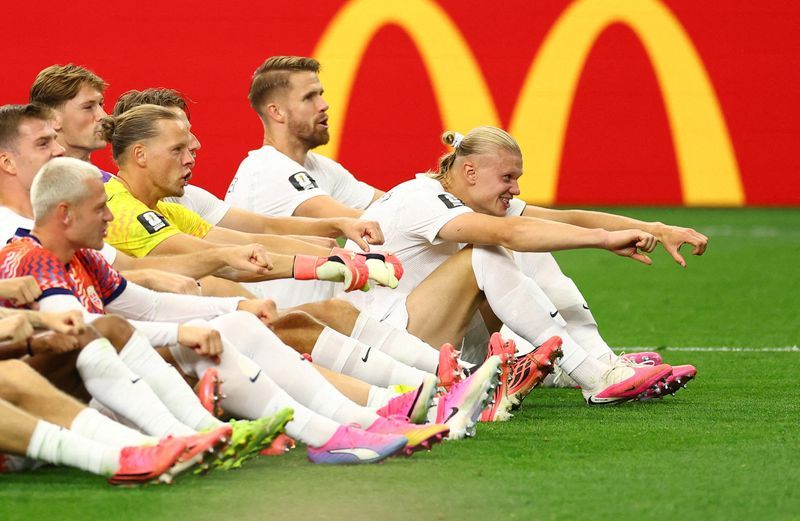
The Norwegians arrived at the finals wrapped in the iconography of their Viking heritage, with a pre-tournament photoshoot that dressed the players in the garb of their seafaring ancestors setting the cultural tone for their campaign. This embrace of national identity proved infectious, particularly when their fans popularized the "Viking row" celebration that became one of the tournament's defining images. The strategic melding of historical pride with contemporary athletic excellence created a narrative that resonated far beyond Scandinavia, transforming the Norwegian team into cultural ambassadors for their small nation.
Erling Haaland and his teammates stormed through the group stage with the kind of attacking verve that suggested they could challenge any opposition. Haaland's clinical finishing proved instrumental in their opening knockout victory against Ivory Coast, where his double in a 2-1 triumph secured passage and announced Norway as genuine contenders rather than mere participants. The psychological boost from this victory set the stage for what would become the tournament's most stunning upset—a commanding 2-1 dismantling of Brazil that left observers questioning whether Norwegian football had undergone a fundamental transformation from its historical reputation as a direct, physical approach.
That remarkable victory over the five-time world champions exposed the depth of talent emerging from Norwegian football culture. The performance was not a tactical aberration or a fortunate result, but rather a demonstration of technical proficiency, intelligent movement, and collective cohesion that suggested Norway's football development had entered a new era. Manager Solbakken's influence was evident in the organization and discipline his players displayed, while captain Martin Odegaard orchestrated play with the composure of someone accustomed to competing at Europe's highest level.
The accumulated physical toll of their demanding matches ultimately proved decisive against England in the quarter-finals. With both Haaland and Odegaard visibly fatigued, England capitalized ruthlessly when Jude Bellingham scored twice in extra time to overturn Norway's one-goal advantage and send his team through to the semi-finals. The defeat marked not a failure of ambition or tactical approach, but rather the inevitable collision between a rising squad and the grinding realities of tournament football at the elite level.
Beyond the World Cup performance, Norwegian football's structural health suggests this tournament represents merely a waypoint rather than an outlier. Bodø/Glimt's sustained success in European club competitions over recent years indicates a domestic ecosystem increasingly capable of developing players who can compete with established European powerhouses. The Norwegian league has begun attracting technical investment and sophisticated coaching approaches that mirror the progression seen across Scandinavia in recent decades, moving the nation's football culture decisively away from its former reputation as a kick-and-rush footballing nation.
The triumvirate of Solbakken, Odegaard, and Haaland embodies a distinctly Norwegian character that combines quiet confidence with self-aware humor and ruthless professionalism. Their collective demeanor—never taking themselves too seriously while maintaining absolute commitment to winning—reflects a cultural approach that has proven remarkably effective in elevating Norwegian performance. These players have normalized competing against and defeating the world's elite, fundamentally shifting expectations within Norwegian football from survival to genuine aspiration.
Solbakken's post-tournament assessment acknowledged that his players have internalized the crucial realization that they belong among the game's elite. This psychological recalibration may prove as significant as any tactical innovation or technical improvement. When young Norwegian players recognize that competing successfully against world-class opposition is possible rather than presumptuous, it establishes a performance standard that ripples through the entire system, influencing youth development, player mentality, and institutional confidence.
For Southeast Asian football observers, Norway's trajectory offers instructive lessons about the possibilities inherent in sustained developmental investment and structural coherence. A nation of just 5.5 million inhabitants has produced players and systems capable of competing with populations many times larger, suggesting that scale alone need not determine footballing destiny. The Norwegian experience demonstrates how strategic investment in coaching, player development, and organizational discipline can elevate a football culture significantly within a generational timeframe, a dynamic particularly relevant for ASEAN nations seeking to improve their competitive standing on the continental and global stage.

