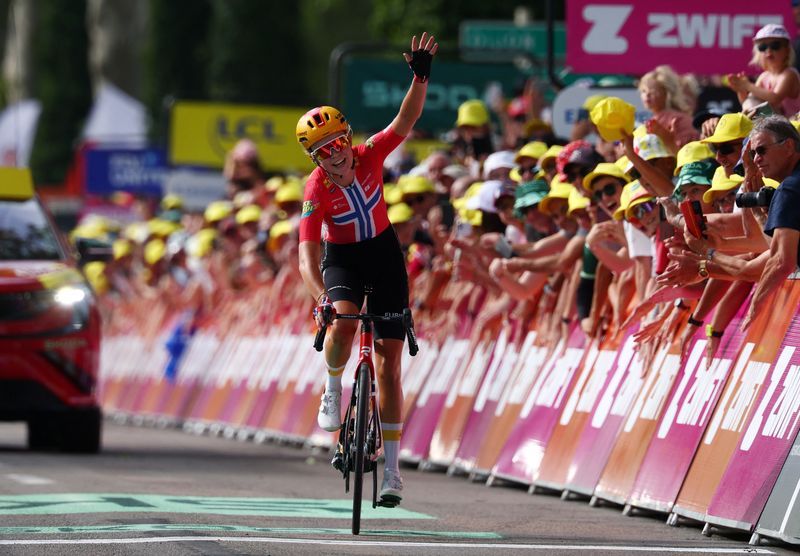
Sigrid Haugset etched her name into Norwegian cycling history on Monday by capturing a solo victory at the Tour de France Femmes, a breakthrough moment that propelled the 27-year-old Uno-X Mobility rider into the race's overall lead. The Norwegian's commanding performance marked the first stage win by a competitor from her country in the women's version of cycling's most prestigious race, a milestone that carries significant weight in a nation with a storied cycling tradition. Her triumph also saw her claim the coveted yellow jersey, displacing Dutchwoman Lorena Wiebes from the top position.
Haugset's winning performance unfolded across a challenging mountain terrain as the race ventured into the Swiss Alps for the first time. The 156.5-kilometre stage featured multiple category-one climbs that tested the field's climbing prowess and mental fortitude. Her ultimate winning margin of one minute and 24 seconds over Belgium's Lotte Kopecky underscored the strength of her execution on the day, whilst third-place finisher Marianne Vos of the Netherlands rounded out the podium in the picturesque town of Poligny.
The emotional weight of the achievement was evident in Haugset's immediate reaction at the finish line. Speaking moments after crossing the line, the Norwegian cyclist admitted her disbelief at what she had accomplished, describing the moment as surreal. The significance of being the first from her nation to wear the yellow jersey in the Tour de France Femmes clearly resonated deeply, connecting her personal triumph to the aspirations of cycling enthusiasts back home. This development marks a turning point for Norwegian women's cycling on the sport's grandest stage.
Haugset's tactical approach during the final kilometres revealed the mental battle underlying her physical dominance. As Kopecky launched her pursuit during the Col de la Savine climb, the Norwegian found herself under mounting pressure with the Belgian rider closing the gap to just 10 seconds with approximately 10 kilometres remaining. However, rather than succumbing to the pressure, Haugset summoned additional reserves of strength and extended her advantage to nearly a minute by the three-kilometre mark, effectively sealing her victory and the psychological momentum that comes with such a decisive advantage.
The stage itself was marked by a significant crash during the category-one ascent of Col de la Faucille as the peloton navigated the increasingly demanding terrain. Reigning world champion Magdeleine Vallieres and former Tour de France Femmes winner Demi Vollering both went down, though riders quickly remounted without causing a general collapse in the race dynamics. The peloton's stability through the descent and onto the final climb suggested that the major contenders had largely escaped the incident's consequences.
Haugset's overall margin of two minutes and 22 seconds over Kimberly Le Court of Mauritius provides a substantial buffer heading into the remaining stages. This cushion reflects not only her stage performance but also her consistent positioning throughout the race thus far. Le Court's presence in second place represents a notable achievement for Mauritian cycling on the international stage, demonstrating that the Tour de France Femmes is increasingly attracting competitive talent from outside the traditional European cycling powerhouses.
Prior to Monday's stage, Lorena Wiebes had controlled the race with a commanding presence in the yellow jersey, but Haugset's breakthrough performance fundamentally altered the race narrative. The transfer of leadership marks a significant shift in momentum and reflects the unpredictable nature of stage racing, where a single strong performance can dramatically reshape the overall classification. For readers across Southeast Asia following the sport, Haugset's emergence as a race leader offers an instructive lesson in how breakthrough performances often come from lesser-fancied competitors who execute their tactical plans with precision.
The psychological dimension of Haugset's victory extended beyond the finish line. During her post-race comments, she revealed that she had contemplated settling for second place during the climb, recognizing that a podium finish would represent a significant achievement in itself. Her decision to press onwards despite the growing presence of Kopecky demonstrates the mentality required to succeed at cycling's highest level, a combination of ambition tempered by realistic assessment of circumstances. That she persevered through moments of doubt speaks to her competitive character and hunger for success at the sport's premier event.
As the Tour de France Femmes continues through its demanding mountain stages, Haugset's unexpected assumption of the yellow jersey injects fresh intrigue into the race. Her breakthrough victory suggests that the competition for the ultimate prize remains wide open, with multiple riders capable of producing the kind of sustained strong performances required to win the event outright. For Norwegian cycling enthusiasts, the imagery of their national cyclist in the yellow jersey represents a watershed moment that may inspire a new generation of riders to aspire to excellence on cycling's biggest platform.
The broader context of women's professional cycling in recent years has seen accelerating investment, professionalization, and global expansion that extends opportunities to athletes from traditionally underrepresented nations and regions. Haugset's prominence in the 2024 Tour de France Femmes reflects this evolution, where talent pools beyond the traditional Belgian, Dutch, and French strongholds are now producing world-class performers capable of winning stages and competing for overall victory. This competitive deepening benefits the sport's global profile whilst opening pathways for ambitious cyclists across the world to reach the highest echelons of professional racing.

