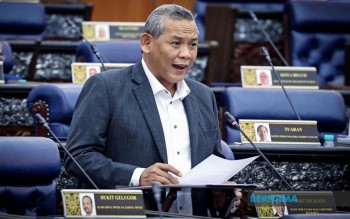
The distinction between legitimate investment losses and those stemming from poor governance has become central to Malaysia's reassessment of Tabung Haji's troubled financial performance. During parliamentary debate on the Royal Commission of Inquiry report, Port Dickson Member of Parliament Datuk Seri Aminuddin Harun urged lawmakers to evaluate the pilgrim fund's investment decisions with nuance, acknowledging that market volatility naturally impacts returns across all portfolios whilst isolating instances where negligence, conflicts of interest, or administrative failures caused preventable damage.
Aminuddin's intervention reflects broader concerns within government circles about ensuring accountability without unfairly attributing ordinary market risks to individuals. The former Negeri Sembilan menteri besar emphasised the need for parliamentary discourse to be anchored in fairness, recognising that investment outcomes depend on numerous factors beyond management's immediate control. However, he drew a firm line at governance shortcomings—arguing that losses traceable to poor decision-making processes, conflicts of interest, or institutional weaknesses demand separate scrutiny and remedy.
The RCI, which examined Tabung Haji's operations between 2014 and 2020, recommended forensic audits of 14 investments that experienced significant declines. These investigations will attempt to establish whether losses resulted from market conditions beyond management's reasonable foresight or from decisions that prudent stewardship should have prevented. This distinction carries profound implications for determining whether individuals within the institution bear personal responsibility or whether systemic weaknesses created conditions for avoidable losses.
Aminuddin launched a pointed critique of Tabung Haji's historical appointment practices, arguing that board positions and senior management roles should be filled exclusively on merit rather than political patronage. He contended that the institution has suffered from a culture where key posts were treated as rewards for political loyalty or vehicles for building influence, rather than as serious professional responsibilities requiring specific expertise. This observation resonates across Malaysian governance discourse, where accusations of cronyism and politically-motivated appointments have long undermined institutional effectiveness and public confidence.
Recognising the need for comprehensive reform, Aminuddin proposed establishing detailed screening criteria for all future board candidates. His framework extends well beyond general management experience, encompassing specialised competencies directly relevant to Tabung Haji's dual mandates of financial stewardship and religious obligation. Prospective directors would need demonstrated expertise in investment management, Islamic finance, risk assessment, accounting standards, auditing practices, corporate law, governance frameworks, and hajj administration. Additionally, candidates would be required to formally declare potential conflicts of interest, creating transparency mechanisms designed to prevent situations where personal financial stakes compromise institutional decisions.
The RCI itself recommended that active politicians be barred from chairing or serving on Tabung Haji's board and subsidiary company boards. Aminuddin supported this proposal whilst arguing Parliament should implement it decisively and comprehensively. The prohibition addresses a structural vulnerability in the institution's governance model—the inherent tension between political appointment cycles and the long-term stewardship requirements of managing pilgrim savings and investment portfolios. Removing serving politicians from board positions would create clearer separation between electoral politics and fiduciary duty, potentially reducing instances where short-term political pressures influence investment strategy.
Parallel concerns about the RCI's temporal scope emerged during parliamentary proceedings. Datuk Mohd Isam Mohd Isa of Tampin raised substantive objections to the inquiry's limitation to the 2014–2020 period, arguing that significant developments affecting Tabung Haji have unfolded since 2020. The period between 2021 and 2025 encompasses critical decisions regarding institutional reform, management transitions, and investment repositioning occurring in response to the RCI findings themselves. Mohd Isam contended that a comprehensive accountability process should extend through 2025 at minimum, capturing the full implementation phase of post-RCI changes.
Mohd Isam proposed establishing a new RCI to examine the 2021–2025 interval specifically, believing that limiting scrutiny to an earlier period leaves crucial gaps in understanding how Tabung Haji's leadership has responded to identified problems. As a Public Accounts Committee member, he also advocated referring Tabung Haji governance matters to the PAC for detailed examination covering 2022 through 2026, ensuring parliamentary oversight mechanisms operate beyond the RCI's constrained timeframe. This proposal reflects institutional awareness that RCI inquiries, whilst valuable, cannot substitute for ongoing parliamentary oversight of implementation and emerging challenges.
The original RCI report, released publicly on July 29, runs to 211 pages and identifies multiple weaknesses in Tabung Haji's management and operational frameworks spanning the 2014–2020 period. The inquiry produced 25 specific recommendations for institutional improvement, with Tabung Haji demonstrating noteworthy progress by implementing approximately 75 per cent of these recommendations within a month of the report's public release. This relatively rapid implementation suggests institutional commitment to remedying identified governance failures, though some observers caution that quick adoption of recommendations requires verification that implementations address underlying systemic issues rather than merely technical compliance.
The government established the RCI in 2021, formally appointed its members in January 2022, and received the completed report on August 30, 2022. The extended timeline between establishment and public release reflects the complexity of investigating a major institutional failure spanning multiple years and involving numerous investment decisions. For Malaysian pilgrims and their families, whose hajj savings remain invested through Tabung Haji, the RCI process represents an important but necessarily incomplete mechanism for restoring institutional confidence. The inquiry's focus on distinguishing market-driven losses from governance failures, combined with parliamentary pressure for merit-based appointments and stricter oversight, signals that accountability mechanisms are gradually strengthening—though implementation and prevention of future misconduct remain subject to sustained political commitment.

