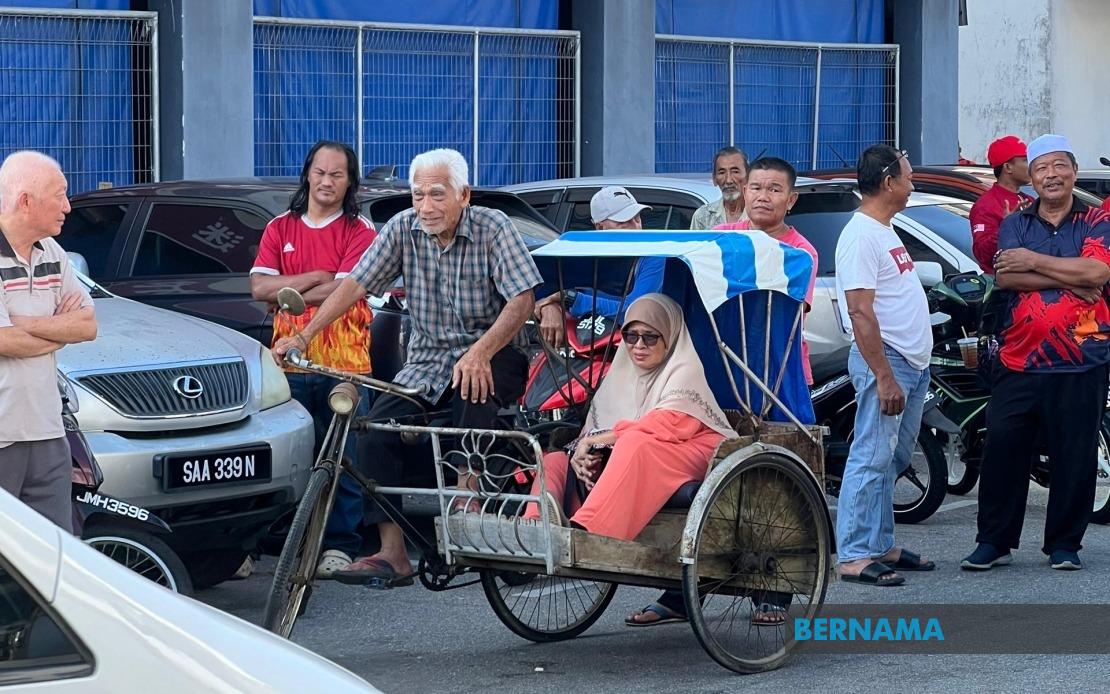
An 86-year-old imam in the Johor town of Batu Pahat undertook a determined physical effort on a sweltering afternoon, pedalling his trishaw nearly a kilometre from his village home to catch a glimpse of Prime Minister Datuk Seri Anwar Ibrahim at a local coffee shop. Abdul Razak Pelangga, the imam of Masjid Raudhatul Jannah Parit Bugis, made the journey with his wife Jamilah Samsudin, driven by a combination of personal history and civic enthusiasm as the state grappled with its electoral cycle.
The decision to use his trishaw rather than driving a motorised vehicle proved pragmatic. Pelangga explained that he had chosen the unconventional mode of transport to sidestep the challenge of locating parking in the crowded town centre, where Anwar's presence had drawn substantial numbers of residents to Kedai Kopi Hailam Sri Medan. The heat was formidable, yet neither the temperature nor the physical exertion deterred the elderly couple from their purpose.
Pelangga's motivation extended beyond mere curiosity or partisan enthusiasm. Decades earlier, before ascending to the nation's highest office, Anwar had visited Pelangga's mosque to lead prayers. That encounter left an impression sufficiently vivid that Pelangga retained the memory and had shared the experience with his wife over the intervening years. Learning that the Prime Minister would be in Senggarang activated a long-dormant intention to create a fresh encounter, this time with his spouse present to witness the connection.
The meeting, when it materialised, fell short of Pelangga's initial hope for direct face-to-face engagement. The crowd density surrounding Anwar at the coffee shop precluded intimate conversation. Yet proximity to the Prime Minister from a short distance appeared to satisfy the couple's objective. For Jamilah, viewing her husband's acquaintance in person represented a marked distinction from the mediated experience of watching Anwar solely through television broadcasts in their Kampung Parit Bugis home.
Anwar's visit to Batu Pahat formed part of a broader engagement strategy for the Senggarang state constituency. The Prime Minister spent approximately fifty minutes at the coffee shop, interacting with local residents as part of the PMX Meet-and-Greet Programme aligned with the Johor state election campaign. The visit carried considerable symbolic weight, as it represented the governing Pakatan Harapan coalition's direct outreach to voters in a competitive electoral environment. Datuk Fahmi Fadzil, the Pakatan Harapan Communications Director and federal Communications Minister, accompanied Anwar during the engagement.
The timing of the electoral contest added another dimension to Pelangga's personal narrative. The Johor state election was scheduled for July 11, coinciding precisely with his 87th birthday. This convergence transformed an ordinary civic duty into a notably memorable occasion. Pelangga emphasised that whilst he had participated in numerous elections throughout his life, this particular instance would carry special significance by virtue of occurring on his birthday. The alignment of personal milestone and democratic participation resonated with him as a pleasing coincidence.
Early voting for the election was scheduled for July 7, providing flexibility for those unable to cast ballots on polling day. This structural arrangement acknowledged the logistical challenges facing certain voter populations, including the elderly and infirm. For Pelangga, reaching the polling station on his birthday would likely present few obstacles, particularly given the demonstrated physical vigour he displayed through his trishaw journey to encounter the Prime Minister.
The anecdote illustrates broader patterns of voter engagement in Malaysian electoral contests. The voluntary effort expended by older citizens to participate in campaigns and vote reflects deeply rooted commitments to democratic processes and governance. Pelangga's choice to travel by trishaw, a vehicle associated with traditional Malaysian culture and manual labour, added texture to the narrative of an ordinary citizen participating in national affairs. The juxtaposition of modern political campaigns against traditional transport methods captured something essential about Malaysian society's evolving yet rooted character.
Johor's electoral cycle represented a significant political moment, as state elections carried implications extending beyond regional boundaries into federal political dynamics. The Pakatan Harapan coalition's engagement efforts in constituencies like Senggarang reflected recognition that electoral contests, whilst ostensibly local, contributed to the broader trajectory of national governance. Anwar's willingness to conduct breakfast meetings with constituents, coupled with supporting ministerial presence, signalled commitment to grassroots-level political communication and relationship-building.
The encounter between Pelangga and Anwar, though brief and mediated by crowd constraints, represented the intersection of personal political history, familial aspiration, and contemporary electoral participation. For Pelangga, the effort to bring his wife to see the Prime Minister culminated in a modest but meaningful achievement. The act of pedalling through heat to witness a political moment, performed by an elderly man on the eve of an election and his own birthday, embodied the quiet persistence with which ordinary Malaysians engaged with their democratic system and national leaders.

