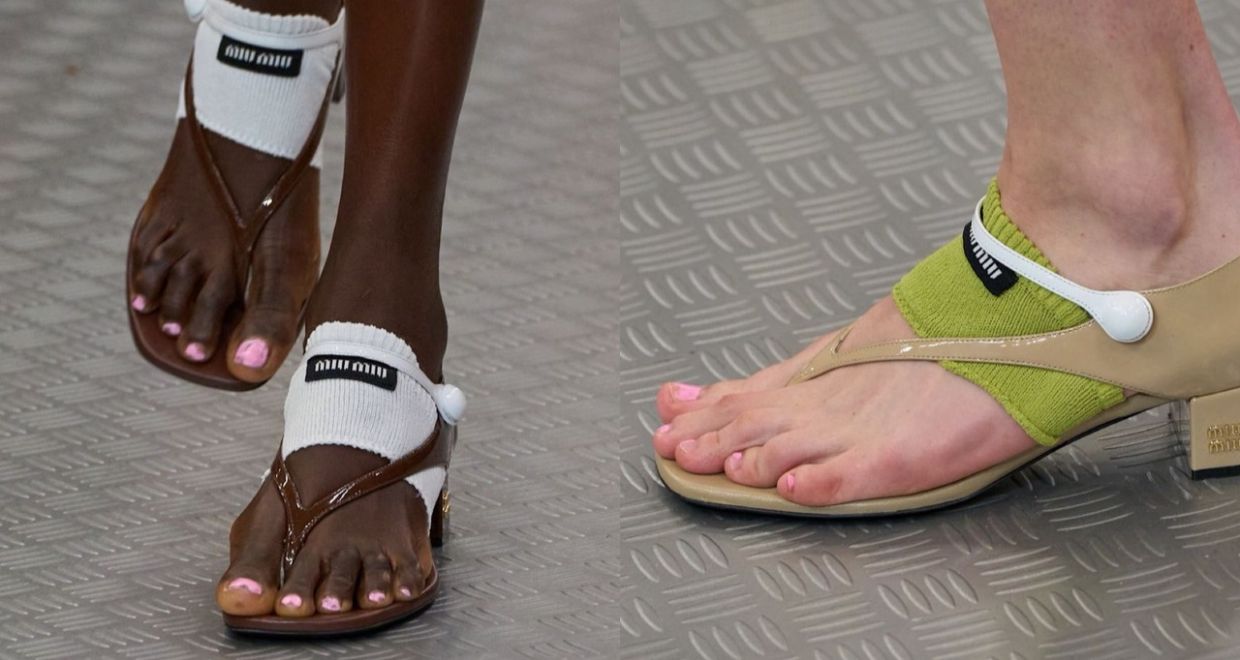
A new sartorial compromise is gaining traction across Asian fashion circles: open-toe socks that expose the toes while covering the arch and upper foot. The trend, which emerged during South Korea's early spring heat wave this year, represents an unconventional solution for style-conscious consumers who find bare feet too plain yet traditional socks unbearably warm in tropical climates—a dilemma particularly resonant for Malaysian and Southeast Asian consumers navigating high humidity and fluctuating temperatures throughout the year.
The phenomenon gained momentum following Miu Miu's 2025 Spring/Summer collection, which showcased socks designed to wrap only around the arch rather than envelop the entire foot. This minimalist approach caught the attention of fashion influencers and style editors, with actor Cha Jung-won subsequently posting social media content pairing sky-blue flip-flops with beige knit leg warmers, lending celebrity credibility to the unconventional pairing.
Retailers and fashion platforms tracking the movement report striking growth metrics. W Concept documented an 80 percent surge in summer footwear sales—including mules, slides, and flip-flops—between May 31 and June 7 compared to the previous year. More tellingly, commerce platform Ably recorded a 1,664 percent increase in transaction value for socks designed to wear with flip-flops over a month-long period, while search volume skyrocketed 3,227 percent, indicating substantial consumer curiosity beyond initial early adopters.
These figures suggest the trend transcends mere novelty, reflecting instead a genuine shift in how consumers conceptualize sock functionality during warm weather. The current generation of open-toe socks differs fundamentally from their winter predecessors through material composition and design philosophy. Manufacturers have engineered these items using sheer, mesh, and loosely knit fabrics that prioritize breathability and aesthetic contribution over thermal insulation. Rather than serving exclusively as utilitarian foot coverings, they function as visible accessories capable of injecting colour, pattern, and textural interest into otherwise monochromatic summer wardrobes.
For tropical regions like Malaysia, where monsoon seasons bring intense humidity and rainfall, the practical applications prove particularly compelling. The socks reduce friction and chafing that frequently occurs when flip-flop straps repeatedly contact bare skin during extended wear—a common discomfort during long, humid days. Additionally, during heavy rains and flooded conditions typical of monsoon periods, wearing open-toe socks with rain boots provides a protective barrier against direct skin contact, minimizing the risk of irritation and potential infections that can develop in persistently damp environments.
Fashion editors and styling professionals emphasize that the trend succeeds through restraint and complementary styling choices. A 29CM official explained that open-toe socks function as "summer cheat codes" for elevating basic footwear like flip-flops, sandals, and ballerina flats with minimal effort. The styling approach intentionally counters the maximalist impulse by requiring that the remaining outfit remain deliberately understated. When socks and shoes already command visual attention, pairing them with simple T-shirts, Bermuda shorts, or basic skirts allows the foot styling to become the focal point without overwhelming the overall silhouette.
Color selection and coordination strategies have emerged as central to executing the trend successfully. Style guides recommend beginning with neutral foundations—grey, black, and white socks offer the greatest versatility and pose minimal risk for beginners. A grey sock paired with black flip-flops or ballerina flats coordinates seamlessly with denim, Bermuda shorts, and satin skirts, creating cohesive summer outfits that feel intentional rather than accidental. Those seeking bolder visual statements can graduate to vivid hues such as yellow, pink, or sky blue, with the added styling trick of deliberately mismatching sock and shoe colours to project contemporary fashion awareness and individual personality.
Pattern integration represents another sophisticated application of the trend. Socks bearing visible motifs such as polka dots or floral designs create particularly striking combinations when paired with solid-coloured flip-flops and simple summer garments. This approach adds visual complexity and personality to what might otherwise constitute a forgettable seasonal outfit, transforming basic fundamentals into considered, fashion-forward choices that suggest deliberate curation rather than hasty assembly.
The broader cultural significance of this trend reflects evolving attitudes toward visibility and intentionality in fashion construction. Historically, socks occupied an invisible, merely functional position within outfit hierarchies—items to be hidden beneath trouser legs or dismissed as purely practical necessities. The open-toe sock movement actively repositions this category as worthy of aesthetic consideration and deliberate styling choices. Fashion editor Je Hye-yoon captured this transformation, stating that "socks are no longer an item to hide," inviting wearers to expose toes, leave them open, or tuck them strategically between flip-flop straps, thereby granting socks "a new kind of presence" within contemporary summer fashion narratives.
For Malaysian consumers navigating between practical comfort and stylistic expression, the trend offers particular relevance. In a tropical climate where weather extremes and rapid temperature fluctuations characterize much of the year, solutions that blend genuine utility with aesthetic appeal address real wardrobe challenges. Open-toe socks represent the latest iteration of how fashion evolves responsively to environmental constraints, transforming potential limitations into creative opportunities. As the trend gains traction throughout Southeast Asia, Malaysian fashion enthusiasts may find that this quirky summer staple provides an elegant resolution to the age-old tension between comfort and style, proving that innovative fashion solutions often emerge from addressing authentic everyday needs.
%22%2F%3E%3C%2Fpattern%3E%3C%2Fdefs%3E%3Crect%20width%3D%22100%25%22%20height%3D%22100%25%22%20fill%3D%22url(%23ph180wag)%22%2F%3E%3Crect%20width%3D%22100%25%22%20height%3D%22100%25%22%20fill%3D%22url(%23ph180wap)%22%2F%3E%3Ctext%20x%3D%2250%25%22%20y%3D%2250%25%22%20text-anchor%3D%22middle%22%20dominant-baseline%3D%22central%22%20fill%3D%22rgba(255%2C255%2C255%2C0.95)%22%20font-family%3D%22Georgia%2C%20'Times%20New%20Roman'%2C%20serif%22%20font-weight%3D%22700%22%20font-size%3D%22170%22%20letter-spacing%3D%22-0.02em%22%3EMalaysia%3C%2Ftext%3E%3C%2Fsvg%3E)