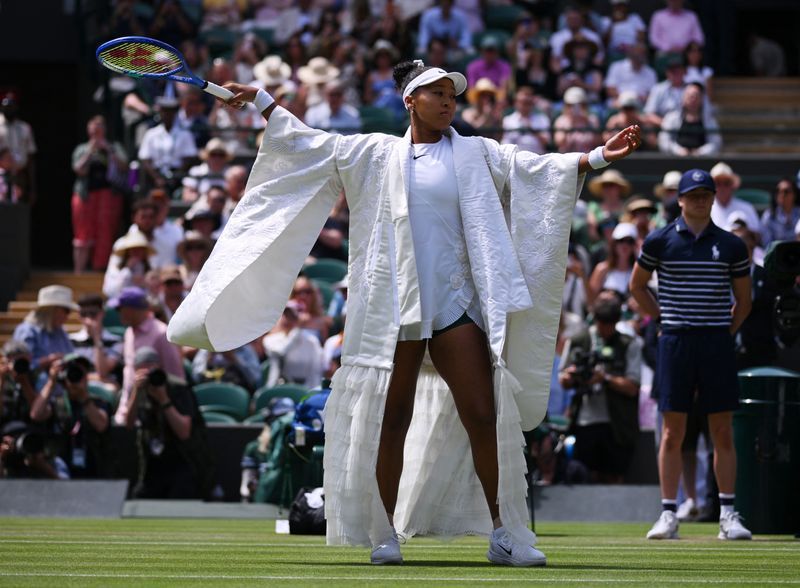
Naomi Osaka has successfully blended her renowned off-court presence with increasingly dominant on-court performance at Wimbledon, dismantling Russian-born Daria Kasatkina 6-1 6-3 on Friday to secure a last-16 berth that marks her deepest run at the All England Club. The four-time Grand Slam champion from Japan has become synonymous with bold fashion choices throughout tennis, and her latest appearance featured another eye-catching ensemble—a flower-patterned kimono-style robe reminiscent of her "Kill Bill" themed entrance wear—yet her performances have begun to overshadow the sartorial spectacle that typically defines her Wimbledon appearances.
The 14th-seeded Osaka demonstrated precisely why she remains one of the sport's most dangerous competitors when fully engaged, combining raw power with measured court positioning to overwhelm Kasatkina across the opening set. Her decisive opening came in just the second game when a backhand winner helped her secure a break, followed immediately by a penetrating forehand that extended her advantage to two breaks as she seized control on a sun-soaked Court One. This commanding start illustrated the significant gap between Osaka's current trajectory and that of an unseeded challenger, suggesting momentum has genuinely shifted in her favour following her recent grass-court preparation.
Osaka's journey to this stage has involved navigating the peculiar demands of grass-court tennis, a surface where her aggressive baseline game requires careful calibration. Prior to Wimbledon, she reached her first tour-level grass final at Bad Homburg, though injury forced her withdrawal from that match—a setback that has only seemed to sharpen her competitive edge. The past two weeks of grass-court competition have evidently provided the conditioning and confidence necessary to challenge elite opponents at the sport's most prestigious venue, transforming her from a stylish spectator into a legitimate contender for tournament progression.
While Osaka cruised through the opening set, the second frame revealed her capacity to remain mentally sharp even when confronted with adversity. After squandering an early advantage, she demonstrated the fighting qualities that have defined her previous Grand Slam triumphs, rallying from potential vulnerability to manufacture two match points. The clinical manner in which she converted the second opportunity underscored her growing comfort with grass surfaces and the aggressive mindset required to sustain success across the tournament's final stages.
Looking ahead to the round-of-16 contest, Osaka faces either world number one Aryna Sabalenka or former French Open champion Jelena Ostapenko, a matchup that promises considerably greater technical and tactical complexity than the Kasatkina encounter. Both potential opponents possess the weaponry and experience to trouble Osaka should she falter in her service games or fail to maintain the relentless baseline intensity that characterised Friday's performance. The significance of reaching this juncture cannot be understated for Osaka's confidence trajectory, particularly following her injuries and mental health challenges in preceding seasons.
In post-match remarks conducted courtside, Osaka expressed genuine delight at her achievement, noting that she had never previously won on Court One despite multiple appearances at the venue. Her acknowledgment of the crowd's support reflected not merely courteous obligatory commentary but rather an evident appreciation for the momentum generated by spectator enthusiasm on grass courts, where atmospheric conditions and crowd energy can meaningfully impact match dynamics. The Japanese champion's measured approach to each subsequent challenge—articulated through her emphasis on taking "one day at a time, one point at a time"—suggests a mental framework focused on process rather than distant outcomes, a philosophy that has served elite athletes well in tournament environments.
Osaka's Wimbledon campaign represents more than individual achievement; it signals a broader reassertion of Japanese excellence at major championships following injuries and competitive absence. Her presence among the tournament's final stages provides inspiration for Japanese tennis development and demonstrates that players from non-traditional tennis nations can sustain competitiveness at the sport's highest echelon when fully committed and injury-free. For Malaysian and Southeast Asian tennis enthusiasts, Osaka's trajectory underscores the importance of sustained investment in athlete development and mental health support systems, factors that have contributed meaningfully to her recent resurgence.
The trajectory from fashion spotlight to tennis prominence that Osaka has negotiated at Wimbledon carries broader implications for how female athletes navigate celebrity and sporting excellence simultaneously. Rather than treating her distinctive style as secondary entertainment, she has demonstrated that personal expression and elite athletic performance need not exist in tension, instead reinforcing each other when properly balanced. This integration of identity and athletics resonates particularly strongly with younger players and fans across Asia, where cultural expression through sport has gained increasing prominence in recent years.
As Osaka prepares for her next engagement, she carries not only the genuine accomplishment of advancing through Wimbledon's early rounds but also the psychological advantage of having dismantled a seeded opponent with methodical precision. The combination of renewed confidence, improving grass-court technique, and focused mental approach positions her as a legitimate threat to any remaining challenger, suggesting that her Wimbledon journey may extend considerably beyond the anticipated narrative of stylish appearances and early exits that might have been projected based on her recent competitive history.

