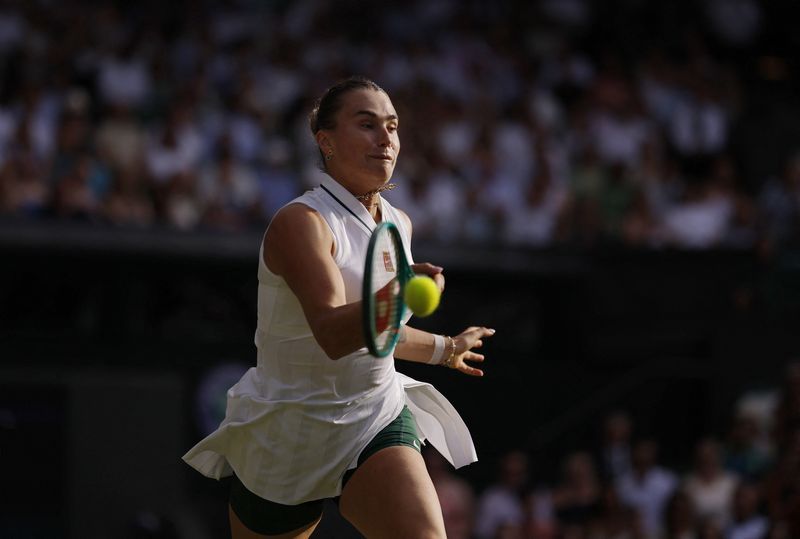
Naomi Osaka has fundamentally altered the landscape of the women's Wimbledon championship by dismantling top-seeded Aryna Sabalenka 6-2 7-6(2) on Centre Court in the fourth round on Sunday, marking a stunning upset that reshapes expectations for the tournament's remaining weeks. The 14th-seeded Japanese player controlled the match with such authority that she not only claimed her most significant victory since her 2024 return to professional tennis following the birth of her daughter Shai, but also cemented her status as a genuine threat to claim her first Wimbledon title.
The significance of this upset extends far beyond a single match result. With defending champion Iga Swiatek eliminated in the third round on Saturday and second seed Elena Rybakina also falling away, Osaka's victory means all three highest-ranked players have unexpectedly exited the tournament. This development leaves a vacuum at the top of the draw that multiple challengers can now realistically aspire to fill, creating an unusually open contest where unseeded or low-seeded competitors have genuine paths to the final.
Osaka's performance was characterised by relentless precision rather than theatrical brilliance. She broke Sabalenka's serve twice during an opening set that lasted merely 32 minutes, with her service returns consistently unsettling the top seed's typically dominant baseline game. Sabalenka, renowned for her power-based approach on hardcourts, found her weapons misfiring spectacularly in the early stages, and her mounting frustration became evident as she vocalised her displeasure throughout the opener.
The second set proved more competitive, with the packed Centre Court crowd anticipating the fireworks that two eight-time Grand Slam champions might produce. Sabalenka recovered some equilibrium and matched Osaka point-for-point through much of the set, yet she never managed to seize control. Instead, Osaka maintained her composure and entered the tiebreaker where she showcased her growing command of the situation, dispatching the deciding set breaker 7-2 to secure her passage into the quarter-finals.
A particularly telling moment came when Sabalenka, devastated after squandering a match point opportunity, released her anguish by striking a ball with such force that it sailed completely out of the stadium—a rare lapse in professionalism that underscored the psychological toll of the defeat. The 28-year-old Belarusian, who had reached three consecutive semi-finals at Wimbledon, had entered this match harbouring legitimate hopes of capturing her first grass-court Grand Slam title, only to find herself thoroughly outplayed.
Osaka's narrative carries particular resonance across Asia and for Malaysian tennis enthusiasts who have followed her extraordinary journey. Born seven months apart, Osaka and Sabalenka have traced remarkably divergent professional paths. Osaka captured all four of her Grand Slam titles on hardcourts before stepping away from the sport, while Sabalenka—the slightly younger competitor—did not claim her maiden Slam until 2023. This fourth-round encounter represented their first Slam meeting since 2016, when Osaka prevailed en route to her inaugural US Open championship, yet their head-to-head record beforehand had favoured Sabalenka with three consecutive victories.
What makes Osaka's resurgence particularly compelling is her demonstrable progress since returning to competitive tennis in 2024. The quality of her tennis, combined with her distinctive Japanese-inspired walk-on attire that has sparked considerable public interest, suggests she has genuinely recovered her championship form. She attacked from the opening moments on Sunday, establishing control through her service games and maintaining relentless pressure through her return of serve—typically regarded as the foundation stone of grass-court success.
For Malaysian observers and Southeast Asian tennis followers, Osaka's breakthrough holds significance beyond mere sporting achievement. Her willingness to step away from the sport to balance motherhood with professional ambitions challenges conventional narratives about elite athlete commitments. Her comeback victory over the world's top-ranked player demonstrates that such breaks need not signal career decline, and her advancing deeper into the tournament suggests sustained momentum rather than a one-match anomaly.
Sabalenka's loss, while disappointing for the top seed and her supporters, inadvertently opens genuine championship possibilities for multiple competitors across the remaining draw. Osaka herself advances to face Czech 10th seed Karolina Muchova in the quarter-finals, encountering an opponent who has also demonstrated impressive form throughout the tournament. The quarter-final encounter will provide a significant test of whether Osaka can maintain her elevated performance level or whether this breakthrough represents a temporary peak.
Osaka's own assessment of the match revealed her satisfaction with the quality of her play rather than dwelling on having defeated such an illustrious opponent. She described the experience as genuinely enjoyable, underlining that competing on Centre Court represented a cherished opportunity that transcended the match outcome. This perspective stands in marked contrast to Sabalenka's immediate post-match comments, in which the top seed announced her intention to forget about tennis entirely, suggesting the psychological weight of the defeat.
The broader implications for the women's tournament now centre on whether any single competitor can emerge from the suddenly expanded field of possibilities, or whether multiple challengers will continue claiming significant scalps. Osaka's performance provides a compelling template: aggressive returning, clinical serving, and unwavering mental composure throughout crucial moments. As the championship progresses, her continued success will largely determine whether her fourth-round victory represents merely an impressive upset or the opening chapter of an improbable Wimbledon triumph.

