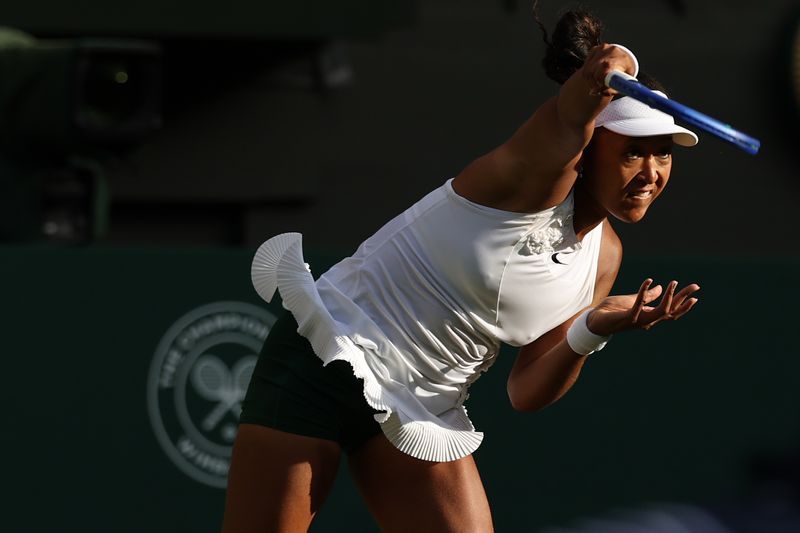
Naomi Osaka has reignited her Grand Slam credentials with a devastating straight-sets victory over top-ranked Aryna Sabalenka on Day Seven at Wimbledon, dispatching the Belarusian powerhouse 6-2 7-6(2) to reach the quarter-finals. The Japanese 14th seed's triumph marks her first appearance in the last eight at the All England Club and represents a significant resurgence following her return to professional tennis in 2024 after maternity leave.
Osaka's performance demonstrated the consistency and precision that earned her four Grand Slam titles, particularly on hard courts where both she and Sabalenka have traditionally excelled. Rather than engaging in an extended baseline slugfest with one of the tour's most powerful hitters, Osaka controlled the tempo and court position with methodical aggression, leaving Sabalenka visibly frustrated throughout their encounter on Centre Court. The comprehensive nature of the win—claiming the opening set with a decisive 6-2 scoreline—established the tone early and prevented the Belarusian from gaining any momentum.
The significance of Osaka's advancement extends beyond her personal rehabilitation. Her victory arrives amid an extraordinary collapse of Wimbledon's established hierarchy in the women's competition. Defending champion Iga Swiatek and 2022 winner Elena Rybakina both exited in the third round, while Barbora Krejcikova, a perennial contender, succumbed to fellow Czech Karolina Muchova in the fourth round. The collective elimination of the tournament's top three seeds guarantees that Wimbledon will crown a first-time champion for the ninth consecutive year—an unprecedented sequence that reflects the sport's shifting competitive landscape and the absence of any dominant figure capable of establishing sustained supremacy.
For Malaysian and Southeast Asian tennis enthusiasts, Osaka's resurgence carries particular resonance. Her mixed heritage and career choices have made her a transcontinental sporting figure, and her ability to reclaim peak form following personal circumstances that caused her to step back from professional tennis offers an inspirational narrative that extends beyond sport. Her victory over Sabalenka—whom she had lost to on three consecutive occasions earlier this season—demonstrates that recent form cannot always predict tournament outcomes, and that psychological factors and tactical execution often prove decisive over shorter formats.
On the men's side, Novak Djokovic advanced to his 17th Wimbledon quarter-final despite acknowledging his own unsatisfactory performance during a 7-6(6) 6-3 3-6 6-3 conquest of Russian qualifier Roman Safiullin. The 39-year-old Serbian champion explicitly stated that enjoyment and satisfaction were absent from his fourth-round triumph, yet his ability to convert a challenging situation into a winning outcome underscores his championship mentality. With this victory, Djokovic surpassed Roger Federer's Wimbledon match-win record with his 106th victory at the venue, a statistical achievement that further cements his legendary status at the grass-court Grand Slam.
Djokovic's path toward contention for an eighth Wimbledon title—which would equalize his record haul—requires navigation of a stern challenge against Canadian third seed Felix Auger-Aliassime in the quarter-finals. Should Djokovic prevail, a potential semi-final confrontation with defending champion Jannik Sinner awaits. Auger-Aliassime earned his quarter-final berth through a gruelling four-hour 26-minute encounter against Spain's Alejandro Davidovich Fokina, a match that concluded in an acrimonious exchange at the net between the exhausted competitors following a 6-7(4) 7-6(6) 6-3 6-7(2) 6-1 result.
Elsewhere in the men's draw, the All England Club witnessed an emotional moment when Polish competitor Hubert Hurkacz was compelled to retire during the fifth set against German veteran Jan-Lennard Struff. Struff's advancement represents a remarkable achievement for the 36-year-old German, who has reached his first Grand Slam quarter-final at an age when most professional players have already departed the tour. Such occurrences remind observers that Grand Slam tournaments remain unpredictable spectacles where experience, tactical astuteness, and physical resilience can overcome ranking hierarchies.
Osaka's preparatory theatrics—entering Centre Court in a kimono-style ensemble inspired by the protagonist of Quentin Tarantino's "Kill Bill" film—generated significant attention before the match. However, the champion acknowledged afterwards that such pre-match presentations distracted from her primary focus, and she consequently indicated an intention to reduce the theatrical elements of her appearance. This perspective reflects a prioritization of competitive performance over entertainment, suggesting a mature approach to balancing personality expression with professional objectives.
In the women's quarter-finals, Osaka faces Czech competitor Karolina Muchova, who achieved her own notable victory by eliminating Krejcikova 7-5 5-7 6-3 in an absorbing three-set battle. This matchup represents an intriguing tactical contrast between Muchova's varied shot-making and movement against Osaka's power-driven approach. Meanwhile, American fourth seed Jessica Pegula demonstrated superior match management against 18-year-old Iva Jovic, controlling Court One's proceedings in a 4-6 6-3 6-1 victory that showcased the experience advantage in professional tennis.
The emergence of five American women in the last 16—the highest number since 2002—signals a resurgence in competitive depth from the United States. Pegula's continuation of her best Wimbledon run, combined with the prospect of further American representation if Coco Gauff advances past Belinda Bencic, creates the possibility of multiple American representatives in the latter stages. This collective progress suggests renewed competitiveness within the American women's draw and potentially strengthens the nation's prospects for eventual title contention. The juxtaposition of Wimbledon's traditional reliance on established power figures with the emergence of new challengers and returning former champions reflects the sport's contemporary dynamics, where preparation, physical fitness, and mental resilience determine outcomes more than historical pedigree.

