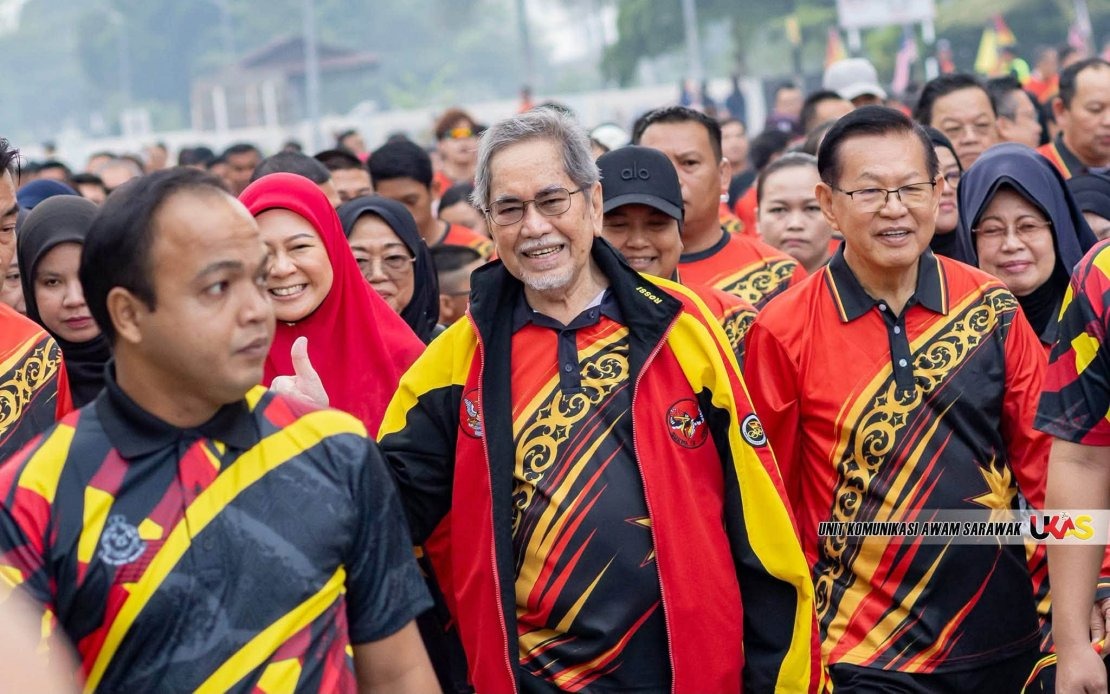
The streets of Sibu witnessed a remarkable display of community solidarity on July 22 as more than 10,000 Sarawakians converged on Dataran Tun Tuanku Bujang for the Sarawak Day Unity Walk 2026. Participants dressed in the state colours of red, yellow and black created a visual tapestry reflecting the demographic diversity that characterises Sarawak, with families, professionals, students and retirees joining together to celebrate their shared identity and common values.
Sarawak Governor Tun Dr Wan Junaidi Tuanku Jaafar officially launched the procession, accompanied by his wife Toh Puan Fauziah Mohd Sanusi. The event attracted significant government representation, with Transport Minister Datuk Seri Lee Kim Shin, Tourism and Creative Industry Minister Datuk Seri Abdul Karim Rahman Hamzah, and Women, Childhood and Community Wellbeing Development Minister Datuk Seri Fatimah Abdullah among the dignitaries present. The turnout of state officials underscored the political importance attached to strengthening communal bonds across Sarawak's ethnically plural society.
The procession traversed a nearly five-kilometre route that constituted an informal tour through Sibu's commercial and residential heartland. Starting from the main plaza, participants walked along Jalan Kampung Datu, Jalan Kampung Hilir, passed through the Simpang 3 Roundabout, continued down Jalan Awang Ramli Amit and Jalan Tun Abang Haji Openg before returning to their starting point. This carefully planned routing ensured maximum community visibility and participation, transforming the urban landscape into a moving statement of civic pride.
The composition of marchers reflected Sarawak's multicultural fabric. Malays, Melanau, Iban, Bidayuh, Chinese and Orang Ulu communities participated side by side, their unified presence amplified by the waving of both the Jalur Gemilang and Sarawak state flags. This visible manifestation of interethnic cooperation carries particular significance for Malaysia's largest state, where managing communal relations across such disparate populations remains a ongoing governance priority. The intergenerational character of participation—encompassing senior citizens, working-age adults, youth and children—further illustrated how Sarawak Day functions as a unifying force extending across age cohorts.
Families participated as units, which transformed what could have been a purely ceremonial exercise into an occasion for households to invest together in collective identity-building. The inclusion of elderly participants and children suggests organisers had deliberately engineered accessibility and created an environment where commemoration could occur across generational lines. Such inclusive design reflects broader Southeast Asian trends toward using public rituals not merely as top-down political messaging but as spaces where ordinary citizens actively construct shared belonging.
Following the walk itself, Governor Wan Junaidi and accompanying officials visited the Sarawak Day 2026 History Exhibition, which documented the state's historical trajectory toward self-government. This educational component elevated the unity walk beyond symbolic gesture into a pedagogical moment where participants and leaders could reflect on Sarawak's constitutional journey and political achievements. The subsequent refreshments at Sibu Kitchen maintained the communal atmosphere, transforming the event's final phase into an informal networking opportunity.
The celebrations continued that evening with the Sarawak Day Assembly and People's Concert at the same venue, bringing the commemorative calendar toward its crescendo. Sarawak Premier Tan Sri Abang Johari Tun Openg was scheduled to officiate the assembly, signalling that top-level leadership would directly address the assembled populace. The inclusion of a concert alongside formal ceremonies suggests organisers recognised that patriotic commemoration functions most effectively when combining solemn reflection with entertainment and cultural expression.
Sarawak Day 2026 thus emerged as more than a simple anniversary observation. Rather, the event functioned as a carefully choreographed demonstration of the state's capacity to mobilise tens of thousands across ethnic and generational divides toward common purposes. For Malaysian observers accustomed to periodic concerns about intercommunal tensions, the Sibu turnout offered a counternarrative emphasising how particular institutions and commemorative occasions can generate solidarity among deeply diverse populations. The event's scale and peaceful character suggested that beneath surface-level political differences, substantial reservoirs of shared civic identity persist across Sarawak's communities.
From a broader Southeast Asian perspective, Sarawak's approach to state-level commemoration offers instructive lessons. While Malaysia's federal structure sometimes generates headlines concerning centre-state relations, events like the Sarawak Day Unity Walk illustrate how regional governments leverage cultural nationalism toward integrative rather than divisive ends. The deliberate emphasis on interethnic participation, family involvement and historical education suggests sophisticated understanding of how public rituals shape political consciousness and community cohesion.
The participation of multiple state ministers and the governor's personal engagement demonstrated governmental commitment to legitimising the occasion through high-level endorsement. This combination of grassroots mobilisation—the 10,000 ordinary participants—with elite participation creates a particular political grammar in which state identity operates as something beyond mere administrative convenience but as a genuinely mobilising force. For Sarawak's diverse communities, such occasions provide periodic opportunities to rehearse unity and reinforce shared civic bonds.

