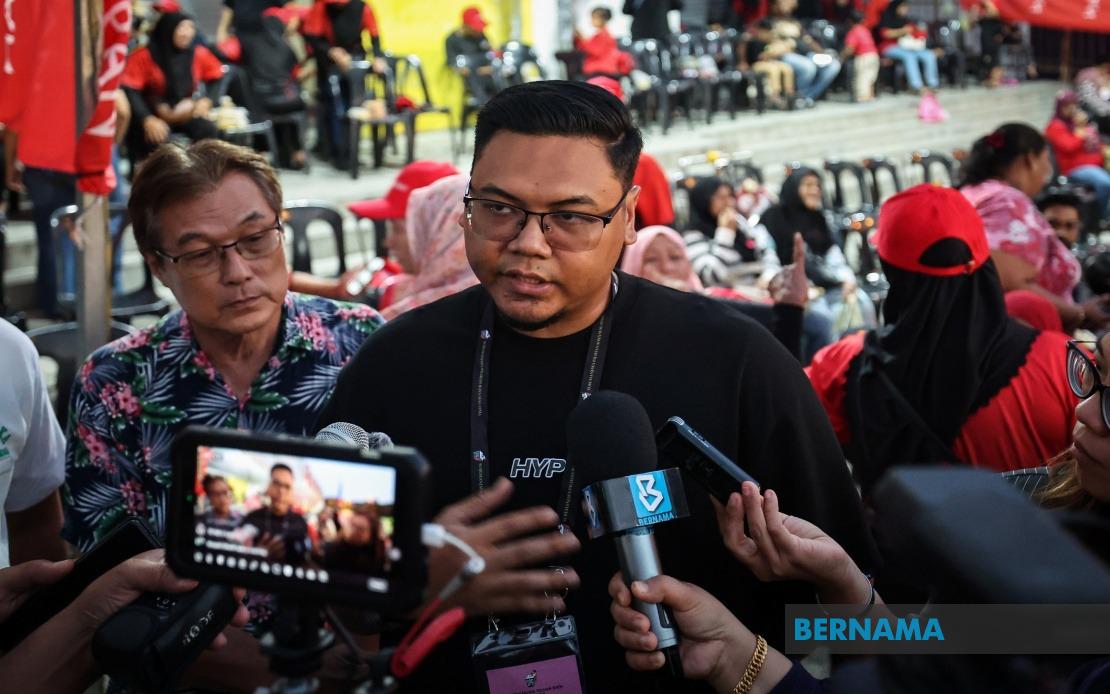
A significant political realignment unfolded in Johor on July 8 when more than 120 former members and leaders from the Pulai division of Parti Pribumi Bersatu Malaysia formally announced their backing for Pakatan Harapan, signalling deepening fractures within the Bumiputera-centric party ahead of the state election. The public declaration, made at a press conference in Johor Bahru, underscores mounting frustration among grassroots Bersatu cadres over what they characterise as the party's failure to deliver tangible benefits to constituents and recognise the contributions of rank-and-file members.
Muhammad Faezuddin Mohd Puad, the PH candidate contesting the Kempas state assembly seat, revealed that the defectors had communicated their intention to support the coalition earlier but strategically delayed public announcement until this week. The delegation of former Bersatu figures included prominent party officials such as Rafidah Ani, the former Pulai Bersatu Srikandi Information chief; Noriah Mat Daud, the former Pulai Srikandi secretary; and Mohd Suhimi Abdul Rahman, who previously headed the Bukit Mewah Bersatu branch. Muhammad Faezuddin, also serving as head of Johor Angkatan Muda Keadilan, noted that the switchers had formally informed the Bersatu leadership of their decision, suggesting the move was conducted with a degree of transparency rather than clandestine political manoeuvring.
The defectors cited a fundamental philosophical disagreement with Bersatu's governance approach as their primary motivation for realignment. According to Muhammad Faezuddin, the incoming members were attracted to PH's purported commitment to constituency service that transcends partisan boundaries. He articulated a vision of inclusive governance wherein elected representatives and ruling coalitions direct state resources and development assistance to all residents irrespective of their party membership or voting patterns. This contrasts sharply with what he characterised as an outdated political model that reserves government benefits exclusively for party loyalists and connected elites, a critique that implicitly targets both Bersatu's internal management and the governance practices of other traditional coalition partners.
Rafidah Ani provided particularly candid testimony regarding her disillusionment with Bersatu's internal hierarchy and resource allocation mechanisms. Throughout her tenure within the party, she maintained a strong commitment to community welfare initiatives, particularly programmes targeting single mothers and vulnerable populations. However, she encountered persistent obstacles in mobilising party institutional support for these grassroots welfare initiatives, leading her to conclude that the party apparatus was fundamentally unresponsive to needs-based advocacy. Her experience exemplifies a recurring complaint among second and third-tier party members: that Bersatu's leadership concentrates decision-making authority and material resources at the apex whilst rendering lower-ranking cadres, particularly women's wing members, marginalised and unappreciated within the party hierarchy.
Mohd Suhimi similarly articulated grievances rooted in both personal treatment and perceived institutional neglect of local development priorities. His separation from Bersatu, which began informally following the 2022 Johor state election, reflected broader dissatisfaction with the party's prioritisation of internal factional interests over constituent welfare. He explicitly linked his departure to what he termed the party's focus on narrow individual advantages rather than collective advancement, a thinly veiled reference to the personality-driven politics that has characterised much of Bersatu's internal dynamics since its establishment. His hopes for the upcoming election centre on PH delivering demonstrable improvements in economic development and healthcare provision within the Kempas constituency, metrics against which he implicitly judges his former party's record as deficient.
The Kempas constituency contest represents a three-way competition featuring Muhammad Faezuddin as the PH standard-bearer, with candidates from Barisan Nasional and the smaller Parti Bersama Malaysia completing the field. The 2022 election saw incumbent Datuk Ramlee Bohani of BN-UMNO secure victory with a majority of 3,514 votes, establishing a competitive baseline for the forthcoming contest. The defection of over 120 organised Bersatu activists and their mobilisation machinery could materially impact the electoral arithmetic, particularly given that Bersatu had historically contested Kempas and related seats within the broader Johor political landscape.
The timing of this announcement within the compressed campaign period preceding the July 11 election reflects strategic calculation by both the PH apparatus and the defecting Bersatu members. Public declarations of party switching during active elections generate media momentum and shape the prevailing narrative about which coalition possesses institutional vitality and grassroots confidence. For the switchers, announcing their realignment during rather than before the campaign maximises their utility in persuading undecided voters whilst simultaneously demonstrating to PH leadership their value as community organisers capable of mobilising networks on short notice.
These defections must be contextualised within the broader fragmentation of Bersatu since its remarkable political trajectory. The party, founded as an ostensibly moderate Bumiputera alternative positioned between UMNO and smaller Islamist formations, has experienced recurring internal convulsions over strategy and personality. The departure of former Prime Minister Mahathir Mohamad and subsequent factional divisions have weakened the party's institutional coherence. These grassroots departures in Johor suggest that factionalism has penetrated deep into local party structures, with ordinary members increasingly willing to exit rather than remain within an organisation they perceive as delivering diminishing tangible benefits.
Muhammad Faezuddin's articulation of PH's approach to governance—emphasising universal service delivery untethered to partisan calculation—appeals to a constituency of voters exhausted by transactional politics and patronage systems. Whether such aspirational messaging translates into electoral performance depends on PH's demonstrated record in constituencies it currently controls. The Johor electorate's judgment will partly reflect voters' assessment of whether PH's rhetoric about inclusive governance matches its actual conduct in office, particularly regarding development prioritisation and resource allocation across diverse communities.
The 16th Johor state election will see 172 candidates contending for 56 state assembly seats, with the outcome determined by approximately 2.73 million eligible voters on Saturday, July 11. The broader context suggests a competitive election environment wherein established BN and UMNO advantages have been substantially eroded compared to preceding contest cycles. PH's recruitment of seasoned Bersatu organisers contributes incrementally to its capacity to mobilise and persuade voters in state constituencies, though individual seat outcomes will ultimately depend on localized dynamics and candidate quality.
The defection movement underscores deeper questions about party loyalty and political commitment in Malaysia's contemporary electoral environment. As voters increasingly perceive parties as instrumental vehicles for delivering constituent services rather than repositories of ideological identity, the willingness of party members to migrate between coalitions based on perceived organisational competence and governance philosophy becomes more pronounced. Bersatu's loss of over 120 activist-members in a single Johor division signals that the party faces structural challenges in retaining grassroots engagement and member satisfaction, challenges that could progressively accumulate across other constituencies and states unless addressed through substantive organisational reform and recommitted focus on constituent service delivery.

