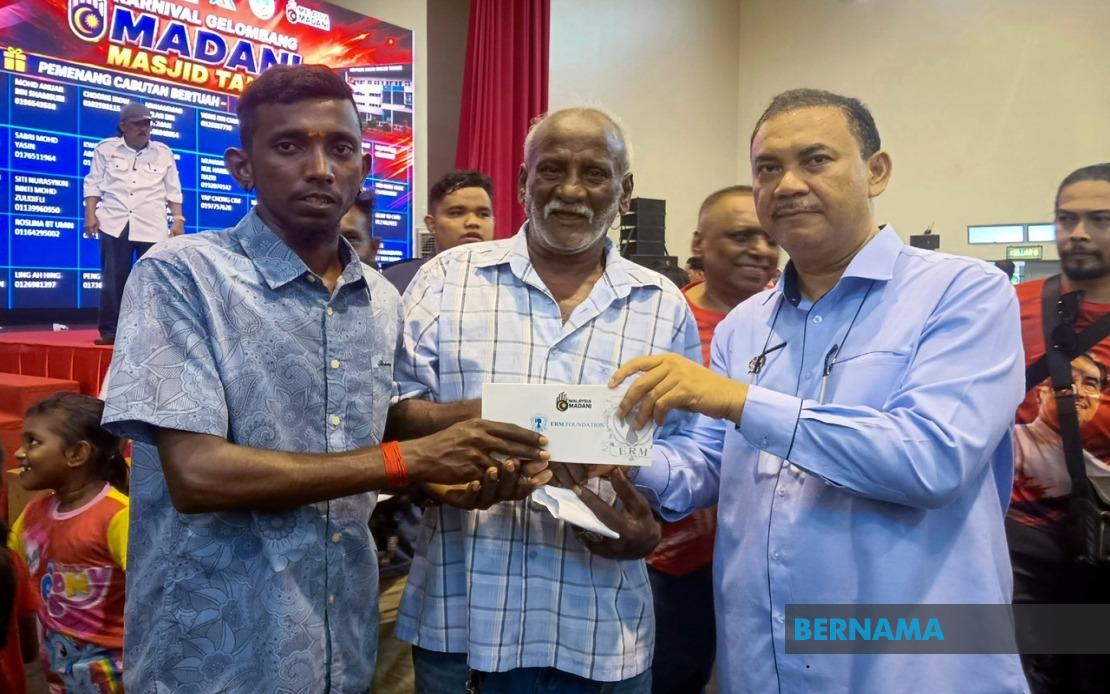
The Gelombang MADANI Carnival held at Masjid Tanah Sports Complex in Alor Gajah on August 7 marked a significant outreach effort by the federal government to assist vulnerable populations across the parliamentary constituency. Through the Sentuhan MADANI Donation initiative, roughly 2,000 economically disadvantaged residents walked away with RM200 in direct cash assistance, a contribution designed to provide immediate relief for essential household expenditures.
Datak Azman Abidin, political secretary to the Prime Minister, oversaw the donation ceremony and explained the programme's scope and beneficiaries. The initiative deliberately targeted multiple disadvantaged segments of society, encompassing members of the bottom 40 percent income bracket, persons living with disabilities, senior citizens, and workers earning low wages. This multi-pronged approach reflects government strategy to address financial strain across diverse vulnerable populations rather than concentrating aid narrowly.
The geographical reach of the assistance spanned five state constituencies nested within Masjid Tanah's parliamentary boundaries: Kuala Linggi, Lendu, Tanjung Bidara, Ayer Limau, and Taboh Naning. This distribution pattern ensured that the aid programme penetrated multiple electoral divisions, demonstrating coordinated implementation across administrative tiers. Such geographic stratification suggests the government's intent to demonstrate visible presence and tangible support across its political territory, particularly in constituencies where voters may feel economically marginalised.
For recipients like 63-year-old Ramlah Othman from Tanjung Bidara, the RM200 represented more than symbolic assistance. In her remarks to media, she underscored how the contribution would meaningfully reduce the financial pressure of managing daily household costs, acknowledging the government's recognition of ordinary Malaysians struggling with living expenses. Her expression of gratitude, framed in traditional language, reflected a genuine sense of relief that such assistance arrived when needed.
The programme's inclusion of disabled persons and elderly recipients carries particular significance for Malaysia's social welfare landscape. N. Mariappan, a 69-year-old stroke survivor from Ladang Sungai Baru, articulated how the initiative signalled governmental concern for seniors and persons with disabilities facing compounded economic vulnerability. His participation highlighted how chronic health conditions often correlate with reduced income-earning capacity, making targeted assistance programmes essential for maintaining dignity and meeting basic needs among this demographic.
The timing and scale of the Gelombang MADANI Carnival reflect broader government messaging around the MADANI framework, which emphasises prosperity, inclusivity, and economic wellbeing. By distributing assistance through public carnival events rather than purely bureaucratic channels, authorities create opportunities for direct engagement with recipients while generating visible evidence of government benevolence. This approach serves dual purposes: delivering practical relief whilst simultaneously constructing political narratives around governmental attentiveness to voter welfare.
For Malaysian policymakers and observers, the MADANI initiative demonstrates continued reliance on targeted cash transfer programmes to address income inequality and poverty. The RM200 amount, while modest in absolute terms, targets households where such sums represent meaningful portions of weekly or monthly budgets. Similar assistance programmes have proliferated across Southeast Asia in recent years, reflecting recognition that direct cash transfers offer efficient, low-friction poverty mitigation compared to complex bureaucratic welfare schemes.
The programme's emphasis on the B40 demographic reflects Malaysia's ongoing policy focus on the bottom 40 percent income earners, a segment that Malaysia's government has designated as priority for developmental support since the introduction of the Shared Prosperity Vision. By concentrating assistance on economically vulnerable households across multiple categories—whether disabled, elderly, or simply low-wage earners—the government attempts to demonstrate inclusive growth benefits reaching ordinary citizens rather than remaining confined to headline statistics.
Meanwhile, the multi-state constituency coordination suggests improved administrative capacity for implementing nationwide social programmes with local penetration. The successful mobilisation of resources across Kuala Linggi, Lendu, Tanjung Bidara, Ayer Limau, and Taboh Naning implies functional links between federal funding, state-level implementation, and grassroots distribution networks. For Malaysian readers observing government competence in delivering promised benefits, such operational success carries messaging value beyond the immediate assistance delivered.
The Sentuhan MADANI initiative also carries implications for understanding electoral dynamics in Masjid Tanah and similar constituencies across Malaysia. Direct cash assistance distributed immediately before or after major political events often correlates with subsequent voting patterns, though causality remains contested among political scientists. Nonetheless, the visible delivery of promised government benefits strengthens narratives of incumbent responsiveness, potentially influencing voter perception during upcoming electoral cycles.
Looking forward, the scalability and sustainability of programmes like Sentuhan MADANI warrant scrutiny from fiscal policy perspectives. While the immediate cost of RM200 multiplied across 2,000 recipients represents RM400,000—modest in national budgetary terms—the replication of such initiatives across numerous constituencies aggregates to significant expenditure. Understanding whether such programmes form permanent welfare architecture or temporary electoral measures remains important for evaluating government social policy direction.
For regional observers, Malaysia's continued investment in direct cash transfer mechanisms alongside broader social safety nets positions the nation within evolving Southeast Asian approaches to poverty reduction. Countries like Indonesia, Thailand, and the Philippines similarly employ targeted cash assistance, suggesting convergence around this policy instrument despite differing political systems and fiscal capacities. The MADANI framework and its associated initiatives therefore merit comparative analysis for understanding how Malaysian policymakers balance immediate poverty alleviation with longer-term inclusive growth objectives.

