In a significant effort to reinforce national pride during the 2026 National Day and Malaysia Day (HKHM) celebrations, the Federal Territories administration has rolled out more than 62,000 Jalur Gemilang flags across its three jurisdictions. Since early August, 62,386 of the nation's iconic flags have been strategically positioned throughout Kuala Lumpur, Putrajaya and Labuan, adorning protocol routes, civic spaces and neighbourhoods in a visible show of patriotic sentiment ahead of the upcoming commemorations.
Minister in the Prime Minister's Department Hannah Yeoh, who oversees Federal Territories affairs, spearheaded the initiative and called upon all Malaysians to actively participate in flag displays both offline and through digital platforms. Her message centred on leveraging this moment to express collective appreciation for the nation's independence and the freedoms citizens enjoy today. The campaign represents an attempt to deepen patriotic consciousness at a grassroots level, transforming the National Day period into a vehicle for strengthened national identity across the three federal zones.
Yeoh's remarks extended beyond mere encouragement to address practical concerns that often deter public participation in flag-flying initiatives. Recognizing widespread anxiety among citizens and business proprietors about protocol compliance, she stressed that comprehensive guidelines are readily available online to eliminate uncertainty surrounding proper flag presentation. This approach acknowledges a cultural gap in Malaysia where fear of contravening regulations—even trivial ones—can dampen genuine patriotic expression, particularly among the business community and ordinary households.
The minister emphasized that anxiety about procedural correctness should never become an impediment to displaying national symbols. She advocated for normalizing flag-flying as a universal practice, positioning it as something Malaysians should feel empowered to undertake without apprehension. Yeoh further highlighted the role of educational institutions and families in cultivating this confidence from childhood, suggesting that patriotic habits ingrained early would create a culturally embedded norm rather than a forced or occasional gesture.
For organizational settings, Yeoh directed her counsel toward business leadership and facility managers, urging them to ensure staff charged with flag installation receive proper training. Management-level oversight mechanisms should encompass regular verification procedures to prevent mishandling that could undermine the campaign's symbolic purpose. This dual focus—on public confidence and institutional accountability—reflects an understanding that effective patriotic campaigns require both bottom-up enthusiasm and top-down structural support.
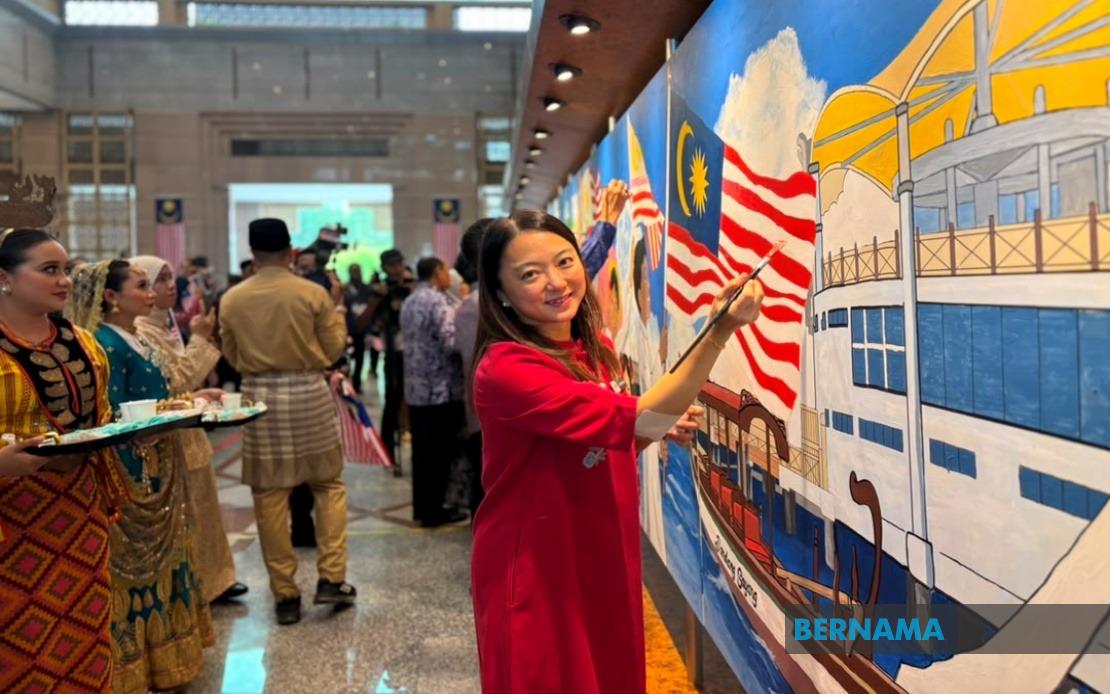
A centrepiece of the HKHM 2026 campaign unfolded at Menara Seri Wilayah, where Yeoh and personnel from the Federal Territories Department (JWP) collaborated to complete a 25.40-metre mural celebrating independence. This artistic undertaking served multiple purposes: it provided tangible evidence of government commitment to the campaign, created a focal point for media coverage and public attention, and transformed patriotic messaging into a visual landmark accessible to the broader public.
The independence mural itself carried symbolic weight, incorporating representations of distinctive landmarks from all three Federal Territories alongside the Jalur Gemilang. By interweaving architectural and geographic identity markers with the national flag, the design subtly reinforced how regional pride and national unity coexist rather than compete. The choice to feature Kuala Lumpur, Putrajaya and Labuan equally ensured that Labuan, often marginalized in national discourse, received recognition alongside the more visible capital and administrative centre.
The Federal Territories Department director-general Datuk Muhammad Azmi Mohd Zain and Putrajaya Corporation president Datuk Mohd Sakeri Abdul Kadir's presence at the mural event signified institutional alignment across different arms of the federal administration. This coordination indicates a coordinated strategy rather than isolated departmental initiative, suggesting broader government buy-in for the HKHM 2026 campaign and its emphasis on patriotic visual culture.
For Malaysian readers, particularly those in the Federal Territories, this initiative represents an official signal that National Day observance in 2026 will prioritize grassroots, visible demonstrations of national identity. The distribution of over 62,000 flags suggests the government anticipates substantial public participation and has committed resources accordingly. The campaign's emphasis on proper protocols and accessible guidance also indicates an attempt to professionalize how Malaysia engages with its national symbols, moving beyond ad-hoc or inconsistent practices toward standardized patriotic expression.
Regionally, Malaysia's approach mirrors broader Southeast Asian trends where governments increasingly leverage National Day periods to reinforce national cohesion, particularly amid rapid social change and external pressures. The decision to combine grassroots flag distribution with high-visibility artistic projects reflects sophisticated communications strategy, recognizing that patriotism functions through both quotidian symbols and spectacular public events. The Federal Territories campaign thus positions Malaysia within contemporary approaches to nation-building that emphasize inclusive participation alongside institutional guidance.

