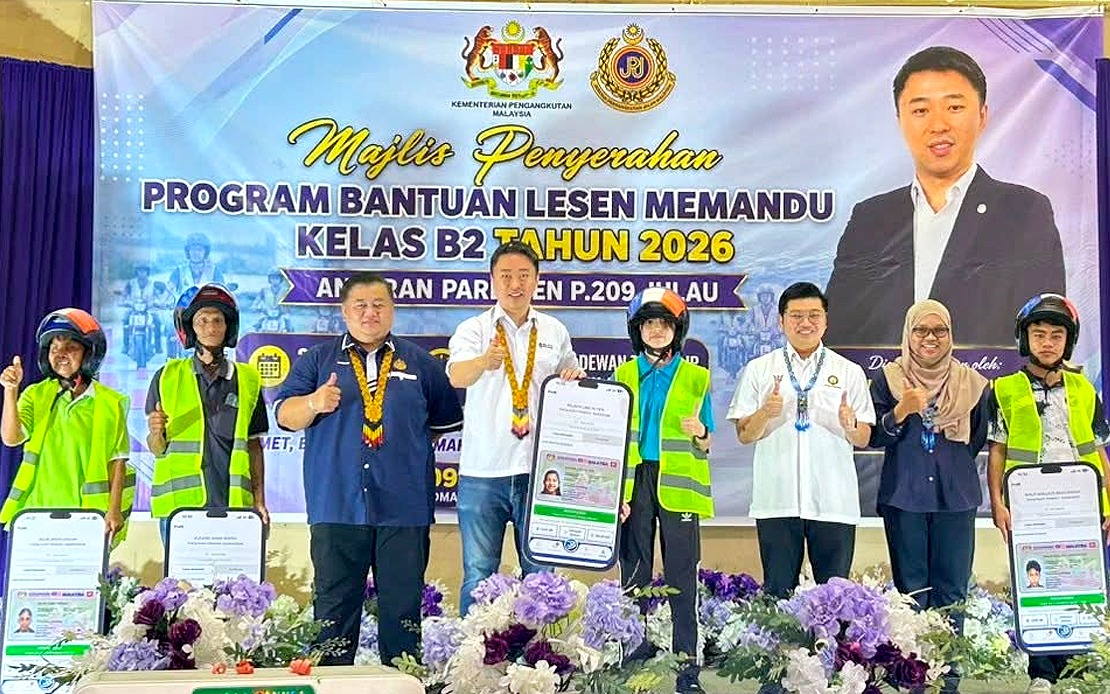
The Driving Licence Assistance Programme in Julau has delivered tangible economic relief to over 800 rural residents struggling with mounting fuel costs. The closure of the 2026 Class B2 Driving Licence Assistance Programme marked the culmination of an initiative that processed 885 participants from countryside communities surrounding Sarikei, with each participant now qualified to access subsidised petrol—a benefit previously unavailable to those without valid motorcycle licences. The ceremony, held at Julau Closed Stadium, was officiated by Julau Member of Parliament Datuk Larry Sng Wei Shien, who concurrently chairs the Malaysian Timber Industry Board, and witnessed by Sarawak's Road Transport Department director Norizan Jili.
For many rural Malaysians, motorcycle ownership represents essential transport infrastructure rather than discretionary possession. The participants hail predominantly from smallholding communities where motorcycles function as primary vehicles for accessing orchards, palm oil lots, and market centres scattered across Sarawak's interior. The subsidy eligibility transforms these everyday journeys from financial liabilities into manageable expenses, particularly significant given recent petrol price escalations that have squeezed household budgets across the country. Without valid licensing, rural workers previously faced the untenable choice between operating illegally or bearing non-subsidised fuel costs that could constitute a substantial percentage of their daily earnings.
Bajik Undum, aged 57 from Rumah Ajau in Ulu Kuntau, Pakan, exemplifies the programme's impact on older female participants in agricultural communities. She previously operated her motorcycle without a valid Class B2 licence, forced to purchase full-price petrol despite using the vehicle for legitimate economic purposes—transporting agricultural produce and accessing her orchard. The absence of a licence, she explained, carried both legal and financial penalties. Now holding her probationary licence, Bajik accesses the same subsidised fuel rates available to compliant riders, immediately reducing her operational costs and acknowledging the programme as transformative for her economic sustainability.
The oldest male participant, Kudang Jenggi, aged 64 and employed as a bird's nest house caretaker in Bayong near Sarikei, articulated the psychological dimensions of legalisation alongside financial benefit. His daily work, involving travel between multiple locations, previously exposed him to enforcement risk at roadblocks and checkpoints. Legal anxiety compounded the fuel cost burden. The licence eliminates both concerns simultaneously—Kudang now operates without transgression while accessing subsidised petrol, permitting greater confidence in routine activities including workplace commuting, family visits, and local errands.
Daniel Padong, 45, from Rumah Pom in Ulu Amot, Pakan, operates within the oil palm smallholding sector increasingly prevalent across Sarawak's rural regions. His motorcycle serves as sole transport to and from his smallholding, with fuel expenses directly impacting agricultural profitability. Recent petrol price movements, reflecting global petroleum market volatility, have compressed margins already thin in smallholder agriculture. Access to subsidised fuel through legitimate licensing directly improves his competitive position and financial viability, enabling sustainable operation during periods of global energy cost inflation.
The programme demonstrates targeted policy effectiveness in addressing rural economic hardship through regulatory compliance rather than punitive enforcement. Rather than prosecuting unlicenced rural riders, the initiative provides accessible pathways to legitimate licensing while simultaneously conferring immediate economic benefits. This approach recognises that rural populations often operate outside formal regulatory systems not from defiance but from practical barriers including distance to licensing facilities, cost constraints, and limited awareness of procedures. By removing barriers and offering concurrent subsidies, the programme aligns compliance incentives with economic self-interest.
Sarawak's Road Transport Department implementation of this programme reflects broader Southeast Asian challenges in vehicle regulation across dispersed rural populations. Transportation licensing systems originally designed for urban environments often create unintended consequences in countryside contexts where alternative transport options remain limited. This Julau initiative represents evidence-based policy adjustment, acknowledging that enforcement alone cannot achieve compliance when legitimate alternatives to illegal operation remain economically inaccessible to vulnerable populations.
The subsidy eligibility specifically for Class B2 licence holders—motorcycle riders—targets precisely those Malaysian rural workers most dependent on two-wheeled transport and most economically vulnerable to fuel price fluctuations. Unlike car owners who typically possess alternative transport options or greater financial buffers, motorcycle-dependent workers face severe livelihood impact from energy cost increases. The programme's laser focus on this demographic reflects sophisticated policy targeting that maximises welfare improvement per resource unit spent.
Beyond individual beneficiaries, the programme generates systemic benefits including increased regulatory compliance, enhanced road safety data through proper licensing channels, and improved government revenue collection from legitimate transport users. Rural areas previously operating substantially in the informal transport economy now integrate into formal regulatory frameworks, permitting more accurate traffic planning and safety intervention. These structural improvements compound the immediate fuel subsidy benefits, creating longer-term institutional gains for transport administration and road safety across the region.
The 885-participant programme scale indicates substantial rural demand for accessible licensing pathways combined with economic incentives. Replication across other Sarawak constituencies or Malaysian rural regions could potentially regularise thousands of currently unlicenced riders while simultaneously addressing rural fuel cost pressures. The Julau initiative thus serves as a policy pilot potentially applicable to broader national rural transport challenges, suggesting that procedural simplification and benefit linkage can achieve simultaneous compliance and welfare objectives where enforcement alone fails.
As Malaysia continues grappling with transport accessibility across its geographically dispersed rural regions, programmes like this demonstrate pragmatic alternatives to perpetual enforcement approaches. The visible gratitude expressed by participants reflects recognition that government policy occasionally aligns their regulatory obligations with their economic interests rather than creating conflict between compliance and survival. For rural Southeast Asian economies dependent on motorcycle transport, such alignment represents genuine policy innovation.

