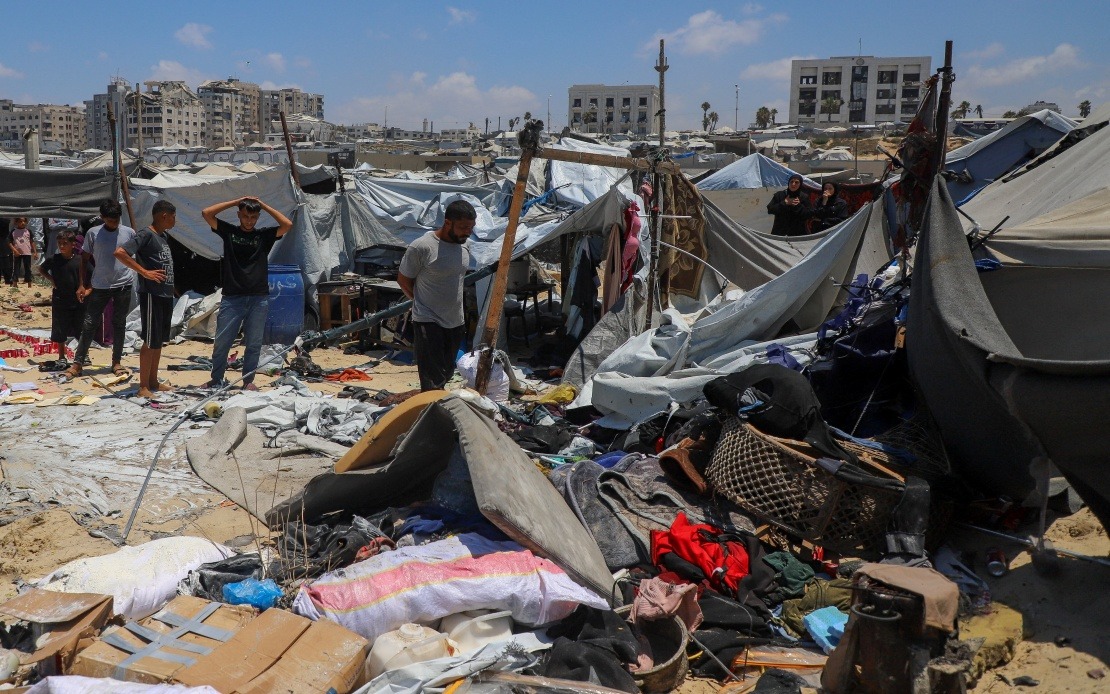
The scale of destruction across the Gaza Strip has reached devastating proportions, according to a situational assessment released by the Palestinian Government Communication Centre at the Prime Minister's Office. Drawing on local sources and field data collected between June 29 and July 6, the Palestinian authorities estimate that more than 90 per cent of the Gaza Strip has been destroyed, whilst Israeli occupation forces now exercise control over approximately 80 per cent of the war-torn enclave. For regional observers and Malaysian policymakers monitoring the humanitarian crisis, these figures underscore the unprecedented scale of the conflict's physical toll on civilian infrastructure and communities.
The intensity of military operations has not diminished in recent weeks. Throughout the assessment period, the Israeli military conducted heightened campaigns concentrated in Khan Younis, Rafah, and Gaza City—three densely populated urban centres that have borne the brunt of sustained military action. Local medical sources documented eight Palestinian fatalities resulting from these operations, though the actual casualty figures remain contested and difficult to verify given the conditions on the ground. Beyond direct military engagement, residential neighbourhoods have faced continuous bombardment, with houses demolished and families forced to abandon their homes, adding further to the displacement crisis that has characterised the conflict.
The destruction extends well beyond Gaza's borders into Palestinian territories controlled by the Israeli military. Across the occupied West Bank, occupation forces have intensified what the Palestinian report describes as widespread raids targeting residential areas. These operations have included forced entries into homes, arbitrary detentions, movement restrictions imposed on Palestinian civilians, and strategic road closures affecting multiple municipalities. Cities and towns cited in the report—including Ramallah, Nablus, Hebron, Bethlehem, Jenin, Qalqilya, Tulkarem, and East Jerusalem—paint a picture of comprehensive military presence and control over Palestinian civilian life and movement.
Parallel to official military operations, Israeli settler militias have pursued a pattern of attacks against Palestinians and their property, according to the Palestinian authorities. These incidents include arson directed at civilian establishments, physical assaults on Palestinian herding communities, and attempts to confiscate livestock. Symbolic and strategic targets such as village entrances have been blocked, effectively restricting Palestinian access to their own communities. Such actions, characterised by the Palestinian government as colonial settler violence, reflect the complex security environment beyond direct military-to-military conflict, where Palestinian civilians face threats from multiple armed actors within Israeli-controlled territories.
The agricultural sector has emerged as a particular focus of disruption, with systematic targeting documented by the Palestinian Ministry of Agriculture. Over the course of a single week, authorities recorded the destruction of 2,559 olive trees through uprooting, burning, or deliberate damage. The damage concentrated in the Salfit, Jenin, and Nablus governorates, historically significant olive-growing regions that form the backbone of Palestinian rural economies. At least 125 farming families have been directly affected by these operations, representing a significant blow to livelihoods already strained by years of conflict and economic restrictions.
The financial impact of agricultural destruction carries immediate and long-term implications for Palestinian economic resilience. Documented direct losses from the week's incidents alone totalled approximately US$11.78 million—a substantial sum for Palestinian communities already facing severe economic constraints. These figures represent not merely abstract economic data but reflect the destruction of productive assets, generational agricultural knowledge embedded in olive groves, and the disruption of food systems that rural communities depend upon for sustenance and income. The targeting of agricultural infrastructure suggests a deliberate strategy to undermine Palestinian economic independence and self-sufficiency.
For Malaysian observers and policymakers, these developments carry strategic significance in several dimensions. The scale of destruction and the scope of military control documented in the Palestinian report represent an escalation in the conflict's intensity that reverberates across regional politics and international relations. Malaysia's traditional advocacy for Palestinian rights and its role within the Non-Aligned Movement position it as a country whose foreign policy discourse engages closely with Middle Eastern developments. The humanitarian dimensions of the crisis—mass displacement, civilian casualties, agricultural destruction—align with Malaysia's broader commitment to humanitarian principles and international law.
The systematic nature of the operations documented in the Palestinian report, encompassing military raids, settler violence, and agricultural targeting, suggests a comprehensive strategy extending beyond conventional military objectives. The occupation and control of 80 per cent of Gaza's territory indicates a shift toward long-term territorial administration rather than temporary military presence. For regional analysts, this development raises questions about the conflict's trajectory and the prospects for eventual political resolution. The destruction of over 90 per cent of infrastructure creates enormous reconstruction challenges that will require international coordination and financial resources regardless of how the immediate conflict concludes.
The displacement of Palestinian families continues to accelerate as military operations persist across both Gaza and the West Bank. The combination of home demolitions, shelling of residential areas, and forced evacuations has created what humanitarian organisations describe as one of the world's most significant contemporary displacement crises. The ripple effects extend beyond Palestine, with regional countries including Lebanon, Jordan, and Egypt managing significant Palestinian refugee populations. Malaysia, as a developing nation with experience in managing refugee populations and commitment to humanitarian causes, maintains awareness of the regional implications of these displacement dynamics.
The documentation by Palestinian authorities of these incidents, despite the severe restrictions on movement and communications within Gaza, demonstrates ongoing efforts to maintain administrative records and international accountability despite the operational challenges. The weekly situation reports serve multiple functions—providing baseline data for humanitarian agencies, documenting alleged violations for potential future accountability mechanisms, and maintaining Palestinian institutional continuity in the face of sustained military pressure. The specificity of the figures cited—2,559 trees, 125 farmers, US$11.78 million in losses—suggests systematic data collection efforts undertaken under extraordinarily difficult circumstances.
Looking forward, the trajectory described in these reports carries implications for regional stability and international humanitarian engagement. The extent of destruction suggests that reconstruction, should any ceasefire materialise, will require unprecedented levels of international support and coordination. The agricultural targeting documented by the Palestinian Ministry underscores how conflicts in the region increasingly encompass economic and subsistence systems, not merely military targets. For Malaysia and other regional players engaged in Palestinian solidarity or humanitarian advocacy, these developments reinforce the urgency of international diplomatic initiatives aimed at de-escalation and the establishment of sustainable political frameworks addressing the underlying conflicts driving continued violence.

