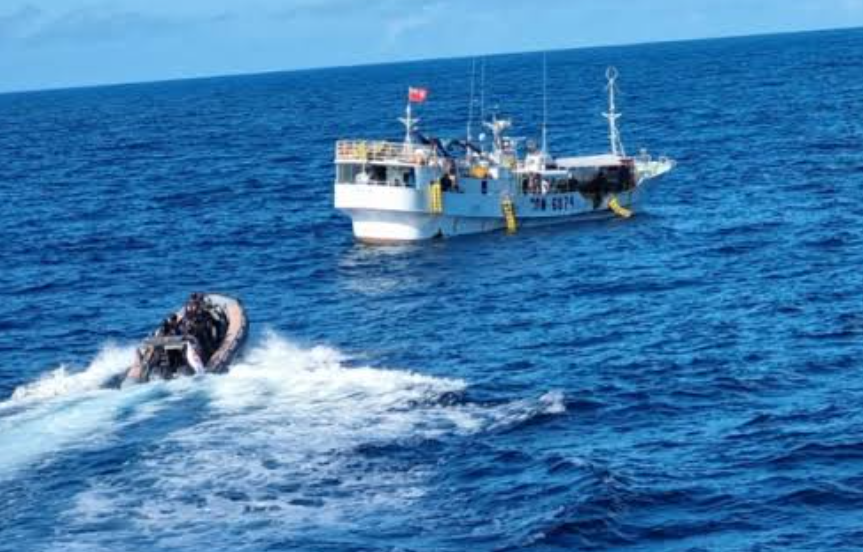
Authorities across the Pacific have intensified efforts to clamp down on unlicensed and illegal fishing activities, with multiple vessel detentions reported this month in what represents a significant push by island nations to reclaim control over their maritime resources. The Pacific Islands Forum Fisheries Agency confirmed that vessels from China and Indonesia were among four boats taken into custody or brought to port by enforcement agencies in Kiribati, Palau and Papua New Guinea, marking the latest escalation in a regional battle over access to fishing grounds that generate hundreds of millions of dollars annually.
The coordinated crackdown, known as Operation Island Chief, reflects the scale of the challenge facing Pacific island states in monitoring and regulating their exclusive economic zones. Over a two-week period from August 3 to 14, a coalition of eleven island nations deployed comprehensive surveillance measures that resulted in more than one hundred vessels being boarded and inspected across an expanse of 28 million square kilometres. The operation combined sophisticated monitoring tools, including aerial reconnaissance conducted by an Australian military aircraft, with on-water patrols by a United States Coast Guard vessel and various Pacific maritime police units.
The commercial significance of these enforcement actions cannot be overstated for the region's economies. Approximately half of the world's tuna supply originates from Pacific waters, yet Pacific Island countries currently process or handle only 15 per cent of this catch themselves. The fishing industry generates substantial revenue streams for these nations, contributing an estimated US$500 million annually through access fees alone, with export earnings reaching US$1.2 billion. Beyond the direct financial benefits, fishing supports the livelihoods of roughly one-third of all Pacific households, making maritime security and resource protection critical economic and social issues for island communities.
The majority of tuna harvested in Pacific waters is processed in Asian markets by industrial-scale long-distance fishing fleets that operate under licence agreements with individual island nations. These arrangements, while providing critical revenue to small island economies, have created vulnerabilities that illegal operators exploit. Vessels from distant waters navigate Pacific exclusive economic zones ostensibly under legitimate licences, but enforcement agencies have identified recurring patterns of non-compliance, false documentation, and deliberate misrepresentation of vessel locations designed to conceal unlicensed fishing activity.
Identifying and naming specific nations whose vessels engage in illegal fishing remains politically sensitive in the Pacific region. Chinese fishing companies operate extensive industrial fleets throughout the area and maintain joint-venture fisheries partnerships with several island states, creating complex economic interdependencies that complicate enforcement and public statements about violations. Nevertheless, the scale of Chinese vessel infringements has become undeniable. Since 2008, inspectors working for the Western and Central Pacific Fisheries Commission have issued 278 penalty notices to Chinese-flagged boats, representing the second-largest tally globally. Only Taiwan has exceeded this record, with 319 infringement notices issued during the same period, highlighting the broader pattern of east Asian fishing vessel non-compliance in the region.
Recent individual cases underscore the methods employed by illegal operators. Last month, Tuvalu maritime authorities apprehended a Chinese-flagged vessel engaged in unauthorised fishing within Tuvalu's territorial waters. The captured boat had been transmitting false location data, a sophisticated technique used to deceive detection systems and conceal the actual geographic location of fishing activities. Following a 24-day detention period, the vessel was issued a fine and subsequently released. Peter Hammarstedt, captain of the conservation vessel Sea Shepherd, which had coordinated with Tuvalu police during maritime patrols, confirmed these operational details. The Tuvalu case gained particular significance because the island nation maintains formal diplomatic relations with Taiwan rather than the People's Republic of China, adding a geopolitical dimension to what might otherwise be viewed as a routine enforcement matter.
The FFA and participating authorities have declined to disclose comprehensive details regarding sixteen additional vessels classified as "of interest" during Operation Island Chief. This cautious approach reflects diplomatic sensitivities and ongoing investigations. Notably, authorities in Palau and Papua New Guinea provided no substantive comment on operation specifics, while Kiribati's maritime police declined to elaborate publicly on their involvement and findings. The selective disclosure of information suggests careful navigation of relationships with major fishing nations whose cooperation remains essential for ongoing compliance and peaceful enforcement activities.
The timing of this enforcement surge carries strategic significance, as Pacific Island leaders are scheduled to convene for an annual summit beginning August 30 in Palau. The gathering of 18 island nation leaders is expected to address evolving challenges to regional fishing interests, with particular focus on developing enhanced mechanisms to protect and exercise fishing rights while simultaneously increasing government revenue from these resources. Climate change poses an emerging threat to tuna stock sustainability, potentially affecting both the environmental viability and economic value of Pacific fisheries in coming decades. New strategies will likely emphasise balancing short-term revenue maximisation with long-term resource preservation.
For Southeast Asian observers, particularly Malaysian stakeholders in regional fishing and maritime commerce, these developments highlight the growing sophistication of Pacific island enforcement capabilities and the broader trend toward stricter maritime governance. Malaysia's own fishing industry and maritime authorities operate across waters where similar challenges exist. The Pacific crackdown demonstrates how island nations with limited individual resources can achieve substantial enforcement impact through coordinated multilateral cooperation, aerial surveillance integration, and international partnerships. The model suggests potential applications for addressing illegal and unreported fishing throughout Southeast Asian and Indian Ocean regions, where Malaysian interests remain significant.

