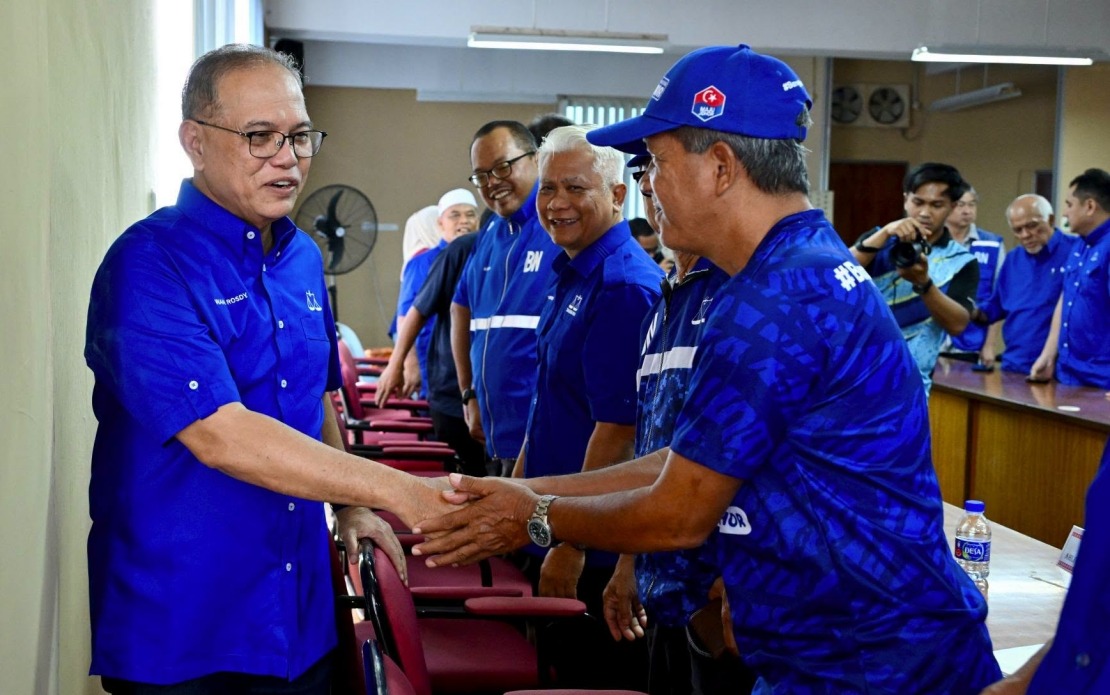
The Barisan Nasional machinery in Pahang has thrown its weight behind the coalition's campaign in Johor's upcoming state election, with senior leadership committing personnel and resources to secure victory in four strategically important constituencies. Pahang Menteri Besar Datuk Seri Wan Rosdy Wan Ismail, who chairs the state's BN chapter, announced that the deployment would concentrate on Pekan Nanas, Pulai Sebatang, Benut, and Kukup state seats—all located within the Tanjung Piai parliamentary constituency—in a coordinated push to strengthen BN's presence across these marginal and contested areas.
This cross-state cooperation reflects the established practice within Malaysia's ruling coalition of mobilising support from stronger regional chapters to reinforce campaigns in more competitive territories. The Johor state election represents a significant test of BN's organisational capacity and electoral appeal, particularly given the region's recent political volatility and the potential impact of an adverse result on the coalition's federal standing. By deploying seasoned campaigners and party machinery from Pahang, BN seeks to leverage experience and momentum from one state to buttress its position in another.
Wan Rosdy expressed considerable optimism about BN's prospects, underscoring the coalition's confidence despite the competitive nature of state elections in Malaysia's current political climate. He attributed this confidence to the visible enthusiasm of party workers on the ground and the receptive response encountered from voters during his three-day campaign visit to Johor following the nomination period. This assessment suggests that internal party morale remains relatively strong and that grassroots sentiment may favour the coalition's candidates, though such observations from senior party figures require careful contextualisation against the unpredictable nature of electoral outcomes.
The Menteri Besar indicated his personal commitment to the campaign effort by announcing plans to travel to the FELDA area in Segamat on the Thursday preceding polling day, dedicating time to strengthen party machinery in what has historically been an important rural constituency bloc. FELDA settlements remain politically significant in Malaysian elections, representing communities with distinct concerns around agricultural support, development infrastructure, and rural livelihoods. BN's historical dominance among FELDA voters has occasionally weakened in recent election cycles, making such targeted outreach essential to securing the seat totals necessary for victory.
The structural composition of the Johor contest reflects the fragmentation of Malaysian electoral competition, with 172 candidates contesting across 56 state seats. This candidate-to-seat ratio indicates competitive three-cornered fights in numerous constituencies, a pattern that characterises contemporary Malaysian politics where opposition parties and independent candidates fragment the vote. Such contests frequently reward candidates and coalitions with superior ground organisation and voter identification systems, areas where BN's establishment resources typically provide advantage.
Polling day is scheduled for July 11, with early voting beginning four days earlier on July 7. This timeline compresses the campaign period and incentivises parties to maximise voter turnout among supporters identified during the pre-nomination phase and nomination week itself. Early voting provisions have grown increasingly important in Malaysian elections, often determining margins in tight contests where mobilisation of specific voter cohorts can prove decisive.
The Johor state election carries implications extending beyond the state itself, as the electoral outcome will send political signals affecting federal coalition calculations and the positioning of senior figures within BN's competing leadership factions. A strong showing would reinforce the coalition's narrative of electoral resilience and organisational effectiveness, while a disappointing result could fuel internal criticism and accelerate discussions about leadership transitions or strategic repositioning within the broader coalition structure.
Pahang's contribution to the Johor campaign underscores the interdependence of state-level political structures within Malaysia's federal coalition system. Stronger-performing states often contribute resources and experienced organisers to weaker positions, creating a mutual support mechanism that helps mitigate localised weaknesses. This practice has historical precedent and reflects both pragmatic campaign management and the solidarity expected within coalition frameworks.
For Johor voters, particularly those in the targeted constituencies, the concentration of external campaign support signals the strategic importance BN assigns to these seats. Pekan Nanas, Pulai Sebatang, Benut, and Kukup sit within an area that encompasses diverse voter demographics, from urban and semi-urban populations to traditional rural communities. Understanding BN's targeting rationale requires recognising that these constituencies likely represent either vulnerable BN-held seats requiring defensive campaigns or opposition-held seats deemed winnable through concentrated effort and superior campaign execution.

