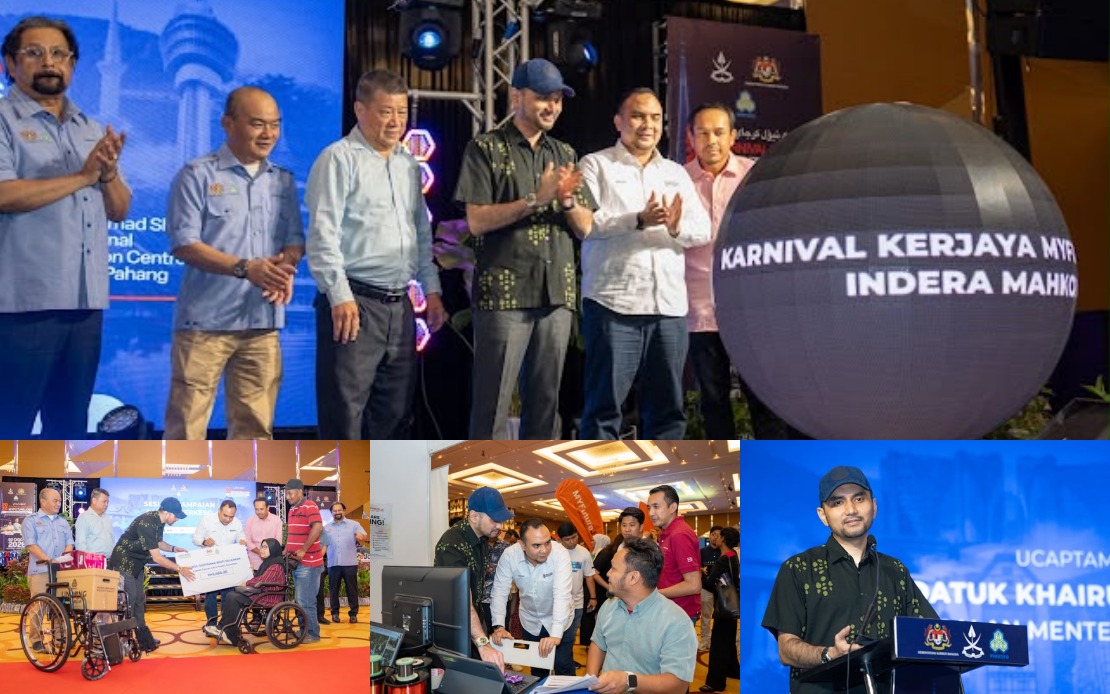
Pahang has emerged as the employment leader on Malaysia's east coast, with labour force participation reaching 65.3 per cent during the first quarter of 2026 and unemployment remaining at a modest 1.9 per cent. The state's strong labour market performance reflects the cumulative impact of targeted government programmes designed to connect job seekers with employers across diverse economic sectors. Deputy Human Resources Minister Datuk Khairul Firdaus Akbar Khan highlighted the achievement during an employment carnival in Kuantan, underscoring how strategic interventions have helped Pahang maintain one of the nation's tightest labour markets.
The driver behind these results is the MYFutureJobs programme, administered by the Social Security Organisation (PERKESO), which has become a cornerstone of Malaysia's employment matching infrastructure. Since its inception in 2023 through late July 2026, the platform has successfully placed 26,877 job seekers in Pahang into employment, demonstrating the scheme's effectiveness at scale. For context, this represents a significant pipeline of talent flowing into the state's labour market, supporting economic activity across manufacturing, services, construction, and other critical sectors. The programme's success in Pahang suggests that well-structured digital employment platforms can meaningfully reduce frictional unemployment and connect workers with suitable opportunities.
The supporting infrastructure built around MYFutureJobs underscores the government's commitment to employment activation beyond simple job posting. PERKESO has organised 1,277 interview programmes and career carnivals throughout Pahang during the same period, bringing together job seekers and recruiters in accessible community settings. This ground-level engagement is particularly significant for rural and remote areas where workers might otherwise lack direct access to employers and recruitment information. The effort to decentralise employment services reflects recognition that participation gaps often stem from access barriers rather than lack of willingness to work.
The Indera Mahkota MyFutureJobs Career Carnival held during the announcement exemplified this approach, offering 6,000 job vacancies across 30 employers in a single event. Such concentrated recruitment exercises create momentum and reduce search costs for both jobseekers and employers, facilitating matches that might not occur through traditional channels. The breadth of employer participation suggests strong business confidence in the region and willingness to invest in local talent development. For jobseekers, particularly younger workers entering the labour market, these events provide rare opportunities to explore multiple career paths and identify sectors aligned with their skills and aspirations.
One often-overlooked dimension of Pahang's employment success is the emphasis on workforce upskilling and continuous professional development. Deputy Minister Khairul Firdaus stressed that government agencies are not merely opening employment doors but also funding training programmes to ensure workers possess relevant competencies for modern industries. This dual approach—matching supply with demand whilst simultaneously upgrading worker capabilities—addresses a fundamental challenge in Southeast Asian labour markets where skill gaps frequently limit both employment prospects and wage growth. By coupling job placement with training, PERKESO reduces the risk that newly employed workers will subsequently lose positions due to inadequate technical capabilities or soft skills.
The 11,857 registered jobseekers using the MYFutureJobs portal in 2026 alone demonstrates growing awareness and adoption of the platform among Pahang residents. This rising registration reflects both successful outreach by PERKESO and growing worker confidence in the platform's effectiveness. For regional observers and policymakers in other Malaysian states, Pahang's experience suggests that public investment in visible, accessible employment infrastructure can accelerate labour market integration and reduce unemployment duration. The platform's transparency and accessibility contrast favourably with informal hiring networks that often exclude disadvantaged groups and limit economic mobility.
Complementing employment initiatives is the Sahabat MADANI programme, launched at the Kuantan event by Prime Minister's political secretary Datuk Ahmad Farhan Fauzi. This volunteer-based community movement aims to bridge government and grassroots constituencies whilst mobilising youth engagement in local development. The distinction Ahmad Farhan drew—that Sahabat MADANI operates as a community movement rather than merely a volunteer organisation—reflects intent to embed civic participation deeply into neighbourhood structures. By recruiting 2,000 Sahabat MADANI members in Pahang and targeting further expansion, the government seeks to create a distributed network of youth leaders embedded in communities and capable of identifying local employment barriers and developmental gaps.
The integration of employment services with broader community organising through Sahabat MADANI suggests recognition that labour market challenges extend beyond individual jobseeker capability to encompass structural and informational barriers. Young volunteers positioned in neighbourhoods can identify underemployed workers, convey training opportunities, and reduce the psychological distance between rural communities and formal employment systems. This approach acknowledges that unemployment and underemployment in remote areas often reflect isolation from information networks rather than lack of employability. By positioning Sahabat MADANI members as intermediaries, the government creates multiple touchpoints for reaching workers who might otherwise remain disconnected from MYFutureJobs and related opportunities.
Looking at Pahang's performance within the broader Southeast Asian context reveals both achievements and opportunities. At 1.9 per cent unemployment, Pahang's rate compares favourably with many developed economies and reflects substantial progress in employment generation. However, interpreting this figure requires attention to labour force participation, which at 65.3 per cent suggests that significant portions of the working-age population remain outside formal measurement. In many developing economies, this gap reflects underemployment, informal work, and incomplete labour force integration rather than pure unemployment. Pahang's challenge lies not merely in placing the remaining 34.7 per cent but in ensuring that employment generated is of sufficient quality and stability to support living standards and enable skill development.
The MYFutureJobs portal, with over 10,000 advertised vacancies cumulated through July 2026, represents meaningful labour demand, yet the ratio of vacancies to successful placements suggests ongoing matching challenges. With 26,877 placements against tens of thousands of vacancy postings across three-and-a-half years, the system appears to operate at moderate efficiency, indicating that either jobs are concentrated in specific sectors or skills mismatches persist despite training efforts. This dynamic underscores why Deputy Minister Khairul Firdaus emphasised training and skills development as essential complements to job matching platforms. Future improvements might involve deeper sectoral analysis of vacancy patterns and customised training pathways aligned to employer demands.
For Malaysian policymakers considering replication of Pahang's model in other states, several elements merit emphasis. First, sustained institutional investment in employment infrastructure, through PERKESO and related agencies, appears essential rather than cyclical or temporary. Second, bringing employment services into communities through carnivals and neighbourhood partnerships yields better results than centralised job portals alone. Third, integrating employment initiatives with civic mobilisation through Sahabat MADANI creates opportunities to address structural barriers and build social capital alongside economic participation. Fourth, coupling job placement with training ensures that employment generates genuine opportunity for advancement rather than precarious, low-skill work.
The achievement of 65.3 per cent labour force participation and 1.9 per cent unemployment in Pahang represents more than statistical success. These metrics reflect thousands of individuals who have transitioned from joblessness or inactivity into productive employment, supported by programmes and people committed to expanding opportunity. The initiatives embedding these results—MYFutureJobs, PERKESO's career services, training programmes, and Sahabat MADANI's grassroots presence—constitute a model of active labour market policy adapted to Malaysian conditions. As other states and regional economies grapple with employment challenges exacerbated by technological change and structural economic shifts, Pahang's integrated approach offers concrete evidence that government commitment, institutional persistence, and community engagement can meaningfully improve labour market outcomes.

