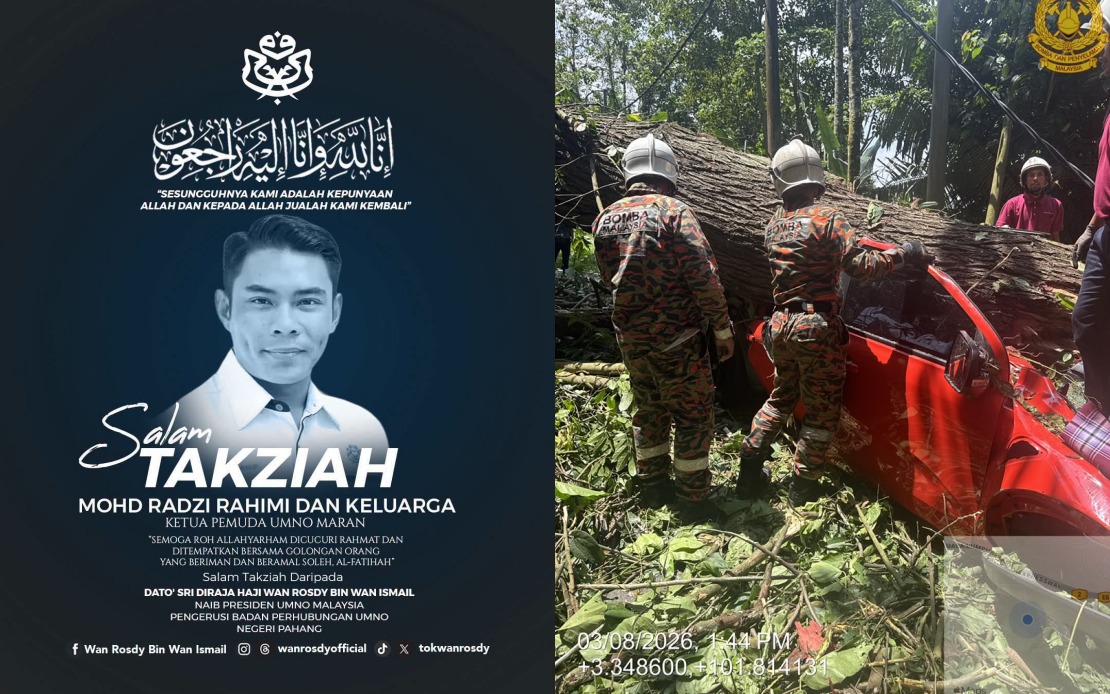
A tragic accident in Bentong has claimed the life of Maran UMNO Youth chief Mohd Radzi Rahimi, prompting senior party officials to reflect on his contributions to youth mobilisation and community engagement in Pahang. The incident, which occurred on the old Kuala Lumpur-Bentong road near Janda Baik on the afternoon of August 3, resulted in the deaths of four individuals when their four-wheel-drive vehicle was crushed by a fallen tree. Beyond the immediate shock of the tragedy, the loss has reverberated through UMNO's organisational structure in the state, highlighting the vulnerability of party workers and the sudden disruptions that natural disasters can inflict on institutional leadership.
Pahang Menteri Besar Datuk Seri Wan Rosdy Wan Ismail released a statement emphasising Mohd Radzi's dedication to public service and his commitment to prioritising community interests throughout his tenure in youth politics. The tribute reflected a broader recognition within UMNO's hierarchy that Mohd Radzi, commonly known as Edy Radzi, had earned respect through consistent engagement with grassroots members and his focus on addressing local concerns. The characterisation of him as a people-centred leader underscores the value UMNO places on officials who maintain close connections with constituents rather than distant administrative approaches.
The fatal incident also claimed three additional victims: Nuriani Mohammad Jafri, her son Muhammad Rizz Hazim, and her younger brother Mohammad Nizam. The presence of a child among the injured survivors adds another dimension to the human cost of the accident, raising questions about road safety conditions during adverse weather or environmental conditions along that particular stretch of highway. The concentration of casualties within a single family unit compounds the tragedy, as Nuriani's household has been fundamentally altered by the loss of multiple members in a single event.
Wan Rosdy's public condolences extended to all bereaved families, acknowledging that the loss transcended the political sphere to affect immediate relatives and broader social networks. His framing of the tragedy as a loss not only to Mohd Radzi's immediate family but to the Maran UMNO division, the Pahang UMNO Youth movement, and the Pahang UMNO Liaison Committee reflects how political organisations in Malaysia conceptualise the deaths of office-holders as institutional setbacks requiring collective mourning and acknowledgement.
The Menteri Besar's invocation of religious sentiment, calling for the deceased to be granted strength and patience, reflects the culturally appropriate response framework for expressing condolences within Malaysia's Muslim-majority society. Such language has become standardised in political communications, serving both to honour the deceased and to provide comfort through familiar spiritual references that resonate with the broader electorate.
UMNO Youth chief Datuk Dr Muhammad Akmal Saleh also issued separate condolences, offering prayers for Mohd Radzi's forgiveness and eternal rest. The involvement of multiple senior UMNO figures in public tributes indicates the significance assigned to Mohd Radzi's position within the party's youth structures and the formal protocols that govern expressions of collective grief within party hierarchies. Such coordinated messaging also serves to reinforce party unity during periods of loss.
The Bentong incident raises practical concerns about road safety along the old Kuala Lumpur-Bentong route, a highway that serves as an important thoroughfare connecting the Klang Valley with Pahang's interior regions. The old road, while scenic and popular with travellers, presents specific hazards during inclement weather when large trees lining the route may become unstable. For Malaysian road users and transportation authorities, such incidents underscore the need for regular maintenance and hazard assessment on secondary routes that carry significant traffic volumes.
For UMNO's organisational structure in Pahang, the loss of an active youth leader creates immediate succession challenges and continuity concerns. Youth wings function as critical recruitment and training grounds for future party leaders, and the sudden removal of experienced office-holders disrupts mentoring relationships and institutional knowledge transfer. The party will need to assess how to fill Mohd Radzi's position while ensuring that momentum in youth engagement programmes continues uninterrupted.
The tragedy also serves as a reminder of the occupational and incidental risks faced by political workers across Malaysia. While elected representatives and party officials receive public recognition for their contributions, they also navigate the same environmental hazards and vulnerabilities as ordinary citizens, sometimes in additional numbers as they travel extensively to engage with constituents and attend party functions.
Within the broader context of Pahang politics, Mohd Radzi's death occurs against the backdrop of ongoing state-level political developments and factional dynamics within UMNO. His role as Maran UMNO Youth chief would have positioned him within local patronage networks and succession planning frameworks that shape political competition in the state. The manner in which UMNO manages the institutional vacuum created by his passing may influence broader perceptions about the party's cohesion and its capacity to support members during crises.
The incident prompts reflection on how Malaysian political parties document and preserve the institutional contributions of deceased members. Creating mechanisms to honour and remember the work of committed youth leaders like Mohd Radzi can strengthen party culture and provide younger members with exemplars of service-oriented leadership. UMNO may consider establishing memorial initiatives or commemorative practices that acknowledge his legacy while channelling party energies toward continued community engagement in the Maran constituency.

