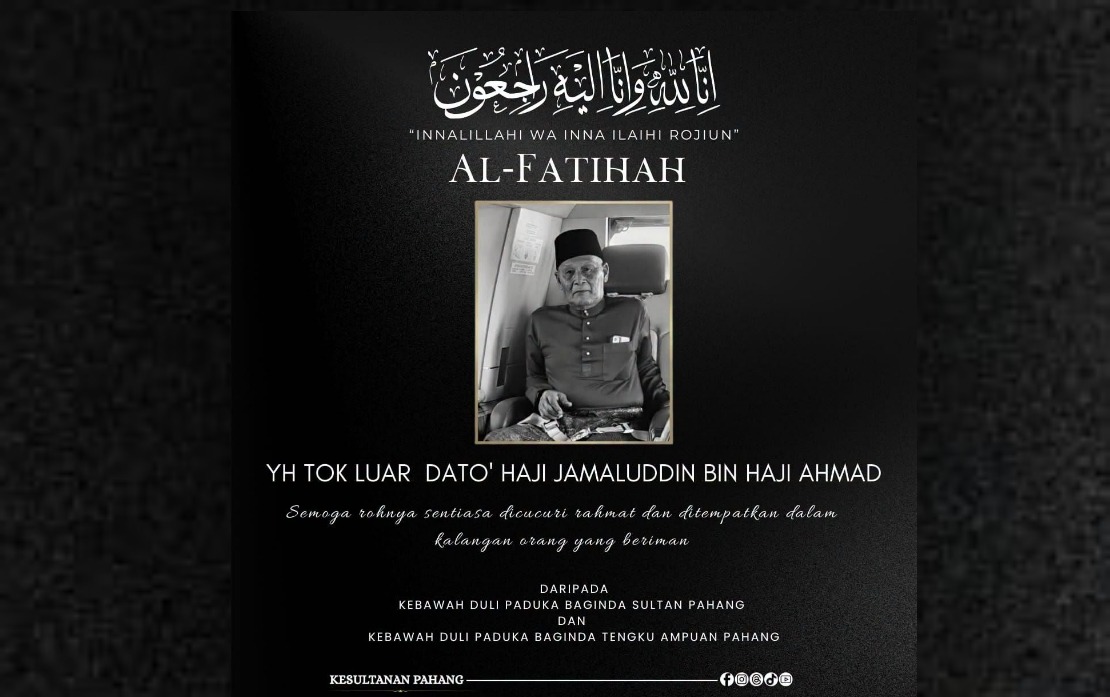
The royal household of Pahang has issued a formal statement of condolence following the death of Tok Luar Datuk Jamaluddin Ahmad, a figure deeply connected to the state's institutional life. Al-Sultan Abdullah Ri'ayatuddin Al-Mustafa Billah Shah and Tengku Ampuan Tunku Azizah Aminah Maimunah Iskandariah conveyed their personal sorrow through an announcement made public via the Kesultanan Pahang's official social media channels on June 28. The statement underscored the royal family's esteem for the deceased, acknowledging his unwavering commitment to the Pahang Sultanate and its traditions over many years.
Jamaluddin breathed his last at Tengku Ampuan Afzan Hospital at 6:48 am, bringing to an end a chapter in Pahang's social and institutional fabric. The timing of the royal acknowledgement demonstrated the swift and personal nature of the sultanate's engagement with matters affecting established figures within its domain. In the Malaysian context, where the institution of the monarchy remains central to state identity and governance, such formal expressions carry significant weight beyond mere protocol, reflecting the bonds that tie traditional leadership structures to community elders and respected citizens.
The royal couple's message transcended customary condolence language by specifically highlighting Jamaluddin's loyalty to the Pahang Sultanate institution itself. This framing suggests a relationship that extended beyond casual proximity, indicating instead a deliberate and sustained association with the institution's interests and values. In Pahang's political and social landscape, individuals recognised as "Tok Luar"—a traditional honorific denoting senior status and respected elder—typically occupy positions of influence within community networks, cultural preservation efforts, or administrative advisory roles. The Sultan and Tengku Ampuan's explicit recognition of Jamaluddin's institutional loyalty suggests he held such a position within the sultanate's broader ecosystem.
The religious dimensions of the condolence message reflect Islamic tradition and Malaysian royal protocol. The royal household invoked divine mercy upon Jamaluddin's soul, prayed for forgiveness of his transgressions, and expressed hope that his righteous deeds would be acknowledged in the afterlife. Such language, while conventional in Islamic societies, carries particular resonance when articulated by the sultanate, which in Malaysia serves not only as temporal authority but also as custodian of Islamic affairs within its jurisdiction. The invocation of Al-Fatihah—the opening chapter of the Quran recited during prayer for the deceased—represents the spiritual dimension of the state's relationship with its subjects and respected community members.
The royal statement also directed compassion toward Jamaluddin's immediate family, expressing prayers that they be granted strength, fortitude and patience during their bereavement. This extended concern reflects a principle in Malaysian royalty's public engagement where the sultanate acknowledges itself as a source of emotional and spiritual support for families experiencing loss. Such gestures, while symbolic, reinforce the role of the monarchy in providing continuity and stability during periods of collective grief, particularly when the deceased held recognised standing within state society.
Contextually, the death of senior figures recognised by the sultanate often occasions broader reflection on institutional memory and historical continuity. Pahang, as one of Malaysia's original sultanates, maintains particularly robust connections between its royal house and the broader society, including religious scholars, administrative veterans, and community custodians. The public acknowledgement of Jamaluddin's passing through official channels ensures that his contributions to state life—whatever their specific nature—receive formal recognition and are preserved within institutional memory. This practice strengthens public bonds to the sultanate while honouring individuals who have served state and society.
The announcement through social media platforms demonstrates how traditional Malaysian institutions have adapted to modern communication channels whilst maintaining ceremonial and emotional authenticity. By publishing the condolence message on the Kesultanan Pahang Facebook page, the royal household ensured wide dissemination among both Pahang residents and the broader Malaysian public with interest in state affairs. This approach democratises what might traditionally have been restricted to formal gazette announcements or limited circulation announcements, allowing Jamaluddin's family and broader networks to receive acknowledgement simultaneously.
For readers in Pahang and across Southeast Asia more broadly, such announcements serve multiple functions beyond mere courtesy. They signal the sultanate's engagement with the lives of respected community members, reinforce hierarchies of recognition within state society, and provide a template for how institutions acknowledge loss and honour service. In societies where formal institutions sometimes appear distant from everyday life, these moments of demonstrated care strengthen public attachment to constitutional frameworks and traditional authority structures.
The passing of Tok Luar Datuk Jamaluddin Ahmad thus represents not merely a personal loss for his family but a broader institutional moment for Pahang. The sultanate's swift and substantive response through both religious and secular language affirms continuities that characterise Malaysian governance—the integration of Islamic principles with institutional protocols, the recognition of service and loyalty, and the commitment to providing spiritual and emotional leadership during times of transition. As Pahang continues its development as a state, such moments remind both residents and observers of the persistent importance of these traditional connections.

