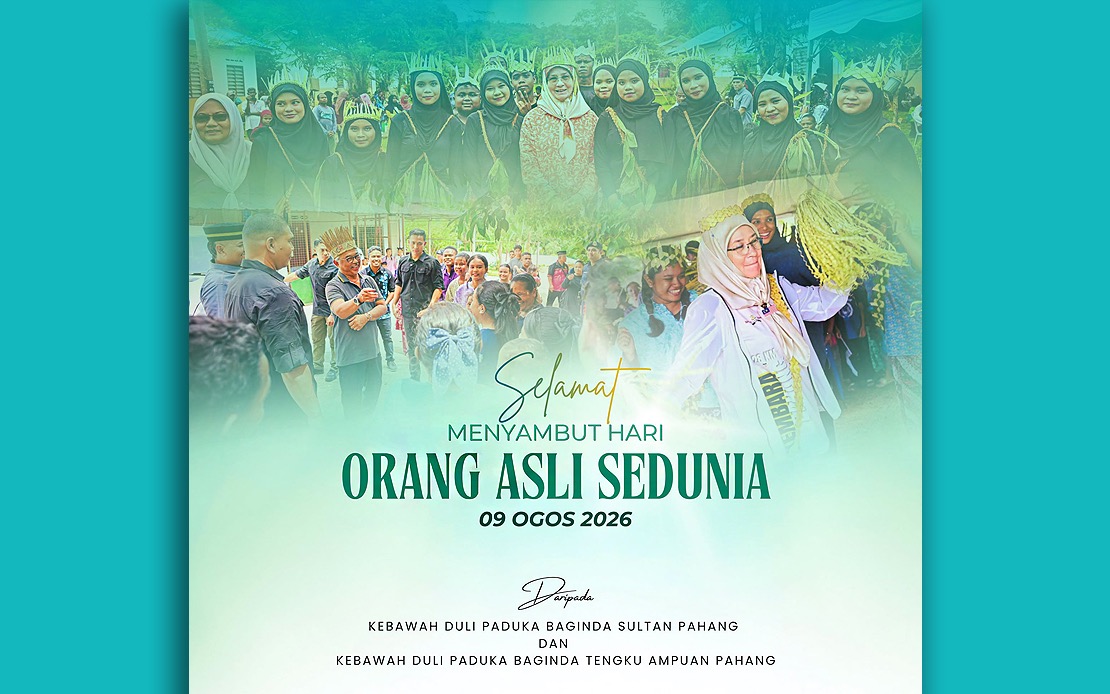
Malaysia's Orang Asli communities received royal recognition and a commitment to expanded development opportunities from Pahang's leadership this week, as the Sultan of Pahang, Al-Sultan Abdullah Ri'ayatuddin Al-Mustafa Billah Shah, and Tengku Ampuan Pahang Tunku Azizah Aminah Maimunah Iskandariah acknowledged their irreplaceable role in shaping the state's cultural landscape. The royal couple's statement, issued through official channels ahead of the 2026 International Day of the World's Indigenous Peoples, reflects renewed attention to indigenous communities at a time when development pressures continue to reshape rural Malaysia.
The Sultan and Tengku Ampuan specifically recognised the contributions made by Orang Asli communities to Pahang's customs, traditions and broader cultural identity. Their statement went beyond ceremonial acknowledgement to articulate a vision for tangible improvements in living standards, framing indigenous development as a collective responsibility rather than a peripheral concern. This positioning carries significance for policymakers across the region, suggesting a model where royal institutions actively champion marginalised groups rather than maintaining symbolic distance.
Education emerged as a priority area in the royal couple's statement, reflecting long-standing challenges in bringing quality schooling to indigenous settlements scattered across Pahang's forested interior. Many Orang Asli children face barriers including remote location, language instruction gaps and limited access to qualified teachers. The royal emphasis on education signals potential momentum for initiatives addressing these structural obstacles, though implementation will depend on coordinated efforts between state and federal authorities.
Economic development opportunities represent another pillar of the commitment articulated by Al-Sultan Abdullah and Tunku Azizah. Orang Asli communities historically have experienced economic marginalisation, with limited access to capital, markets and employment pathways beyond subsistence activities. The royal couple's call for expanded economic opportunities suggests openness to enterprise schemes, vocational training and market linkages that could enhance community incomes while respecting traditional livelihoods where preferred.
Skills and human capital development were highlighted as essential components of the development agenda, acknowledging that sustainable advancement requires investment in capability building. This framing aligns with broader Malaysian aspirations for workforce development but recognises that Orang Asli communities require tailored approaches accounting for their specific circumstances, educational backgrounds and geographic distribution. Training programmes designed with community input could unlock economic potential while building institutional capacity within indigenous groups.
Crucially, the royal statement emphasised preservation of Orang Asli identity, customs and heritage alongside development initiatives—a balance often difficult to achieve in practice. Indigenous communities worldwide face pressure to assimilate or abandon traditional practices in pursuit of economic advancement. By explicitly positioning cultural preservation as non-negotiable, the Sultan and Tengku Ampuan framed development as enhancing rather than replacing indigenous ways of life, a distinction with profound implications for community agency and self-determination.
The 2026 International Day of the World's Indigenous Peoples provides a global platform for Malaysia to demonstrate commitment to indigenous welfare. Pahang's advance positioning on this observance could establish expectations for comparable action across other states and at federal level. The effectiveness of such gestures ultimately depends on translating rhetoric into resource allocation, policy reform and genuine partnership with indigenous groups in planning and implementing programmes affecting their futures.
For Malaysian readers, the royal statement reflects broader conversations about national development equity and pluralism. Orang Asli represent approximately 0.5 per cent of Malaysia's population but inhabit significant land areas, control natural resources and embody distinctive cultural traditions. Their development trajectory will shape discussions about land rights, environmental conservation, cultural preservation and inclusive growth across Southeast Asia, where indigenous communities face similar pressures across national boundaries.
The Sultan and Tengku Ampuan also called for unity, respect and cooperation across Pahang's diverse communities, framing indigenous welfare as integral to statewide harmony and prosperity. This language connects indigenous development to broader social cohesion, suggesting that marginalisation of any group carries costs for collective wellbeing. Such framing could strengthen political will for comprehensive support programmes and counter narrative of indigenous issues as peripheral or charity-driven.
The royal couple's wellwishing and emphasis on sustained prosperity indicates commitment extending beyond immediate gestures. Translated into practice, this could mean systematic review of policies affecting Orang Asli access to education, healthcare, economic opportunities and cultural spaces. Civil society groups and development partners will likely scrutinise follow-through, using the royal statement as benchmark for measuring governmental action and resource allocation in coming months.
Pahang's leadership on this issue may set expectations for other states with significant indigenous populations, including Perak, Selangor and Terengganu. Coordinated regional action, if it emerges, could strengthen indigenous communities' bargaining position in negotiations with government and private sector actors, particularly regarding land and resource management. For indigenous communities themselves, the statement provides political space and rhetorical support for advancing their own agendas around development and cultural preservation.

