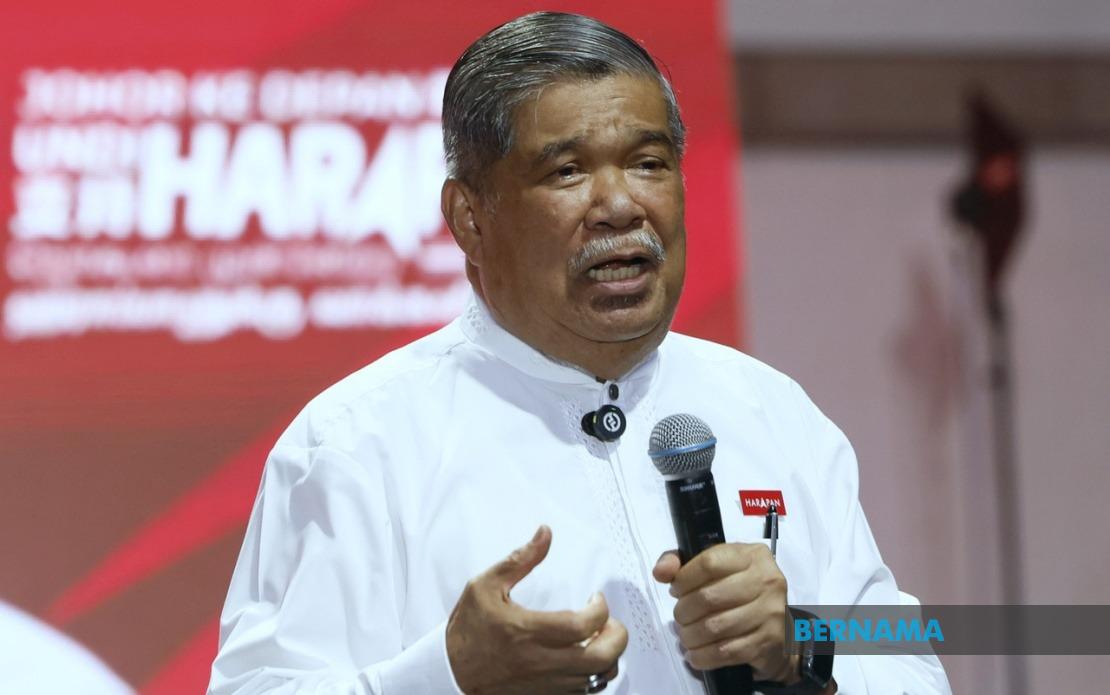
The Pakatan Harapan coalition has remained resolute in its campaign strategy despite PAS's controversial instruction to its supporters to back Barisan Nasional candidates in constituencies where the Islamic party is not fielding contestants in the Johor state election. Amanah president Datuk Seri Mohamad Sabu, who doubles as Minister of Agriculture and Food Security, made clear that the opposition alliance views such tactical maneuvering as a distraction rather than a genuine threat to its electoral prospects.
Speaking after a ceramah in Permas Jaya on July 1, Mohamad Sabu articulated PH's confidence that its core messaging and ground machinery would prove resilient against what he characterised as opponent provocations. The deliberate decision by the Amanah leader to downplay PAS's move reflects a strategic calculation that appearing unflustered reinforces the narrative of a unified, confident opposition force capable of governing the state effectively. By refusing to engage in reactive rhetoric, PH appears intent on maintaining the moral high ground in a campaign that will determine control of all 56 state seats.
The Amanah chief grounded his party's competitive advantage in what he described as PH's foundational strength: a multiracial and multireligious political model that transcends narrow communal appeals. This positioning carries particular significance in Johor, where demographic diversity and significant migrant populations complicate traditional voting patterns. Mohamad Sabu's emphasis on this inclusive framework suggests PH believes it can outmaneuver opponents who rely on racial or religious messaging by appealing to voters' aspirations for stable governance that benefits all communities regardless of background.
Central to PH's campaign narrative is the argument that administrative coherence between state and federal governments unlocks economic development. The coalition contends that a PH-led Johor administration working in tandem with the federal government in Putrajaya would accelerate implementation of transformative projects that currently languish due to inter-government friction. This includes overhauls to public transportation infrastructure, upgrades at international border checkpoints, and aggressive investment attraction—all areas where coordination failures between state and federal authorities have previously hindered progress.
Meanwhile, DAP strategic director Liew Chin Tong, serving concurrently as Deputy Finance Minister, introduced a demographic dimension to PH's election calculus by identifying youth voter participation as the critical variable determining the outcome. His analysis references the 2022 Johor state election, where lower voter turnout disproportionately benefited Barisan Nasional, a phenomenon exacerbated by the inability of Johor residents employed in Singapore to return home for voting due to COVID-19-related travel disruptions. This observation hints at structural vulnerabilities within the opposition coalition's support base, particularly among younger, economically mobile voters whose participation rates fluctuate based on accessibility and perceived stakes.
Liew's framework for the election's second phase explicitly rejects zero-sum political competition in favour of policy-focused discourse. This rhetorical pivot attempts to shift the battleground from partisan loyalty toward substantive proposals addressing lived realities. He highlighted several interconnected policy domains—employment creation with competitive remuneration, public transportation modernisation, flood management and drainage infrastructure maintenance, provisions for an ageing demographic, and childcare facility development—that should dominate state-level political debate. By framing these as cross-cutting priorities rather than partisan wedges, DAP signals openness to collaboration while establishing benchmarks against which both ruling and opposition coalitions can be evaluated.
The employment dimension commands particular urgency in Johor's political economy. Liew's concern that young Johoreans remain forced to seek livelihoods across the causeway in Singapore reflects a genuine development challenge that transcends election cycles. The state's chronic inability to generate sufficient high-quality employment opportunities has created a continuous brain drain, undermining long-term competitive positioning and demographic stability. Any credible state government must therefore demonstrate capacity to reverse this trajectory through targeted investment attraction and industry diversification.
The Johor-Singapore Special Economic Zone figures prominently in PH's development vision as a vehicle for unlocking cross-border economic synergies that benefit both populations. Liew emphasised that meaningful progress on the JS-SEZ requires sustained federal-state cooperation, implicitly suggesting that divided government impedes advancement. This framing positions federal-state alignment not merely as administrative tidiness but as an essential precondition for addressing Johor's most pressing economic challenges. The calculation appears to be that voters prioritising employment and prosperity will logically support governance continuity between Putrajaya and Kota Iskandar.
The timing and substance of both leaders' public statements reveal deeper strategic considerations operative in the campaign's second phase. By emphasising multiracial cooperation, policy substance, and administrative synchronisation rather than engaging in tit-for-tat responses to opponent tactics, PH appears intent on occupying the centre-right and reform-minded space of Johor's political spectrum. This positioning allows the coalition to neutralise traditional BN advantages in state administrative capacity and business community relationships by proposing a reformed governance model that delivers measurable improvements in services and economic opportunity.
With polling scheduled for July 11 and early voting on July 7, the election represents a crucial test of PH's organisational capacity and message discipline in a state where it governs federally but operates from opposition at the state level. The coalition's refusal to be rattled by PAS's directive reflects confidence, but also necessity—any appearance of panic or defensive posturing would undermine the broader narrative of a stable, capable alternative government. For Johor voters weighing their options, the choice increasingly appears framed as one between continuity under a revitalised BN and transformation through a federated opposition claiming to offer governance attuned to contemporary economic and social realities.
The election ultimately tests whether policy-focused messaging and federal-state alignment arguments can overcome traditional state-level incumbency advantages and the fragmentation risks inherent in multiparty coalitions. PH's apparent equanimity in face of opponent maneuvers will be validated or repudiated when Johoreans cast their ballots.

