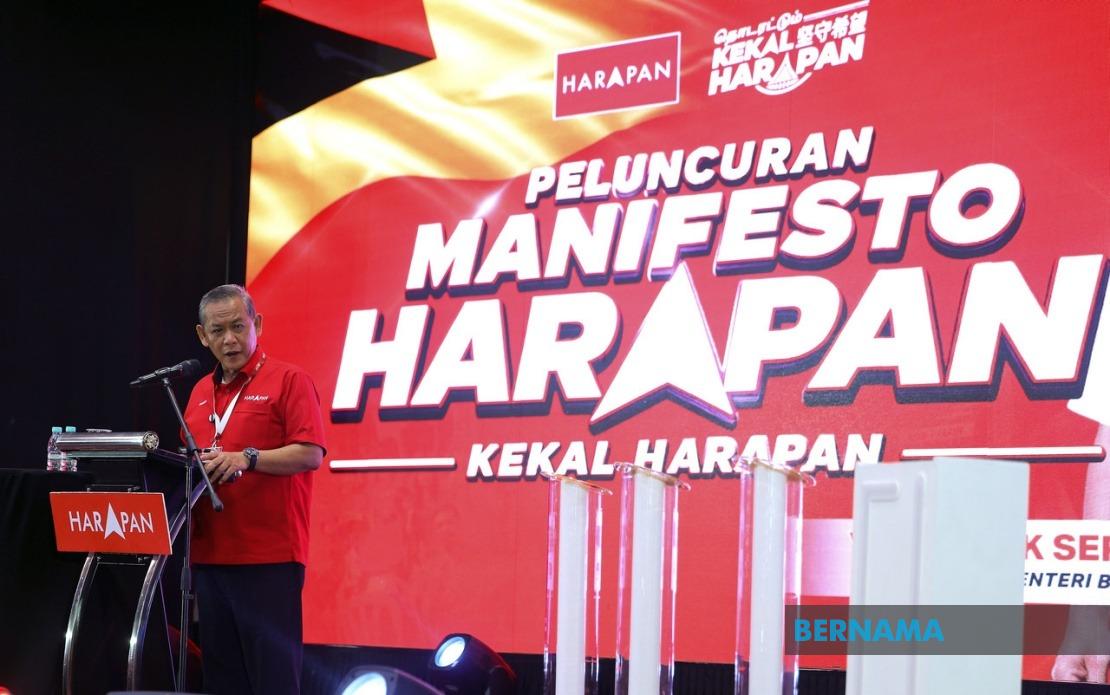
Pakatan Harapan has set out an ambitious reform agenda for voters in Negeri Sembilan, unveiling a comprehensive manifesto ahead of the 16th state election. Launched in Seremban by Menteri Besar Datuk Seri Aminuddin Harun, the ruling coalition's platform carries the resonant title 'Negeri Sembilan Kekal Harapan'—a deliberate reaffirmation of the state's connection to the broader PH brand. The manifesto crystallises a decade of governance priorities into ten concrete commitments, each addressing voter concerns that cut across economic insecurity, housing shortages, and service delivery expectations.
At the heart of PH's electoral pitch lies a commitment to transparent, accountable administration centred on citizen welfare. The coalition frames this foundational pledge as a departure from the old order, emphasising that good governance underpins all other progress. For many in Negeri Sembilan, this framing speaks to the anti-corruption narrative that propelled PH to federal power in 2018, though the party recognises that voter confidence in that promise has eroded amid subsequent political turbulence and leadership transitions. By positioning clean governance first, PH signals that the manifesto's other planks rest on institutional integrity rather than patronage or partisan favour.
Economic revitalisation forms the programme's second major plank. PH commits to building a competitive state economy capable of generating 30,000 high-income jobs—a target that reflects Negeri Sembilan's position as an industrial and manufacturing hub within the Klang Valley corridor. This employment goal matters considerably for younger voters and families seeking stability in an economy buffeted by post-pandemic adjustment and regional competition. The ambition to create high-value work, rather than merely filling job quotas, distinguishes this pledge from generic development rhetoric and suggests a skills-based approach to economic transformation.
The manifesto places substantial emphasis on welfare mechanisms, particularly through enhancement of the 'Skim Sejahtera Rakyat' (People's Wellbeing Scheme). This scheme has become a key differentiator in state-level competition across Malaysia, with voters increasingly judging administrations on tangible benefit delivery rather than ideological positioning. By pledging to strengthen rather than replace existing welfare infrastructure, PH indicates continuity with previous initiatives while promising qualitative improvements—a politically astute balance that avoids alienating those already integrated into the programme.
Housing affordability emerges as another central commitment, with PH promising construction of 20,000 affordable units. This pledge carries particular weight in Negeri Sembilan, where proximity to Kuala Lumpur has driven property speculation and placed homeownership beyond the reach of many working families. Coupled with a promise to resolve long-standing land-related disputes, the manifesto attempts to address accumulated grievances around property transactions and development rights—matters that frequently provoke grassroots frustration with state bureaucracies.
Education and healthcare feature prominently in the platform, reflecting voter anxiety about service quality and accessibility in these essential sectors. PH's promise of quality education for all stands in implicit contrast to concerns about rural schooling standards and unequal resource distribution. Similarly, commitments to strategic healthcare infrastructure suggest recognition that many communities in Negeri Sembilan experience gaps between urban medical facilities and provincial provision. These pledges resonate beyond narrow health policy circles because education and healthcare represent fundamental measures of state competence in voters' minds.
The manifesto's attention to youth empowerment, women's advancement, and family support indicates PH's attempt to address demographic concerns and gender-based vulnerabilities. These commitments acknowledge changing household structures, rising female labour participation, and youth disengagement from politics. By explicitly naming these constituencies, PH counters perceptions of indifference to non-traditional voter blocs while positioning itself as socially progressive within a state that remains quite conservative on cultural questions.
Tourism and cultural heritage development reflects both economic potential and identity concerns within Negeri Sembilan. The state possesses historical significance and natural attractions yet remains overshadowed by neighbouring Selangor in regional tourism hierarchies. A dedicated commitment to this sector signals PH's intention to unlock economic value while asserting Negeri Sembilan's distinct place within Malaysia's tourism landscape. This matters for communities historically dependent on agricultural or extractive livelihoods seeking economic diversification.
Agricultural modernisation and food security form another substantive commitment, addressing concerns that Negeri Sembilan's farming sector has stagnated relative to urban development pressures. The manifesto promises contemporary approaches to agricultural productivity while acknowledging food security as a national resilience question. For rural constituents, these pledges represent recognition that farming communities require targeted investment and strategic planning rather than benign neglect.
The commitment to implement the Federal Land Development Authority (Felda) Development Plan indicates coordination between state and federal authorities on a persistent rural development challenge. Felda settlements have long struggled with aging infrastructure and economic viability, and renewed development attention signals federal-state alignment on this historically fraught issue. For Felda settlers and their descendants, this commitment carries significance beyond symbolic gesture, as settlement rehabilitation directly affects property values and livelihood prospects.
Strategic infrastructure and interfaith unity round out the manifesto, reflecting broader national preoccupations. Infrastructure investment promises modern transport, utilities, and communications systems essential for competitive positioning. The emphasis on interfaith harmony, while perhaps seeming peripheral to economic concerns, acknowledges Negeri Sembilan's religious diversity and addresses latent social tensions that periodic national controversies have exacerbated. By including this explicitly, PH signals commitment to social cohesion as foundational to good governance.
The manifesto's comprehensiveness reflects both PH's attempt to build a governing coalition and recognition that electoral viability in contemporary Malaysia requires addressing diverse voter concerns simultaneously. By anchoring the platform in tangible commitments rather than abstract ideology, and by spanning economic, social, and governance domains, the ruling coalition aims to present itself as responsive and competent. The test will lie in implementation and whether PH can demonstrate measurable progress on these ten fronts before voters render their verdict at the polls.

