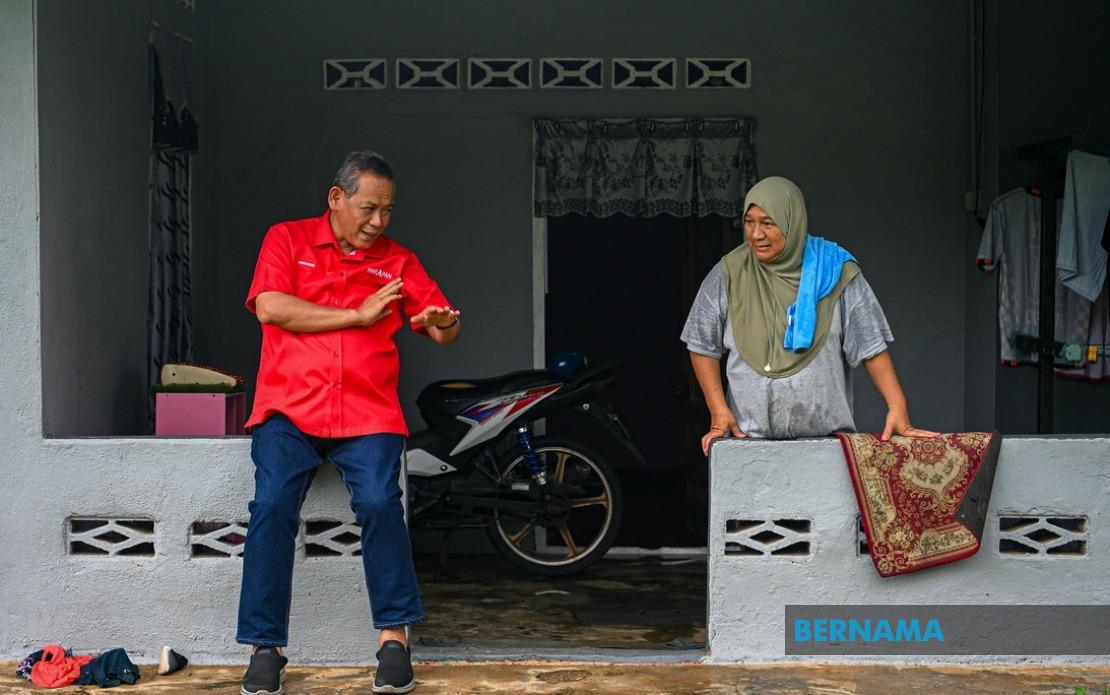
Pakatan Harapan's campaign strategy for the Negeri Sembilan state election centres squarely on the administrative credentials and integrity of incumbent Menteri Besar Datuk Seri Aminuddin Harun, framing clean governance and freedom from major scandal as its primary electoral assets. The coalition is betting that nearly two consecutive terms of stable, unblemished stewardship will persuade voters to maintain their mandate when polling takes place on August 1, with election director Datuk Seri Amirudin Shari expressing confidence based on initial campaign feedback from the first three days of ground engagement.
According to Amirudin, who doubles as Selangor Menteri Besar, party feedback indicates that Aminuddin's track record has generated genuine resonance at grassroots level, particularly among ordinary voters who have encountered no major controversies linked to PH's state administration. This absence of scandal—a perennial vulnerability in Malaysian politics—appears to have become PH's strategic cornerstone, offering voters a contrast narrative in an environment where governance integrity remains a contentious issue nationwide. The emphasis reflects PH's understanding that after five years in power federally and approaching two full terms in Negeri Sembilan, demonstrating competent, scandal-free administration may matter more to voters than ambitious new pledges.
Amirudin acknowledged that while large public rallies might not necessarily convey the full picture of electoral sentiment, the feedback channelled through PH's decentralised grassroots networks has painted an encouraging portrait. He indicated that this granular level of support—obtained through direct interaction with party machinery across constituencies—provides a more reliable gauge of voter intention than media coverage or headline events alone. This assessment carries strategic weight given that Negeri Sembilan's electorate comprises nearly 890,000 registered voters distributed across multiple constituencies, making grassroots organisation and constituency-level penetration decisive factors.
Beyond Aminuddin's personal credibility, PH is leveraging the institutional strengths of his dual roles as both Menteri Besar and Port Dickson Member of Parliament, positioning him as an established, recognised figure with demonstrable influence across state and federal spheres. This dual mandate symbolises continuity and embedded institutional power, contrasting with potential opposition candidates who may lack comparable political entrenchment. Furthermore, Amirudin credited PH's well-oiled grassroots machinery as an additional competitive advantage, suggesting that superior campaign organisation and ground mobilisation capacity would enable the coalition to defend its existing seat portfolio and capture additional constituencies.
The coalition's confidence draws partly from Prime Minister Datuk Seri Anwar Ibrahim's leadership at the federal level and the policy achievements registered under his administration since assuming office. Amirudin indicated that Anwar's personal involvement in campaigning would bolster PH's candidates, citing the Johor state election as a precedent where public confidence in the Prime Minister demonstrably translated into elevated support for coalition candidates at state level. This cascading effect—whereby federal leadership popularity filters down to state elections—represents a measurable advantage that PH hopes to replicate in Negeri Sembilan, though such correlation remains contingent on national political circumstances remaining relatively stable through polling day.
The upcoming PH manifesto, scheduled for launch during the campaign period, is being positioned as a synthesis between consolidating existing initiatives and introducing fresh proposals tailored to Negeri Sembilan's specific development priorities. According to Amirudin, this dual-pronged approach aims to demonstrate both continuity—assuring voters that proven programmes will continue—and innovation, signalling that a renewed PH mandate would unlock additional benefits and economic strengthening for ordinary Negeri Sembilan residents. This framing attempts to occupy the political centre, avoiding the appearance of either stagnation or radical departure from established governance patterns.
Negeri Sembilan's electoral landscape has remained reasonably competitive but favourable to PH since the last state election in 2023, when the coalition secured 17 seats to Barisan Nasional's 14 and Perikatan Nasional's five. This 17-seat majority, while workable, lacks the commanding dominance that would make PH's re-election a foregone conclusion. The relatively tight margin means that modest swings in specific constituencies could alter the overall outcome, underscoring why PH is emphasising ground-level organisation and the stability narrative associated with Aminuddin's administration. Opposition parties, particularly Barisan Nasional, retain realistic pathways to power if they can mobilise disaffected voters or capitalise on any perceived governance shortcomings.
The electoral machinery for Negeri Sembilan's 16th state election has been formally activated following the Negeri Sembilan State Legislative Assembly's dissolution on June 5. Approximately 889,490 registered voters are eligible to participate, comprising 867,151 ordinary voters alongside 16,884 military personnel and spouses and 5,455 police officers designated as early voters. This composition reflects Malaysia's practice of facilitating early voting for uniformed personnel, whose posting patterns might otherwise prevent participation on polling day. Early voting is scheduled for July 28, with the main election occurring on August 1, providing the campaign period with roughly a fortnight for parties to consolidate messaging and mobilise their voter bases.
For PH, the Negeri Sembilan election carries implications extending beyond that state's governance. Success would reinforce the coalition's narrative of stable, corruption-free administration and could provide momentum heading into potential federal-level political developments. Conversely, a disappointing result or loss of the state government would inflict symbolic damage to PH's clean-governance brand and embolden opposition narratives questioning the coalition's political durability. The election therefore serves as a meaningful barometer of voter sentiment regarding PH's federal stewardship and Anwar's leadership, even though Negeri Sembilan's outcome will not directly affect the federal government's parliamentary majority.
The strategic emphasis on Aminuddin's integrity and administrative record reflects broader trends in Malaysian electoral politics, where anti-corruption sentiment and governance competence have emerged as potent voter motivations, particularly among middle-class and urban constituencies. By elevating these themes, PH is attempting to position itself as the custodian of institutional integrity in a political environment where past administrations have been tainted by high-profile corruption scandals. Whether this narrative suffices to overcome potential voter fatigue, economic pressures, or opposition mobilisation will become apparent when Negeri Sembilan votes on August 1.

