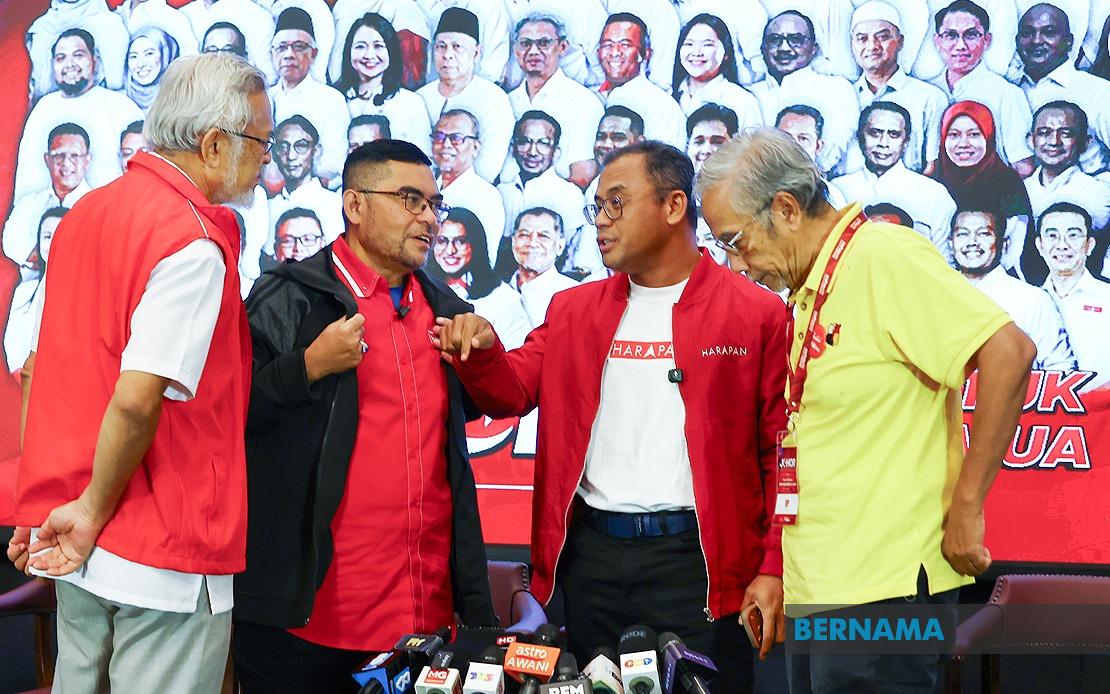
Pakatan Harapan is pressing ahead with a thorough examination of the factors underlying its performance in the recent Johor state election, signalling the coalition's determination to refine its strategy before contesting the Negeri Sembilan polls. Speaking at the coalition's operations centre in Johor Bahru on the evening of the election, senior PH officials indicated that while initial results were still coming in, the leadership intended to extract lessons from voting pattern shifts and gauge support levels among younger constituencies.
Datuk Seri Amirudin Shari, who holds the dual positions of Selangor Menteri Besar and PKR's election co-director, emphasised that rushing to conclusions would be premature given that several seats had yet to be officially confirmed. He noted that a week would be needed to verify actual figures across all polling districts and compile a definitive picture of where voter sentiment had shifted. Nevertheless, he stressed that despite the deliberate pace of analysis, the coalition had no time to waste in preparing for its next electoral challenge in Negeri Sembilan.
The Johor contest itself proved challenging for PH. Barisan Nasional secured 29 of the 56 available state seats as counted by 10.32 pm on election night, thereby securing a simple majority exceeding 50 percent of contested positions. Election Commission chairman Datuk Seri Ramlan Harun confirmed that this threshold afforded BN clear control of the state assembly. For PH, the outcome underscored the difficulty of maintaining momentum in peninsular heartlands where traditional political allegiances remain entrenched and where BN's organisational network continues to hold sway among rural and semi-urban constituencies.
Amirudin's emphasis on young voter engagement reflects PH's recognition that generational divisions may be playing a growing role in Malaysian electoral dynamics. The coalition appears intent on understanding whether younger voters are gravitating toward opposition alternatives, remaining with BN, or withdrawing from political participation altogether. This granular approach to data analysis suggests PH understands that crude seat-level analysis misses crucial information about underlying demographic and ideological shifts that could prove decisive in future contests.
Despite the Johor setback, PH maintains bullish confidence regarding Negeri Sembilan, where it currently governs. The coalition points to the track record of Menteri Besar Datuk Seri Aminuddin Harun as evidence of competent administration and a platform upon which to campaign. For Negeri Sembilan voters, PH's governing performance in the state—encompassing fiscal management, infrastructure development, and social programmes—will likely dominate campaign messaging. The challenge for PH lies in translating local governance achievements into sufficient electoral support, a task complicated if broader national sentiment favours change.
Candidate selection emerged as a critical next step in PH's planning. Amirudin confirmed that discussions among coalition partners would commence the day following the Johor election to settle candidate lists and ensure that nominees aligned with local voter expectations. This timeline pointed toward an official announcement of the full candidate slate on July 14, providing a compressed window in which PH would need to finalise internal negotiations, vet contenders, and communicate choices to grassroots members and the broader electorate.
The selection process carries heightened significance given that candidate quality and local connectivity often prove decisive in smaller state contests where personal relationships and community standing carry disproportionate weight. PH's focus on ensuring candidates met local expectations suggests the coalition recognised that fielding poorly-regarded or externally-imposed contenders could prove fatal, particularly in constituencies where community leaders hold considerable sway over voter behaviour.
Amirudin's remarks regarding federal stability deserve particular attention. He moved to reassure observers that state-level electoral fluctuations would not destabilise the federal government, noting that all component parties—including BN—had committed to maintaining the national administration until the completion of the current parliamentary term. This statement carried significance not merely as coalition morale-boosting but as a signal to markets, investors, and the bureaucracy that political competition at state level would not cascade into federal crisis. For Malaysian business and international observers, such reassurance matters considerably given memories of previous transitions marked by uncertainty and brinkmanship.
The three-day gap between the Johor election and Negeri Sembilan candidate announcements would allow coalition leadership to move swiftly from post-mortem to forward planning. However, this compressed timeline also risked preventing the thorough strategic recalibration that Amirudin suggested was necessary. Internal coalition dynamics—particularly the balance between PKR, Amanah, and DAP—would require careful negotiation to ensure no component party felt disadvantaged by candidate allocations.
For Southeast Asian observers, the Johor result and PH's subsequent positioning illuminates the ongoing realignment within Malaysian politics. Whilst PH commands federal power, its variable performance at state level reflects the continuing strength of BN infrastructure and voter conservatism in certain regions. The coalition's commitment to detailed analysis rather than reactive changes suggests a leadership intent on sustained competitiveness rather than panic-driven tactics. Whether such measured deliberation will yield improved Negeri Sembilan outcomes remains to be tested when voters cast their ballots.

