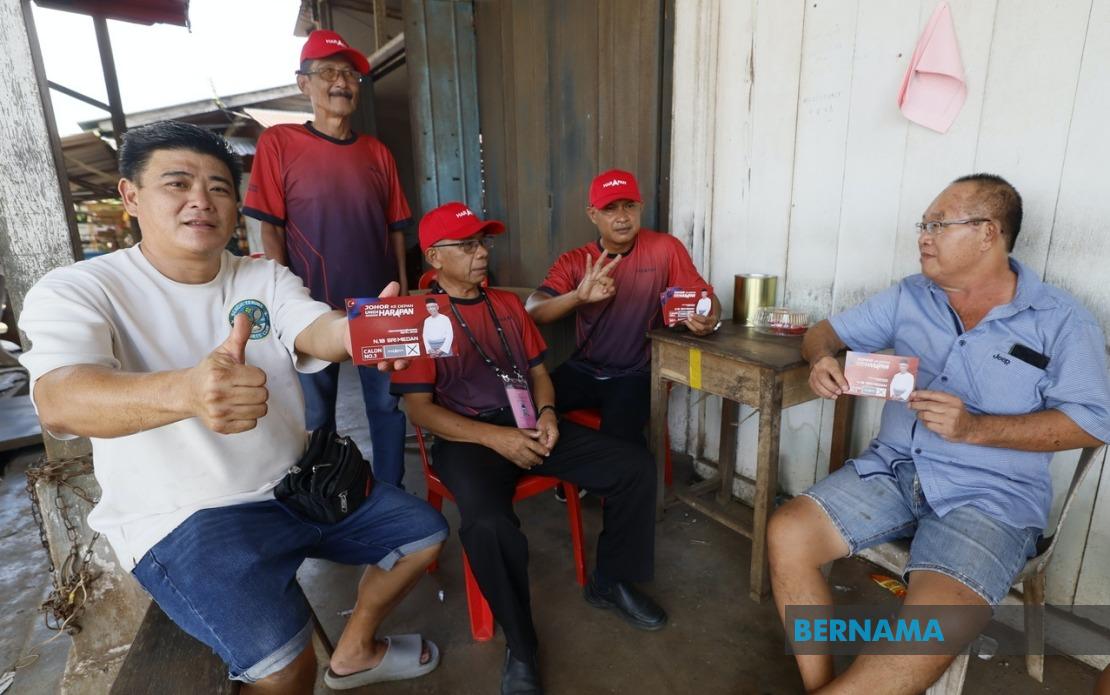
The Pakatan Harapan bid to reclaim ground in traditionally Barisan Nasional territory is taking shape in the form of Hishamudin @ Misrin Ishak, a former mathematics educator now contesting the Sri Medan seat in Johor's 16th state election. Walking the streets of Pekan Kangkar Senangar and engaging voters door-to-door, the affable candidate presents himself as a pragmatic problem-solver intent on translating resident grievances into concrete action rather than political rhetoric. His campaign message centres on a deliberate philosophy of demonstrating competence before making grand promises—a strategic positioning that attempts to distinguish him from typical politicians while building voter confidence through demonstrated commitment to local issues.
The recurring flooding that continues to plague Sri Medan residents occupies prominent space in Hishamudin's platform. Rather than treating this as a peripheral issue, he has identified it as a foundational problem requiring sustained engagement with state and federal authorities. His framing of flood management as a priority reflects broader frustrations across Johor communities that have seen monsoon rains transform neighbourhoods into disaster zones with insufficient preventive infrastructure. By elevating this specific grievance, he is effectively staking claim to responsiveness on an issue where incumbent administrations have arguably underperformed, positioning the PH campaign as ready to break patterns of neglect.
A significant dimension of his outreach involves championing balanced development across diverse settlement types. Sri Medan encompasses urban cores, semi-urban residential areas, and rural sections—each with distinct infrastructure needs and development trajectories. Hishamudin's emphasis on equitable resource distribution across these zones addresses a common complaint in Malaysian constituencies where urban areas monopolize investment while rural hinterlands languish. This inclusive development philosophy has particular resonance in Johor's mixed demographics, where perceived neglect of outlying areas has historically motivated voter backlash against complacent incumbents.
Education and skills development feature prominently in his campaign vision. His commitment to expanding Technical and Vocational Education and Training (TVET) programming signals alignment with Malaysia's economic diversification strategy, which increasingly depends on skilled workers in manufacturing, technology, and services sectors. By offering to facilitate TVET exposure and digital literacy courses, he positions himself as responsive to youth anxieties about employment prospects in an evolving labour market. This approach acknowledges that school-based qualifications alone no longer guarantee economic security for young Malaysians, particularly in secondary towns where job diversity remains limited.
Small and medium enterprise development constitutes another pillar of his platform. Hishamudin recognizes that SMEs form the backbone of Johor's economy, yet many owner-operators struggle with market access constraints and limited distribution networks beyond local demand. His explicit intention to facilitate market expansion—helping business owners reach beyond immediate geographic confines—addresses a genuine pain point in the business community. This focus on supply-chain connectivity and commercial reach carries implications for broader regional trade patterns, particularly as SMEs increasingly seek interstate and cross-border opportunities.
His background as a village headman provides tangible credentials for the community-liaison role he seeks to assume. Unlike candidates parachuted into constituencies with minimal local roots, Hishamudin has accumulated direct experience managing administrative processes, mediating resident disputes, and allocating limited resources—the unglamorous but essential work of local governance. He frames his candidacy as a natural progression from grassroots community service to state-level representation, presenting continuity rather than disruption to established relationships and accountability structures.
The three-day campaign window from which this report emerges captures Hishamudin at an early momentum-building phase. His assessment of voter response as encouraging suggests initial traction in a constituency widely regarded as politically secured by BN, though such optimism must be contextualized within the typical patterns of opposition candidates maintaining morale during campaigns. Sri Medan's stronghold status for the ruling coalition reflects both structural advantages—including patronage networks and administrative resources—and voter demographics that have traditionally favored BN's approach to governance and resource distribution.
Contesting against Datuk Zulkurnain Kamisan of BN and Ahmad Rosdi Bahari of Perikatan Nasional, Hishamudin enters as the underdog challenging two established competitors with deeper political machinery and funding. The three-way split in opposition forces—with PH and PN separately fielding candidates—creates strategic complexity. Voter fragmentation among non-BN alternatives benefits the incumbent, particularly if anti-BN sentiment lacks sufficient concentration to overcome BN's structural advantages. Hishamudin's viability depends substantially on whether PH's organizational capacity can mobilize sufficient support while PN's candidacy either collapses or cannibalizes BN votes rather than opposition support.
His self-presentation as a fresh face represents both advantage and vulnerability. Newcomers to electoral politics offer voters escape from entrenched networks and perceived corruption, yet lack the institutional backing and political capital that senior candidates command. Hishamudin's youth and outsider status may resonate with voters fatigued by career politicians, but could equally disadvantage him when voters assess capacity to deliver results within bureaucratic systems requiring years of relationship-building and political leverage to navigate effectively.
The July 11 polling date approaches with early voting scheduled for July 7, compressing the campaign timeline available for grassroots momentum-building. In Johor's electoral context, where BN retains considerable structural advantages through administrative incumbency and loyalty networks, PH's challenge involves not merely articulating superior policy proposals but mobilizing sufficient voter activation to overcome participation gaps that typically favor ruling coalitions. The Sri Medan contest exemplifies the type of traditionally safe seat where opposition breakthroughs remain possible but require exceptional organizational performance and substantive voter dissatisfaction.
Hishamudin's campaign philosophy of work-first pragmatism rather than promise-making represents a calculated positioning within Malaysian electoral dynamics where voter cynicism toward political rhetoric runs deep. By emphasizing concrete service delivery, community liaison, and responsive governance, he attempts to reframe the electoral choice around competence and accessibility rather than ideological positioning. Whether this approach proves sufficient to overcome BN's structural advantages in a stronghold constituency will become apparent on polling day, with implications extending beyond Sri Medan to broader patterns of opposition performance across Johor's 56 state seats.

