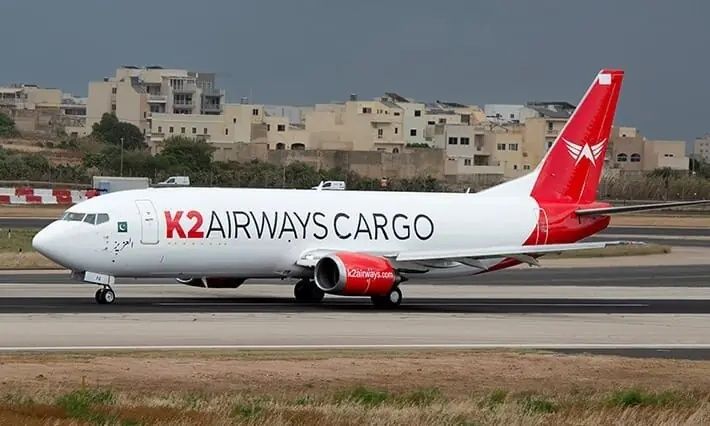
Pakistan is mobilising its navy, air force, and merchant vessels in a coordinated search operation for a K2 Airways Boeing 737-400 cargo aircraft that vanished over the Arabian Sea on Tuesday evening while approaching Karachi from the United Arab Emirates. Prime Minister Shehbaz Sharif has confirmed that the aircraft crashed into the sea, carrying five crew members aboard. The disappearance marks another aviation incident for a nation that has grappled with air safety challenges over the past decade, though this marks the first major incident involving the private carrier K2 Airways.
The aircraft was tracked by radar until contact was suddenly lost at approximately 21:21 Pakistan time, roughly 155 nautical miles west of Karachi. The Pakistan Airports Authority reported that in the final moments before communication ceased, the plane exhibited concerning flight behaviour, including rapid descent and abrupt changes in heading. The crew had previously reported a navigational system malfunction while the aircraft was in the approach phase to Karachi International Airport, indicating they were already troubleshooting technical difficulties when the situation deteriorated catastrophically.
Detailed flight data obtained from Flightradar24, a global flight-tracking service, paints a picture of escalating crisis in the cockpit. The preliminary telemetry shows a concerning sequence: the aircraft experienced a dramatic loss of altitude, managed to climb briefly, and then entered a second, even more severe descent that proved fatal. This pattern suggests the crew may have initially detected the problem and attempted corrective action before losing the battle against whatever mechanical or structural failure was occurring. The speed and severity of the final descent indicate an uncontrolled situation rather than a controlled emergency landing.
K2 Airways operates as a private cargo airline offering both scheduled and charter services across Pakistan and internationally. The company had presumably built its reputation through years of operations without major incident, making this disappearance particularly shocking to the aviation sector. The airline's role in Pakistan's logistics and trade networks means this loss will likely disrupt cargo operations serving businesses dependent on regional air freight connections.
The aircraft itself has a complex history that may be relevant to ongoing investigations. Built in 1999, the Boeing 737-400 originally served passengers with Aeroflot, the Russian national carrier, before being transferred to Garuda Indonesia. The plane underwent conversion to cargo configuration in 2012, a process that involves substantial structural modifications to remove passenger seating and install cargo loading systems. The age of the aircraft combined with its multiple ownership changes raises questions about maintenance records and whether all conversions adhered to international standards, though premature conclusions about causation would be inappropriate pending investigation.
Prime Minister Shehbaz Sharif has directed Pakistan's civil aviation authorities, navy, and air force to treat this as a maximum-effort operation, ordering all available resources be deployed in search and rescue activities. The government has extended condolences to the families of the five crew members who were aboard. Such statements from the highest political level underscore the gravity of the incident and signal that this will not be treated as routine administrative matter, but rather as a national crisis requiring senior government attention and resources.
The involvement of both military and civilian maritime assets reflects the scale of the search operation. Navy vessels, commercial merchant ships, and military aircraft are all participating in the effort to locate wreckage in the Arabian Sea, a vast body of water where recovering debris and determining precise crash locations presents formidable technical and logistical challenges. The depth of the water and ocean currents in the region where contact was lost complicate recovery efforts significantly.
This incident arrives during a period when Pakistan has been working to rehabilitate its aviation safety reputation internationally. The European Union had barred Pakistan's national carrier, Pakistan International Airlines, from European airspace for four years due to safety and licensing deficiencies. That ban was only lifted in 2024, suggesting the country had made measurable progress in addressing systemic safety concerns. However, the distinction between the national carrier and private operators like K2 Airways means this incident will not directly affect that hard-won clearance, though it will invite scrutiny of regulatory oversight across the Pakistani aviation sector.
The history of aviation disasters in Pakistan casts a shadow over this latest incident. The nation has experienced several catastrophic crashes over the past decade, with multiple incidents claiming large numbers of lives. Karachi, the destination airport in this case, has been the site of previous major aviation accidents, making this latest disappearance particularly resonant for a city already familiar with aircraft disasters. These historical incidents have contributed to Pakistan's reputation as a higher-risk aviation market, despite improvements in recent years.
Investigators will face significant challenges in determining root cause without access to the aircraft's flight data recorders and cockpit voice recorder, which remain submerged in the Arabian Sea. The sequence of events—navigational system problems followed by rapid altitude loss—suggests possibilities ranging from instrument failure cascading into spatial disorientation, to structural compromise, to pilot error under stressful conditions with degraded information. The technical investigation will require recovery of the black boxes, detailed examination of maintenance records, and reconstruction of the crew's actions during those final minutes.
The incident highlights ongoing vulnerabilities in Pakistan's aviation infrastructure and regulatory environment. While progress has been made, the system remains dependent on individual operators maintaining adequate safety standards, and the transition from passenger to cargo operations involves specialized technical requirements that not all operators may fully master. For Malaysian and Southeast Asian aviation industries, the incident serves as reminder that regional air safety requires constant vigilance and that even experienced operators can face catastrophic failures when systems fail and crews face unprecedented situations.

