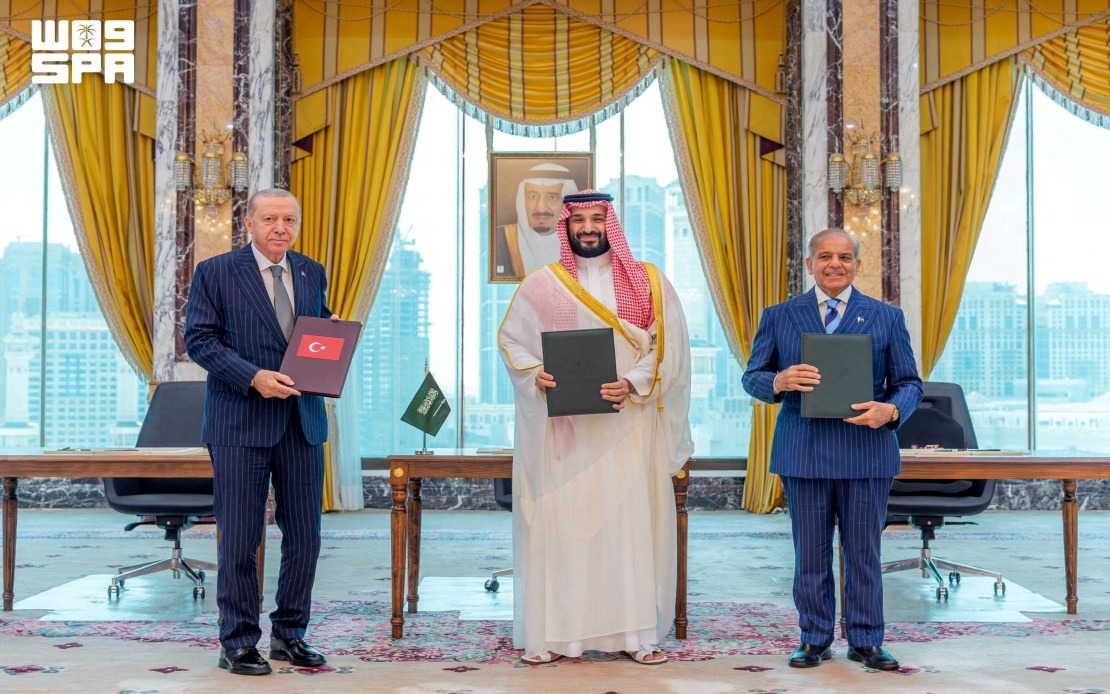
In a significant display of regional cohesion, the leaders of Pakistan, Saudi Arabia and Türkiye have committed to a binding collective defence arrangement, with the formal accord signed during a high-level summit in Makkah. The agreement, executed at Al Safa Palace on Friday, represents a major step towards institutionalising security cooperation among three nations that occupy critical geopolitical positions spanning South Asia, the Middle East and the Eastern Mediterranean.
The accord was signed by Saudi Crown Prince Mohammed bin Salman bin Abdulaziz Al Saud, Pakistan Prime Minister Shehbaz Sharif and Turkish President Recep Tayyip Erdogan following their deliberations at the palace. The three leaders framed their initiative as a mutual pledge grounded in shared values and regional aspirations, with the agreement explicitly stating that any armed attack against one signatory shall be treated as an attack upon all three, thereby creating a unified deterrent framework against potential external threats.
The pact encompasses considerably more than symbolic political alignment. According to official statements, the arrangement mandates comprehensive enhancement of defence cooperation across multiple dimensions, ranging from military coordination and strategic planning to operational integration and capability development. This architectural approach suggests the three nations envision a sophisticated defence arrangement capable of addressing evolving security challenges, rather than a purely declaratory gesture meant for symbolic purposes.
Regional analysts view the agreement through the lens of Pakistan's longstanding security partnerships, which have historically extended across both the Islamic world and strategic allies beyond it. Pakistan's nuclear weapons capability—placing it among the world's nine nuclear-armed nations—substantially elevates the significance of any mutual defence commitment, as such arrangements carry implications extending well beyond conventional military domains. The pact therefore represents not merely a bilateral or trilateral understanding but a development with potential ramifications for the broader strategic equilibrium across multiple regions.
The joint statement released following the summit emphasised the three countries' determination to advance collective security architecture while simultaneously promoting broader regional peace and stability. Language within the declaration carefully delineated the arrangement's ostensible defensive posture, describing it as aimed at strengthening deterrence capacity rather than projecting aggressive intent. The statement further underscored the signatories' commitment to fostering prosperity alongside security, suggesting the accord forms part of a wider vision encompassing economic cooperation and developmental initiatives.
Saudi Arabia's Deputy Public Diplomacy Minister Rayed Krimly subsequently elaborated on the agreement's operational dimensions in remarks disseminated through social media. Krimly characterised the pact as enabling the development of integrated defence capabilities, the fortification of strategic deterrence mechanisms, and the enhancement of operational readiness across the three nations. His comments additionally sought to preempt potential international criticism by explicitly stating that the arrangement neither imperils any other regional power nor constitutes an escalatory measure between existing state actors.
This diplomatic clarification merits consideration, given the sensitive geopolitical environment in which the agreement emerges. Multiple Middle Eastern states maintain complex relationships involving overlapping interests and occasional rivalries, and major powers with vested interests in regional affairs have expressed varying degrees of concern regarding trilateral defence arrangements that might alter the existing balance of power. By positioning the accord as defensive and non-threatening, the three nations appear conscious of potential backlash from parties who might interpret the arrangement as a challenge to their interests.
The current arrangement builds upon pre-existing bilateral defence relationships, most notably the Pakistan-Saudi Arabia defence agreement formalised in September of the preceding year. That earlier accord similarly obligated the two nations to render military assistance to one another in the event of external aggression, establishing a precedent for binding mutual defence commitments. The new trilateral framework essentially expands this bilateral structure to encompass Türkiye, creating a three-tiered security arrangement with potentially cumulative deterrent effects.
For Malaysian and Southeast Asian observers, the development carries several implications worth careful consideration. The arrangement demonstrates how middle powers within distinct regions increasingly pursue security cooperation frameworks that operate independently of traditional Cold War-era alignments. Such initiatives reflect the multipolar nature of contemporary international relations, where nations seek to construct customised security architectures responsive to their particular circumstances and threat perceptions. Additionally, the pact illustrates how nations across the Islamic world coordinate on security matters, potentially influencing regional dynamics that touch upon Southeast Asian interests, particularly given the interconnected nature of maritime security, terrorism financing and ideological movements.
The agreement also reflects each nation's distinct strategic calculus. For Pakistan, the arrangement reinforces security partnerships with wealthy and militarily capable allies whilst simultaneously strengthening ties to a Middle Eastern power that wields considerable influence within Islamic diplomatic circles. For Saudi Arabia, the pact represents an effort to deepen defence partnerships with non-Arab Islamic nations whilst managing regional security challenges independently of exclusive reliance on traditional Western security guarantors. For Türkiye, the arrangement positions it as a bridge between South Asian and Middle Eastern security architectures, potentially enhancing its regional influence and strategic flexibility.
The mechanism by which this trilateral arrangement operates remains partially undefined in publicly available statements, particularly regarding command structures, decision-making procedures and operational protocols. These implementation details typically receive elaboration through supplementary military agreements and technical discussions conducted away from public view, suggesting that the publicly signed accord represents merely the framework within which more granular cooperation will subsequently develop. Such technical elaboration often determines whether declaratory arrangements translate into substantive military capabilities or remain largely symbolic commitments.
Looking forward, the sustainability of this defence arrangement depends considerably upon the domestic political trajectories within each nation and their continued alignment on regional security priorities. Defence agreements historically prove resilient when underpinned by shared threat perceptions and compatible strategic interests, yet can face strain should underlying circumstances shift dramatically. The three nations' demonstrated commitment through high-level participation and formal documentation suggests serious intent, though the practical dividends of such cooperation will become evident only through continued implementation and periodic renewal of mutual security commitments over the coming years.

