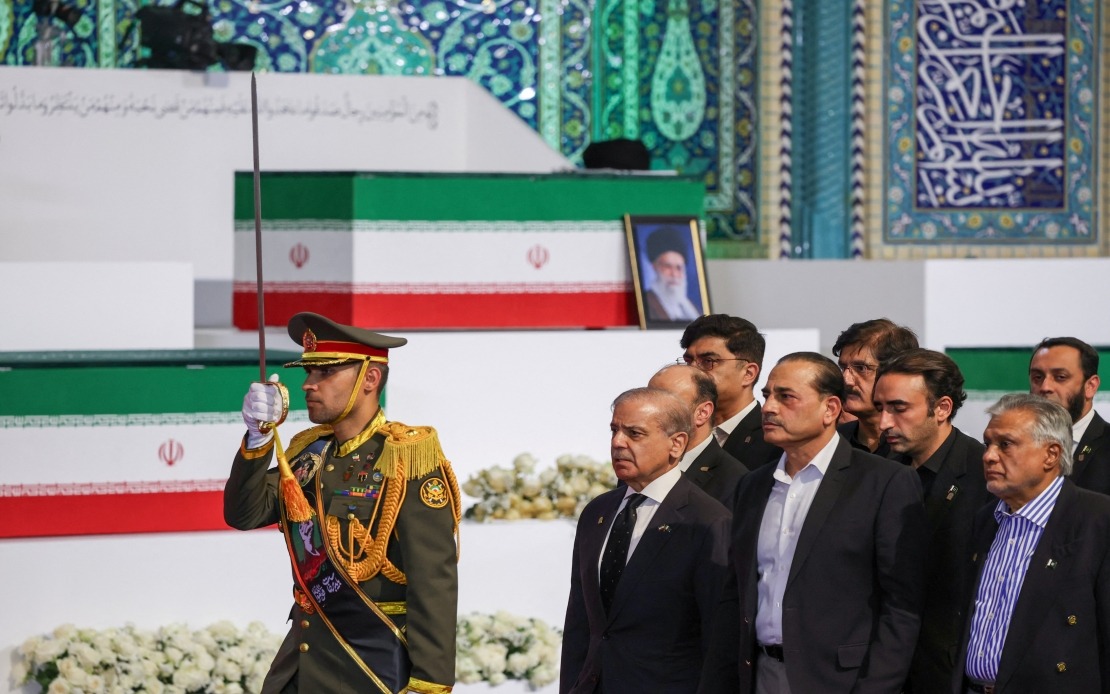
Pakistan's attendance at the funeral of Iran's Supreme Leader Ayatollah Ali Khamenei represents a significant diplomatic moment for the two neighbouring nations, with Tehran acknowledging the gesture as evidence of enduring friendship. The solemn ceremony in the Iranian capital on July 5 drew dignitaries from approximately 100 countries across multiple continents, yet Pakistan's delegation stood out both in size and seniority, underscoring Islamabad's commitment to honouring the relationship with its western neighbour.
The Pakistani contingent was led by Prime Minister Shehbaz Sharif, accompanied by some of the nation's most senior figures. Deputy Prime Minister and Foreign Minister Ishaq Dar attended alongside Chief of Army Staff Field Marshal Syed Asim Munir, signalling the participation of Pakistan's military establishment. The delegation further included Pakistan People's Party chairman Bilawal Bhutto Zardari, National Assembly Speaker Sardar Ayaz Sadiq, Interior Minister Mohsin Naqvi and Information Minister Attaullah Tarar, reflecting representation from both civilian government and opposition political circles.
Iran's Ambassador to Islamabad, Reza Amiri Moghadam, publicly praised Pakistan's participation, describing it as occurring "at the highest possible level" and noting that the Pakistani delegation was the largest representing any single country at the funeral proceedings. This distinction carries symbolic weight in diplomatic circles, where the composition and scale of funeral delegations often reflect bilateral relationships and geopolitical alignment. The ambassador's emphasis on Pakistan fielding the largest contingent suggests Tehran views the attendance as particularly meaningful.
Moghadam's statement on social media platform X framed Pakistan's presence as testimony to "enduring friendship, mutual respect, and fraternal bonds between our two brotherly nations." The carefully chosen language reflects official Iranian rhetoric regarding its relationship with Pakistan, a connection that spans decades of shared history, geography, and strategic considerations. The ambassador further characterised the gesture as "meaningful and historical," suggesting that Iran interprets Pakistan's delegation as more than mere protocol observance.
Khamenei, who served as Iran's Supreme Leader from 1989 until his death at age 86, was killed in what Tehran attributed to a United States-Israeli attack on his compound in the Iranian capital on February 28. The attack also claimed the lives of several family members, making the funeral a moment of significant national mourning for Iran. His death represented a major transition point for Iranian political leadership and regional strategy, prompting the extensive international attendance and ceremonial arrangements.
Prime Minister Shehbaz Sharif's remarks at the ceremony reflected diplomatic formality coupled with substantive acknowledgement. He stated that Khamenei's "wisdom, leadership and profound influence on Iran and the wider region will be remembered for generations," language that emphasises both the individual's stature and his impact on regional geopolitics. Such statements carry importance for domestic Pakistani audiences as well, demonstrating government recognition of Iran's regional significance.
The funeral ceremonies themselves extended over multiple days, with public proceedings beginning on Saturday and burial scheduled for July 9 in Mashhad, the city where Khamenei was born. This timeline allowed for extensive international participation and reflected the significance attached to honouring Iran's supreme leader. The flag-draped coffins of Khamenei and family members were displayed on stage during ceremonies, a formal arrangement befitting a state funeral of international prominence.
For Malaysian and Southeast Asian observers, Pakistan's prominent role at the funeral illustrates the complex regional dynamics of South and West Asia. Malaysia itself sent a delegation, joining nations including Bangladesh, Saudi Arabia, Turkiye, Qatar, Oman, Egypt, Russia, Iraq, China and India in paying respects. This broad international participation underscores Khamenei's significance as a figure whose death carried implications beyond Iran's borders, affecting regional power balances and diplomatic relationships.
Pakistan's substantial delegation carries particular weight given the two nations' shared border and history of both cooperation and tension. The decision to send multiple senior figures, including military leadership, indicates that Islamabad views the funeral as an opportunity to reaffirm strategic partnership during a period of potential uncertainty in Iran following leadership transition. Such gestures can influence longer-term bilateral relations, trade arrangements, and regional security cooperation.
The Iranian government's public recognition of Pakistan's delegation size and seniority suggests an appreciation for the political message conveyed. Diplomatic protocol often involves careful calculation of which nations receive particular acknowledgement, and the ambassador's specific mention of Pakistan fielding the largest delegation indicates deliberate Iranian effort to highlight this relationship. For analysts of South Asian geopolitics, this exchange represents one data point in understanding how neighbouring states navigate major transitions in regional powers' internal political structures.
For Pakistan, demonstrating solidarity with Iran during a moment of national mourning may yield diplomatic dividends in subsequent months and years. The attendance signals continuity in bilateral relations despite historical tensions and differing approaches to regional issues. Such gestures, particularly when involving military leadership and multiple cabinet-level figures, communicate commitment to maintaining stable relations with a significant neighbouring state.
The broader context of international attendance at the funeral demonstrates how leaders and nations mark significant transitions in major regional powers. The presence of delegations from Russia, China, India and multiple Middle Eastern nations alongside Pakistan and Malaysian representatives illustrates the global dimensions of Iran's strategic position. For Southeast Asian nations like Malaysia, such international moments provide opportunities to maintain diplomatic presence and acknowledge the significance of major global actors' internal developments.

