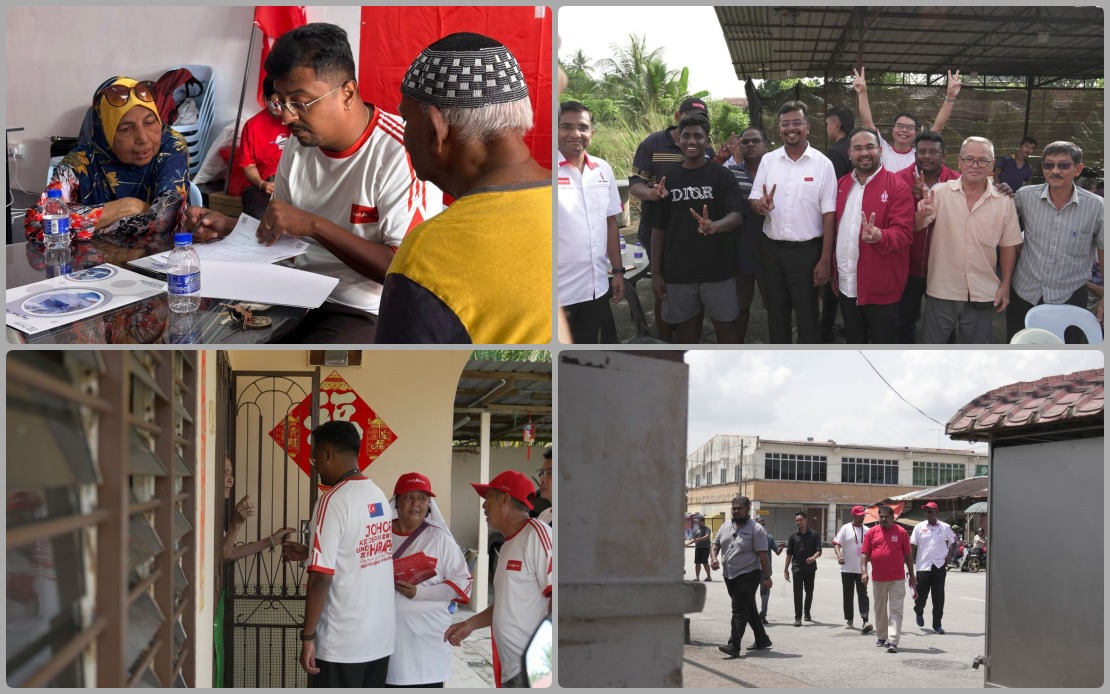
Dr. A. Ruban, the Pakatan Harapan candidate contesting the Paloh state assembly seat in Johor, was admitted to a hospital in Batu Pahat on July 7 after experiencing acute spinal complications. The PH campaign machinery confirmed that the hospitalisation stemmed from a recurrence of pre-existing back problems, exacerbated by the demanding schedule of the ongoing state election campaign.
According to Abdul Majid Abd Aziz, Dr. Ruban's campaign manager, the candidate had been managing chronic spinal issues and had previously undergone surgical intervention for the condition. The pain that forced his hospitalisation emerged suddenly on the morning of his admission, severely restricting his movement and forcing medical intervention. Medical professionals attributed the flare-up to accumulated physical strain, with the intensive ground-level campaigning over several days likely contributing to the deterioration of his condition.
The timing of Dr. Ruban's hospitalisation comes at a crucial juncture, with Johor voters set to cast their ballots on July 11 for the 16th state election cycle. Early voting had already commenced on July 7, making the remaining campaign period exceptionally tight. Nevertheless, Abdul Majid stated that Dr. Ruban's medical team assessed his condition as non-critical, with discharge anticipated within one or two days, potentially allowing him to resume some campaigning activities before the election.
The Paloh constituency presents a complex four-way contest that underscores the fractious nature of contemporary Malaysian state politics. Competing alongside Dr. Ruban are D. Jeevakumar representing Perikatan Nasional, independent candidate G. Kamaleswaren, and the incumbent Lee Ting Han from Barisan Nasional. This multiplicity of candidates reflects the broader fragmentation of the political landscape in Johor and across Malaysia more broadly, where traditional two-coalition contests have increasingly given way to multipolar configurations.
Despite Dr. Ruban's forced withdrawal from active campaigning, his team expressed determination to maintain momentum on the ground. Abdul Majid emphasised that PH's organisational structures in Paloh would sustain engagement with constituents through alternative mechanisms, ensuring that the party's policy platform and campaign messaging continued reaching voters. This contingency approach reflects standard practice among Malaysian political organisations when candidates face temporary incapacitation.
The incident highlights an under-examined dimension of election campaigns in Malaysia—the physical toll of intensive political work on candidates, particularly those conducting extensive walkabouts and ground engagement. Campaign schedules in state and federal contests routinely demand exhausting itineraries, with candidates traversing constituencies across multiple days to maximise voter contact and media visibility. For candidates with pre-existing health conditions, such exertion can precipitate medical crises.
Johor's electoral significance extends beyond the state itself, as outcomes often foreshadow shifts in broader national political alignments. As a key Barisan Nasional stronghold historically, the state has witnessed increasing competition from Pakatan Harapan and Perikatan Nasional, making constituencies like Paloh bellwethers of evolving voter preferences. The contest reflects the three-way competition now characterising Malaysian politics, with traditional BN support being contested by rival coalitions with fundamentally different policy architectures and political philosophies.
The Paloh race exemplifies this triangular dynamic. Barisan Nasional's incumbency advantage, symbolised by Lee Ting Han's continued candidacy, faces challenge from both PH's reformist positioning and PN's Malay-Islamist orientation, alongside an independent candidate potentially fragmenting votes further. Such configurations have proven unpredictable, occasionally producing surprises that defy historical voting patterns and party strongholds.
For PH specifically, Dr. Ruban's temporary absence tests the cohesion and depth of its campaign infrastructure in Johor. Successful transitions in candidate campaigning require well-developed party mechanisms capable of maintaining organisational momentum without individual personalities. The party's response to this situation will provide insight into institutional maturity and operational resilience within its Johor apparatus.
The timing of the hospitalisation also intersects with the physical and emotional demands placed on political candidates generally. Beyond policy formulation and constituency service, modern campaigns require candidates to function as multi-platform communicators, fund-raisers, and organisers—roles that compound conventional campaigning exertions. The Paloh incident underscores how medical crises, though individually circumscribed, acquire broader political significance during election periods, potentially influencing outcomes in tight contests.
Looking forward, the immediate question concerns Dr. Ruban's fitness to campaign meaningfully in the remaining days before July 11. His team's confidence in a swift recovery suggests internal optimism, though uncertainty persists regarding his physical capacity to resume intensive ground work. The outcome of the Paloh contest may ultimately hinge partly on whether Dr. Ruban achieves sufficient recovery to mount an effective final campaign push, illustrating how contingent factors beyond policy platforms can shape electoral results in contemporary Malaysia.

