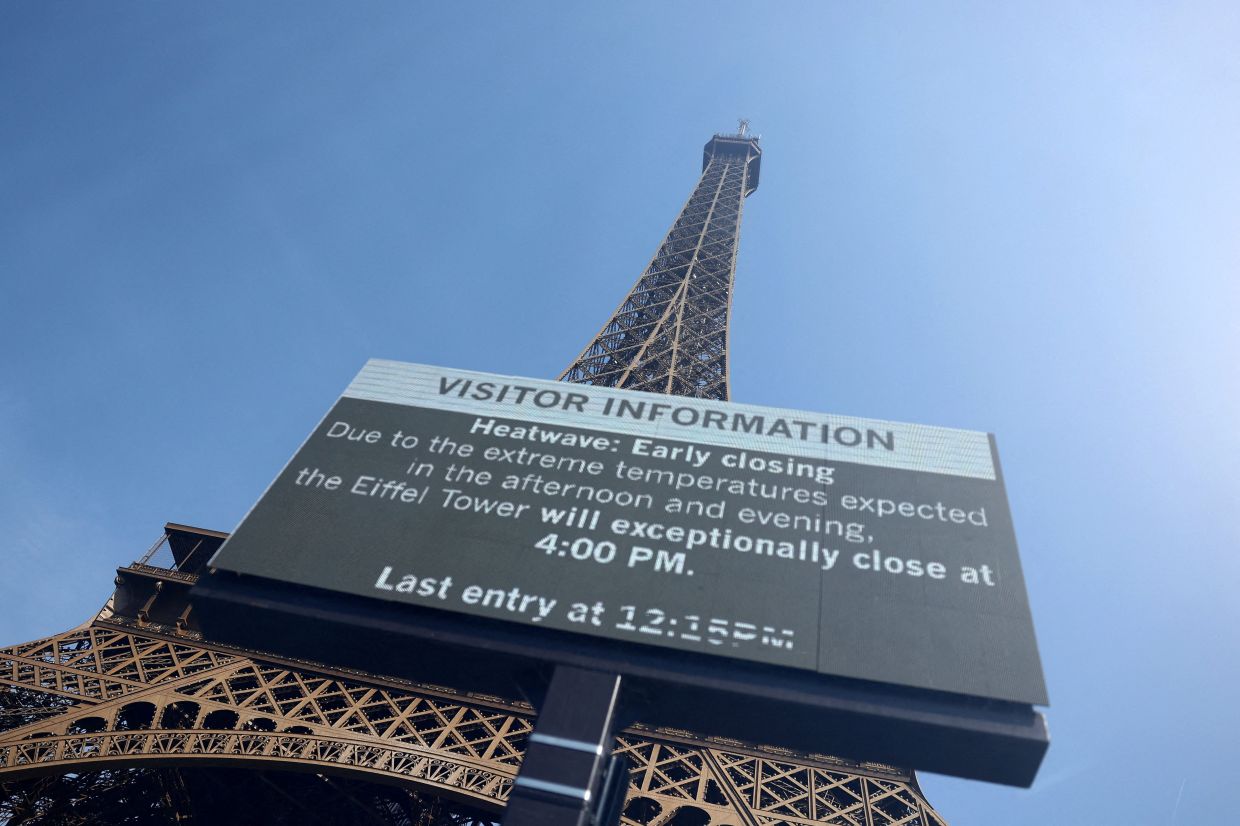
Record-breaking heat gripping France this week has dealt a significant blow to Paris tourism, forcing some of the world's most iconic attractions to shutter their doors earlier than scheduled and leaving thousands of international visitors stranded in sweltering conditions with limited access to the cultural treasures they travelled thousands of kilometres to experience. The severity of the situation highlights not only the immediate disruption caused by extreme weather events, but also raises uncomfortable questions about climate adaptation in heritage sites across Europe that are now buckling under environmental pressures.
On June 23, France recorded its hottest day since temperature measurements began in 1947, a milestone that prompted the Eiffel Tower to announce an exceptional early closure at 4pm instead of its usual midnight or later schedule during peak tourist season. The 324-metre iron monument, which welcomes roughly seven million visitors annually and typically operates well into the evening throughout summer months, found itself unable to manage visitor flow and safety concerns under the intense heat. The tower's operator indicated that shortened opening hours would "very likely" become the pattern for subsequent days, casting uncertainty over the holiday plans of travellers who had booked visits in advance.
Spanish nurse Maite Blazques exemplified the frustration of countless tourists whose carefully planned itineraries unravelled within days of arrival. The 35-year-old from Madrid had spent months saving to bring her six-year-old son to experience Paris, yet the extreme temperatures forced her to completely reorganise their holiday, abandoning visits to signature attractions. "We had to change our whole trip," she explained, her disappointment evident as she held her son's hand. The family would forgo the guided exploration of the historic Marais district, cancel their planned river cruise along the Seine, and abandon their plans to ascend the Eiffel Tower—activities that typically anchor a Parisian holiday for international families.
American tourist Tamara Dancer suffered a more immediate blow when her scheduled guided tour was abruptly cancelled on Tuesday afternoon, destroying weeks of anticipation and advance booking. Similar cancellations cascaded through the tourism industry as operators prioritised visitor safety over commercial obligations, a decision that left holidaymakers feeling their vacation had been fundamentally compromised. The cumulative effect of such disruptions ripples through the entire travel experience, transforming what should be a cherished memory into a chronicle of disappointment and logistical improvisation.
For those managing to remain outdoors, conditions bordered on unbearable. Tourists equipped themselves with umbrellas, wide-brimmed hats, and portable fans in futile attempts to shield themselves from pavements and streets radiating intense heat. American engineer John Beeler, 45, articulated the physical toll with stark candour: "Visiting Paris in this heat is awful." He and his wife found themselves suffocating not only on crowded streets but also in the Paris Metro and even within their rental accommodation, eventually relocating to an air-conditioned hotel room to achieve basic comfort. Such measures, while providing temporary relief, underscore how extreme heat fundamentally compromises the outdoor exploration that defines the Paris tourist experience.
Drake Winners, a 66-year-old retiree from London, captured perhaps the most poignant aspect of the crisis: "You discover Paris by walking, but in this heat, it's impossible." The leisurely pedestrian exploration that allows visitors to stumble upon hidden quarters, appreciate architectural details, and absorb the city's character becomes physically untenable when temperatures soar to record levels. Instead, Winners and many others retreated into air-conditioned museums and religious buildings, transforming what should be a fluid, organic exploration of the city into a series of climate-controlled refuges where tourists merely pass through rather than engage meaningfully.
The Louvre Museum, which attracts approximately nine million visitors annually and houses priceless works including Leonardo da Vinci's masterpieces, implemented its own restrictions. Museum management acknowledged that the institution, a vast palace constructed across centuries by successive French monarchs and presidents, was "not sufficiently adapted to climate change." This admission carries particular weight coming from one of the world's most prestigious cultural institutions, suggesting that Europe's heritage infrastructure may be fundamentally unprepared for the intensifying climate challenges of the coming decades. The Louvre's vulnerability is compounded by recent operational difficulties including a brazen US$100 million jewellery heist, water leakage problems, and ongoing maintenance crises that have already stretched institutional resources.
The disruptions extend far beyond Paris itself. More than half of mainland France remained under the national weather service's highest alert level, prompting tourist sites across the country to announce early closures or issue cautionary guidance. Mont Saint-Michel, the spectacular island fortress in Normandy and one of France's most visited attractions outside the capital region, explicitly urged visitors to "put off your visit during the red alert." Such coordinated warnings represent an unprecedented scenario in which France's entire tourism infrastructure has effectively advised international travellers to stay away, a stark indicator of the crisis's magnitude.
The situation carries particular relevance for Southeast Asian travellers and tourism operators. Malaysia and the region have experienced intensifying heat and climate variability in recent years, and the Paris crisis serves as an early warning about the vulnerabilities of major tourism destinations in our own hemisphere. As global temperatures continue rising, heritage sites across Asia—from Angkor Wat to Borobudur to the temples of Southeast Asia—may face similar pressures requiring substantial adaptation investments. The Paris experience demonstrates that even wealthy, well-resourced European nations struggle to manage extreme heat's impact on tourism infrastructure, raising questions about how developing countries will cope with similar challenges while maintaining economic viability.
Beyond immediate economic losses to the tourism sector, the Paris heatwave illustrates a fundamental tension between climate change and cultural preservation. Iconic monuments that have endured centuries of history now face existential threats from environmental shifts occurring over mere decades. The Eiffel Tower's early closures and the Louvre's admission of inadequate climate adaptation suggest that substantial capital investments will be required to protect Europe's cultural heritage. For tourism-dependent economies globally, the message is clear: climate adaptation is no longer a peripheral concern but a central business requirement that will determine competitiveness and relevance in coming years.

