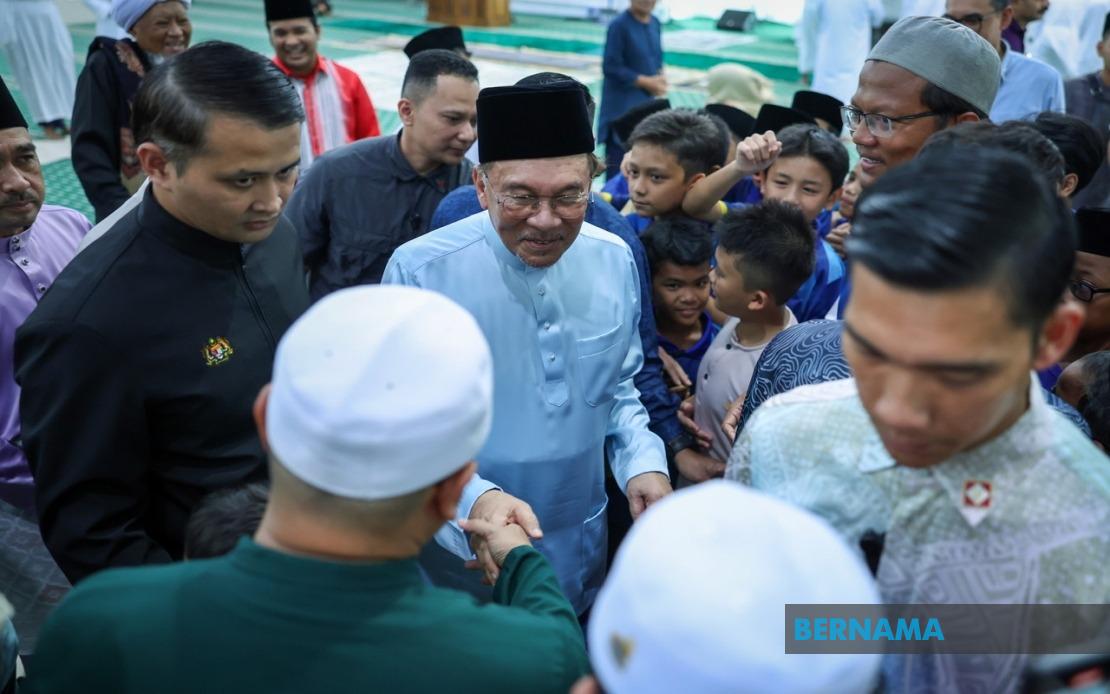
Prime Minister Datuk Seri Anwar Ibrahim has drawn a clear distinction between parliamentary constituency allocations and the personal entitlements of elected representatives, asserting that such funds exist primarily to serve the broader population rather than individual Members of Parliament. Speaking after Friday prayers at Masjid Ar-Rasyidin in Alor Gajah on August 7, Anwar emphasised that the principle underpinning government resource distribution to constituencies centres on improving the material conditions and public infrastructure that benefit residents as a collective group.
The Prime Minister explained that parliamentary allocations should finance concrete improvements to constituency infrastructure and amenities. These designated funds, he elaborated, ought to address genuine community needs such as educational facilities, religious institutions, drainage systems, and other essential infrastructure projects. By framing allocations this way, Anwar positioned government spending as a mechanism for delivering tangible service improvements rather than as discretionary funds subject to MP control or preference.
Anwar's comments emerged in response to complaints from several opposition-aligned Members of Parliament who have claimed the government has reduced or suspended their constituency funding. By clarifying that allocations flow to constituents rather than to MPs themselves, the Prime Minister appeared to justify any differential treatment of opposition lawmakers while maintaining that ordinary citizens in their constituencies would not suffer reduced government services. This distinction proves crucial for understanding the political dynamics at play, particularly in Malaysia's current parliamentary landscape where coalition stability remains fragile.
The government's position reflects a longstanding policy framework that predates the current administration, according to Anwar. He noted that Members of Parliament who previously served in government would understand this principle, implying that the current approach represents continuity rather than innovation. This framing allows the government to present the policy as standard practice rather than as a novel political tool, lending it greater legitimacy within parliamentary tradition and administrative custom.
Regarding the implementation of this principle, Anwar stated explicitly that when opposition MPs represent constituencies, the government will channel constituency funds directly to the people through appropriate channels rather than through those MPs' offices. This direct transfer mechanism ensures resources reach beneficiary communities despite potential political differences between the incumbent government and local representatives. Such an approach effectively circumvents potential obstruction or misuse of funds while maintaining the government's commitment to providing resources to all constituencies.
The Melaka setting for Anwar's remarks carried subtle significance, with the Prime Minister flanked by Minister in the Prime Minister's Department (Religious Affairs) Senator Dr Zulkifli Hasan and Melaka Police chief Datuk Dzulkhairi Mukhtar. This official configuration emphasised the gravity and formal nature of the clarification, positioning it as government policy rather than casual commentary. The presence of religious affairs leadership underscored that religious institutions, often significant within constituency allocation frameworks, would continue receiving appropriate support.
The controversy surrounding constituency allocations reflects broader tensions within Malaysia's governing structures regarding resource distribution and political patronage. Opposition Members of Parliament have increasingly voiced concerns that they face financial disadvantage when their parties stand outside the ruling coalition. From the government's perspective, however, the allocation methodology serves to ensure that partisan considerations do not override the primary objective of delivering services to constituents who did not necessarily vote for the incumbent administration.
Beyond parliamentary funding matters, Anwar also addressed personnel changes within his party. He confirmed that PKR deputy president Nurul Izzah, his daughter, had requested to temporarily step down from her formal position to pursue other commitments. Rather than characterising this as a loss to the party, Anwar framed it as a temporary arrangement allowing Izzah to focus on a special programme elsewhere while maintaining her broader party involvement. This language choice suggested the transition was orderly and consensual rather than indicative of deeper party tensions or personal difficulties.
The relationship between Anwar and his daughter within party structures has occasionally attracted media attention, and his clarification that she remains active despite stepping back from formal duties appeared designed to preempt speculation about her political future or standing within PKR. By emphasising continuity and her ongoing commitment despite reduced formal responsibilities, Anwar addressed potential concerns about dynastic politics or questions regarding her staying power in senior party roles.
For Malaysian constituents, particularly those represented by opposition MPs, Anwar's clarification carries practical implications regarding the availability and delivery of government services. If implemented consistently, the policy ensures that ideological or partisan differences between constituents and their representatives should not translate into reduced access to government-funded improvements and facilities. However, the mechanism for direct resource transfer to communities represented by opposition MPs remains a matter requiring transparent implementation and monitoring to ensure equitable distribution.
The policy statement also reflects the Malaysian government's attempt to distinguish between political competition and administrative fairness. While the ruling coalition naturally possesses advantages in directing resources, maintaining the principle that all constituents deserve adequate government support—regardless of their MP's political affiliation—represents an important safeguard against weaponisation of state resources. This approach, if genuinely implemented, could help preserve public confidence in the impartiality of government service delivery mechanisms.
Moving forward, the effectiveness of Anwar's clarification will depend on consistent implementation across constituencies and transparent accounting of how allocations are distributed and utilised. For opposition-represented constituencies, ensuring direct transfer of funds without requiring opposition MP intermediation becomes critical. Meanwhile, government MPs will need to operate within frameworks that prioritise genuine community benefit over personal political advantage, a transition that may prove culturally challenging within Malaysia's established political economy.

