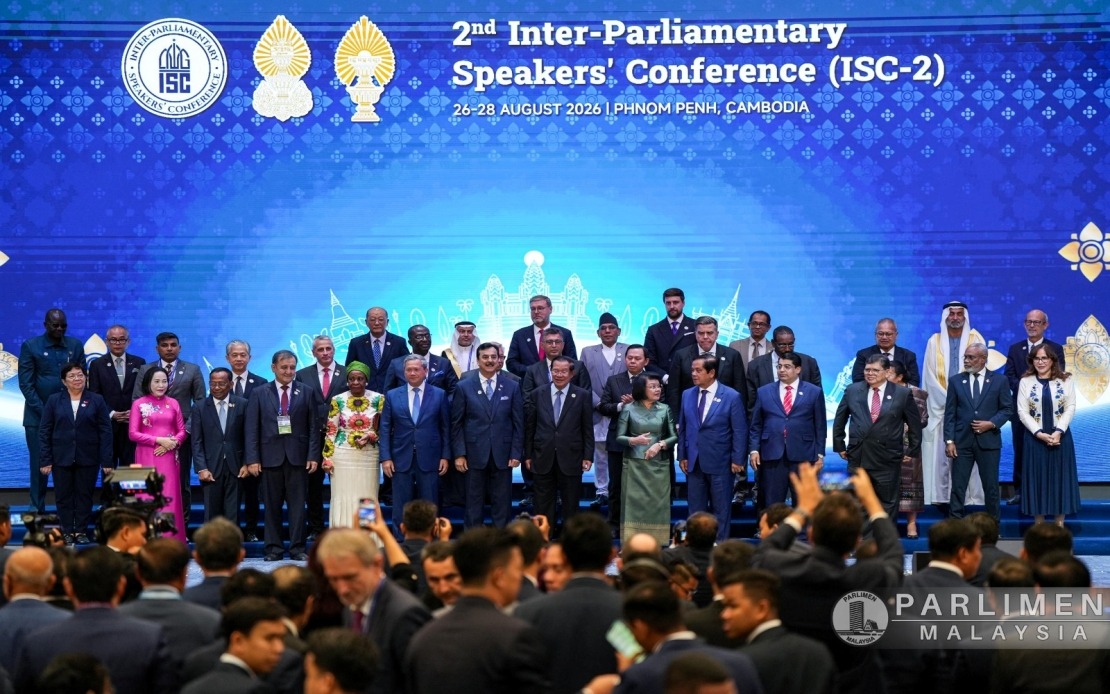
Tan Sri Dr Johari Abdul, Speaker of the Dewan Rakyat, has underscored the critical importance of legislative bodies engaging directly in resolving international conflicts and addressing geopolitical challenges, arguing that such matters should not remain the exclusive domain of executive governments. Speaking in Phnom Penh during the Second Inter-Parliamentary Speakers' Conference last week, Johari articulated a vision in which parliaments function as co-equal partners with government branches in tackling issues of peace and international security.
The conference, hosted jointly by Cambodia's National Assembly and Senate from August 26 to 28, brought together legislative leaders from across the globe to discuss conflict resolution and international law under the overarching theme of solidarity for peace and shared prosperity. Johari's participation reflected Malaysia's commitment to advancing parliamentary diplomacy as a mechanism for managing tensions that increasingly strain international relations. His intervention highlighted a growing recognition within Southeast Asia that legislative engagement can complement—and in some instances enhance—diplomatic efforts conducted through traditional government channels.
The Malaysian speaker contended that the separation of powers between executive and legislative branches creates a structural advantage when navigating complex international disputes. Where executives might approach contentious issues through the lens of immediate political calculation or strategic interest, legislatures often possess a broader, more comprehensive understanding rooted in direct constituent concerns. This complementarity, Johari suggested, strengthens the overall quality of responses to global challenges. By channelling parliamentary input into international negotiations, nations can ensure that diplomatic solutions reflect not merely governmental preferences but also the lived experiences and priorities of ordinary citizens affected by conflict and tension.
Johari specifically emphasized how parliamentary diplomacy maintains communication channels during periods when official government-to-government relations deteriorate or become formally suspended. When formal diplomatic relations cool or break down, parliamentary exchanges and cross-legislative engagement create alternative pathways for dialogue. These informal institutional connections allow disparate nations to continue conversations and explore common ground even when bilateral relations are strained. The existence of such channels reduces the risk of complete isolation and miscalculation, creating space for de-escalation before disputes harden into intractable conflicts.
The human dimensions of contemporary conflict shaped Johari's argument significantly. Rather than treating international disputes as abstract geopolitical games, he emphasized that wars and tensions produce tangible suffering: families torn apart by displacement, children denied education, and communities fractured by violence. Parliamentary involvement ensures that these human costs receive adequate attention in international deliberations. Legislatures, being closer to constituents than executive branches, naturally incorporate these humanitarian concerns into their advocacy positions, thereby enriching the moral and ethical dimensions of peace-making efforts.
Johari anchored Malaysia's position in established principles of international law and Southeast Asian norms. He stressed that enduring peace must be constructed on foundations of respect for national sovereignty, territorial integrity, adherence to international legal frameworks, and commitment to peaceful dispute resolution. For Malaysia and its neighbours, these principles carry particular weight given ASEAN's foundational commitment to dialogue, consultation and non-interference in internal affairs. The Association, established decades ago, has consistently channelled regional disputes through collective discussion rather than military confrontation. Parliamentary bodies, Johari argued, can reinforce this diplomatic culture by strengthening mutual understanding among peoples and encouraging solutions grounded in law and mutual respect rather than coercion.
The Malaysian speaker signalled specific relevance to the Southeast Asian context, where rising geopolitical competition between major powers has created new pressures on regional stability. ASEAN must remain the primary institution through which regional differences are managed and resolved, he suggested. Member parliaments can play a supporting role by fostering people-to-people understanding, building trust between institutions across borders, and promoting the principle that disagreement need not inevitably cascade into confrontation. This approach reflects Malaysia's preference for consensus-building and dialogue-based solutions characteristic of ASEAN's diplomatic tradition.
Johari's remarks arrived amid broader institutional evolution within the inter-parliamentary movement. The Second Inter-Parliamentary Speakers' Conference itself represents a relatively recent innovation in global governance architecture. Pakistan hosted the inaugural conference in 2025, establishing this biennial gathering as a permanent forum for legislative leadership. The decision to hold the third iteration in Indonesia next year demonstrates the institution's expansion and growing perceived importance within Southeast Asia specifically. By rotating hosting duties among regional nations, the conference embeds parliamentary diplomacy deeper within Asian institutional practice.
The timing of these assertions matters considerably for Malaysia and the broader region. Geopolitical tensions between major powers have intensified, with competition over strategic territories, technological dominance and ideological influence affecting smaller nations. Climate-related crises, migration pressures and transnational security challenges demand responses transcending traditional bilateral diplomacy. Parliamentary engagement creates multiple communication nodes and decision-making forums, distributing diplomatic effort across numerous institutional actors. This distributional approach reduces dependence on bilateral government relations alone and creates redundancy in communication systems, making regional relations more resilient and less prone to catastrophic breakdown.
For Malaysian policymakers and citizens, Johari's advocacy reflects an understanding that Malaysia's security and prosperity depend partly on the quality of regional governance architecture. By promoting robust parliamentary exchange and legislative engagement in peace-making efforts, Malaysia positions itself as committed to institutional solutions and rule-based approaches to international relations. This stance aligns with Malaysia's historical preference for multilateral frameworks and ASEAN-centred regionalism over unilateral or confrontational postures. It also suggests that Malaysian domestic political institutions have expanded roles to play in shaping regional outcomes, moving beyond purely internal governance toward participation in international peace-building.
The emphasis on parliamentary diplomacy also carries implications for how Malaysia approaches its own internal governance. If legislatures are to function effectively in international peace-making roles, they must themselves maintain robust democratic vitality, independence from executive domination, and credibility with constituent publics. Johari's international advocacy thus reinforces arguments for strengthening parliamentary institutions domestically, ensuring they remain effective forums for deliberation and repositories of public trust.
Moving forward, the Inter-Parliamentary Speakers' Conference model may expand as a venue for addressing climate challenges, economic cooperation and transnational governance issues alongside traditional conflict resolution. Malaysia's active participation signals commitment to this institutional evolution and suggests willingness to share regional leadership in promoting dialogue-based solutions to complex global problems. The framework Johari articulated—treating parliaments as legitimate actors in peace-building rather than observers of executive diplomacy—potentially reshapes how Southeast Asia approaches its internal relations and international positioning.

