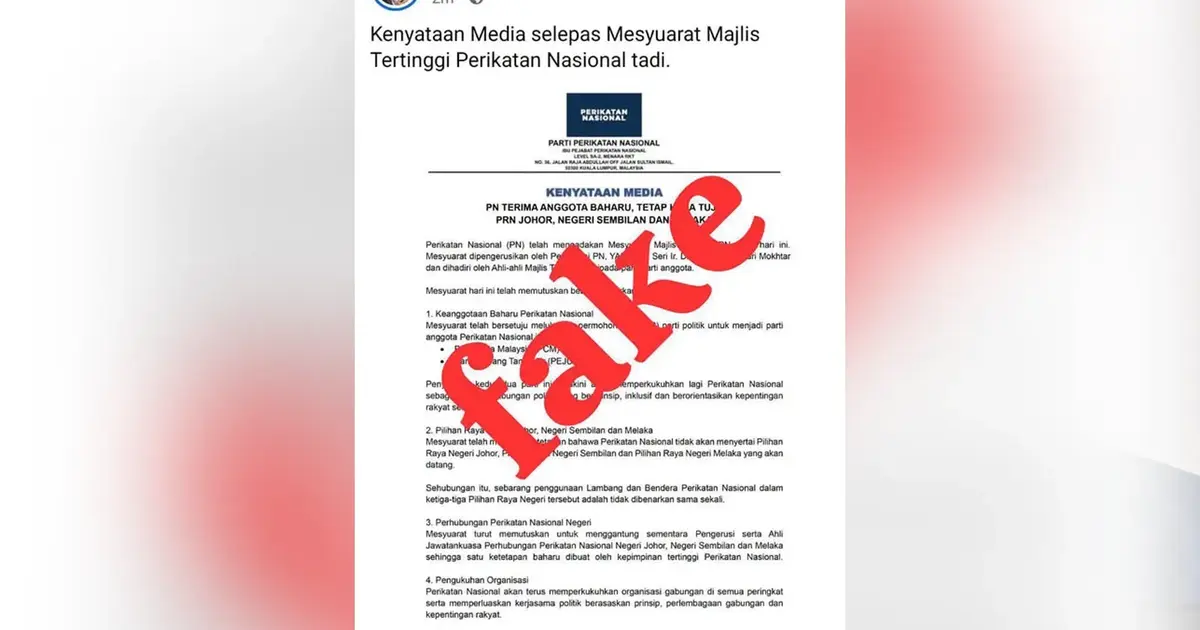
Perikatan Nasional has moved swiftly to repudiate a circulating statement that portrayed the PAS-led opposition coalition as planning to withdraw from contesting three state-level polls, insisting the assertion is entirely without foundation and misleading to the Malaysian electorate.
The coalition's firm denial underscores growing scrutiny of misinformation in Malaysia's political landscape, particularly as the nation approaches several crucial electoral contests at the state level. In recent years, false narratives about party strategies and electoral positioning have repeatedly surfaced across social media and informal channels, complicating the task of voters seeking reliable information about coalition intentions and campaign approaches.
Peikatan Nasional, which consolidated its position as the primary parliamentary opposition following the 2022 general election, has become an increasingly prominent target for misleading claims. The coalition, anchored by the Islamist PAS party alongside several other component groups, commands significant support across multiple states and has demonstrated considerable appetite for electoral competition at all levels of government. Any suggestion that the bloc would voluntarily sideline itself from state contests contradicts its demonstrated track record of fielding candidates aggressively across different electoral arenas.
The timing of such a false assertion carries particular weight given the fluid nature of Malaysia's political alignments in recent years. The country has witnessed repeated realignments, coalition shifts, and strategic repositioning by major political blocs as parties navigate complex federal and state-level dynamics. In this environment of instability and changing partnerships, accurate information about which coalitions intend to contest which elections becomes genuinely important for voters attempting to understand their genuine electoral choices.
Malaysia's experience with electoral manipulation and misinformation has prompted concerns among civil society groups and political analysts about the integrity of public discourse surrounding polling events. The proliferation of false statements—whether originating from fringe accounts, rival political operatives, or simply spreading through networks of credulous sharers—creates a challenging information ecosystem where distinguishing fact from fabrication demands sustained attention and critical engagement from media consumers.
For Perikatan Nasional specifically, the challenge of combating false narratives is compounded by its position as an opposition force not controlling mainstream media resources available to the ruling coalition. This structural disadvantage means the bloc must respond reactively to misleading claims rather than proactively shaping the informational environment around its electoral strategy. The coalition's decision to issue a direct denial reflects recognition that allowing such assertions to circulate unchallenged risks undermining its credibility with voters across multiple states.
The disputed statement's targeting of three specific state elections suggests deliberate effort to strategically damage Perikatan Nasional's positioning ahead of potential polling at the state level. Malaysia maintains a complex federal system in which state governments hold considerable autonomous power over local development, resource allocation, and policy priorities. Control of multiple state governments can meaningfully amplify a coalition's overall political influence and provide platforms for demonstrating governance capability ahead of the subsequent federal contest.
Experts monitoring Malaysian political developments have noted that increasingly sophisticated disinformation campaigns have become standard features of the country's competitive landscape. Sophisticated operators craft false narratives designed to exploit existing partisan divisions, confuse voters about coalition strategies, and generally degrade public confidence in electoral processes and political institutions. The circulation of a fake statement about Perikatan Nasional's electoral intentions fits precisely within this troubling pattern.
The coalition's rapid and emphatic response demonstrates awareness that modern politics demands swift refutation of false claims before misleading narratives can entrench themselves within broader public consciousness. Allowing erroneous statements to persist risks their gradual normalization, particularly among segments of the electorate that encounter them through informal networks rather than official sources. By explicitly characterizing the assertion as inaccurate, Perikatan Nasional aims to inoculate its reputation and prevent the false narrative from achieving wider currency.
Moving forward, the incident illustrates the broader challenge confronting Malaysian democracy: ensuring that citizens can access reliable information about political actors' actual intentions and positions. Whether through social media literacy initiatives, journalist training in verification techniques, or platform accountability measures, addressing misinformation remains essential for maintaining the integrity of electoral competition and public discourse. Both voters and political parties have stakes in establishing information environments where falsehood can be reliably distinguished from truth.