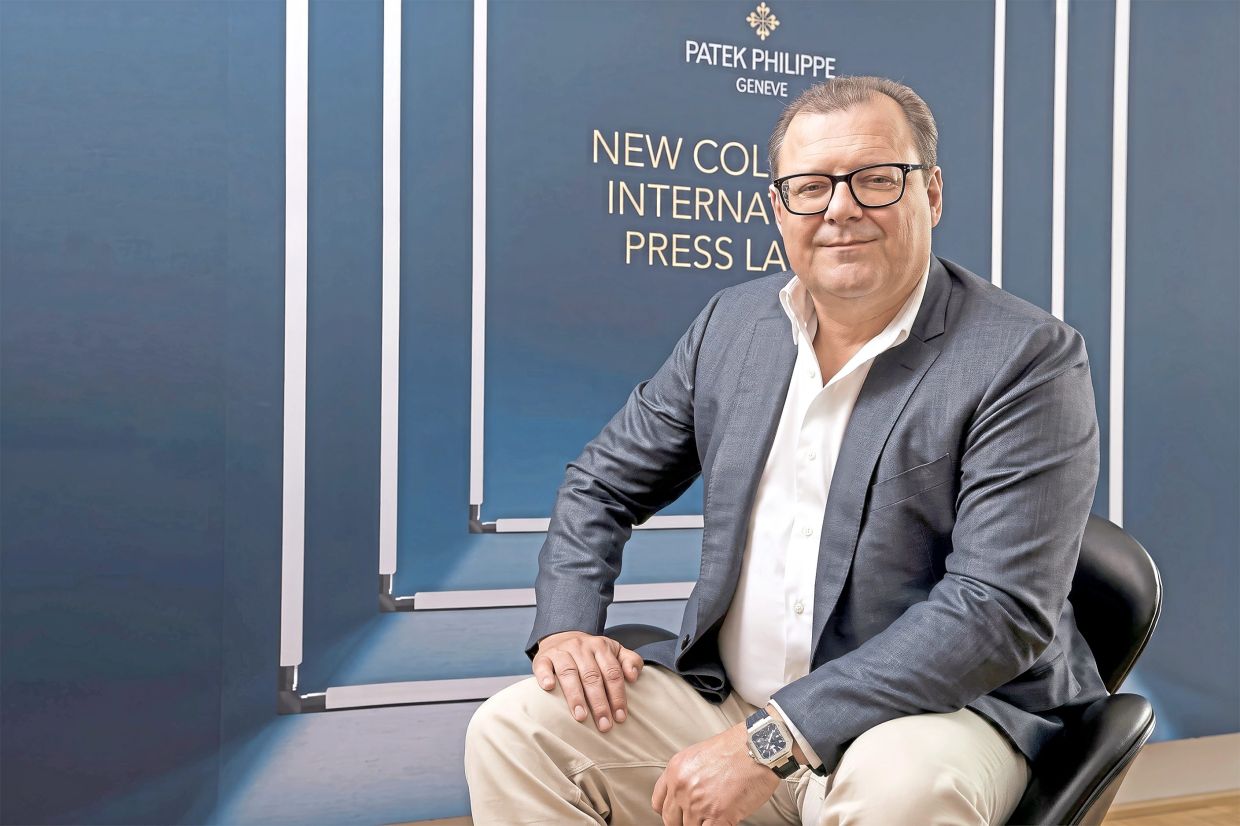
Thierry Stern carries the weight of four generations of watchmaking heritage at Patek Philippe, yet he speaks with the unguarded enthusiasm of a collector rather than a corporate custodian. The 55-year-old president of the prestigious Swiss manufacture refuses to adopt the formal cadence typical of luxury conglomerates, instead channelling the voice of someone genuinely consumed by the mechanics, aesthetics and history of timepieces. This deliberate authenticity, he argues during an interview at the 2026 Watches and Wonders exhibition in Geneva, is not merely a personality quirk but a fundamental operational principle for anyone aspiring to lead the company.
The foundation of Stern's philosophy rests on an uncomfortable truth for many executives: intellectual credentials alone cannot sustain leadership in the watch industry. "If you do not like watches, don't expect to be able to do this job," he states plainly, acknowledging that clients operating in this rarified market possess sophisticated knowledge and can instinctively detect when executives lack genuine conviction. In an era where luxury goods are increasingly commoditised through marketing spin and celebrity endorsements, Stern positions Patek Philippe as an institution where the personal passion of its decision-makers remains visible and essential. The implications of this stance ripple through every strategic choice the house makes, from product development to client relations.
The 50th anniversary of the Nautilus in 2026 provides the perfect case study for Stern's approach to balancing heritage preservation with calculated innovation. When this iconic design first surfaced in 1976, the watchmaking establishment recoiled in horror. Gerald Genta's bold porthole case and integrated bracelet represented an affront to Patek Philippe's classical traditions, appearing simultaneously too industrial, too contemporary and too divorced from the brand's founding principles. The Nautilus violated every unwritten rule of haute horlogerie, and the response from traditionalists was correspondingly fierce. Stern's wry recollection of this initial rejection—noting that most complainers from that era have since passed away—underscores how contemporary controversy often transforms into canonical status once sufficient time has elapsed.
Today, the Nautilus occupies an almost mythical position within the watch collecting world. Waiting lists stretch for years, and secondary market prices routinely surpass suggested retail values by multiples that would astound observers unfamiliar with contemporary luxury watch economics. This trajectory from scandal to desirability illustrates a principle that guides Stern's tenure: willingness to challenge prevailing taste, provided the challenge is rooted in sound design philosophy rather than mere provocation. The watch exemplifies what happens when passionate craftspeople permit themselves to imagine beyond immediate market preferences.
To commemorate this milestone, Patek Philippe has introduced three limited-edition Nautilus variants crafted in white gold and platinum, alongside an accessories piece—a whimsical desk clock interpreting the Nautilus aesthetic. These offerings maintain measured restraint rather than pursuing technical showmanship for its own sake. Stern deliberately resisted the temptation to introduce a tourbillon complication or other mechanical tour de force, conscious that such choices could undermine the Nautilus's essential identity. His reasoning reflects deep engagement with the watch's fundamental character: "For me, the Nautilus is an hour-and-minute watch. That's really its DNA." This commitment to essence over embellishment represents a distinct counterpoint to much contemporary luxury product extension, where heritage models accumulate unnecessary complications simply because brand prestige permits premium pricing.
The new editions showcase ultra-thin cases measuring just 6.9 millimetres in height, powered by the historic micro-rotor Calibre 240 movement. Achieving the ergonomic excellence of both case and bracelet required extended development periods, a reality that underscores Stern's broader philosophy that authentic craftsmanship cannot be rushed. Such attention to proportional minutiae separates truly distinguished design from mere commercial exploitation of established brand equity.
Stern's formative years under his father Philippe Stern, who previously helmed the company, imparted crucial lessons about the epistemological limits of executive decision-making. The younger Stern travelled extensively throughout his early career, observing market conditions and interacting directly with both retail partners and end consumers. His father's recurring counsel—emphasizing the necessity of listening to global stakeholders and understanding the concrete requirements of actual clients—shaped an approach fundamentally opposed to ivory tower management. This grounding in field experience informs Stern's conviction that leadership cannot be adequately conducted from Geneva boardrooms alone.
Within the competitive landscape of Swiss luxury watchmaking, Patek Philippe occupies a position alongside four other houses of comparable significance: Rolex, Cartier, Audemars Piguet and Omega. Each represents a distinct tradition and market positioning, yet all face pressure to maintain relevance across generations of consumers with shifting expectations. Stern perceives the manufacture not as a static institution preserving an immutable legacy but as a living organism that must evolve or risk irrelevance. "If I don't take risks, I'm not evolving," he asserts, recognizing that institutional stagnation represents its own form of risk.
Yet Stern carefully distinguishes between reckless experimentation and thoughtful development. His reference to the Aquanaut, introduced in the late 1990s as a sportier, younger-skewing counterpart to the Nautilus, illustrates this calibrated approach. Rather than dramatically departing from Patek Philippe's foundational aesthetic or technical principles, the Aquanaut extended the house's creative language into adjacent territory. This strategy acknowledges market segmentation without sacrificing brand coherence—a balance that requires both artistic vision and commercial acumen. Such decisions cannot emerge from spreadsheet analysis alone; they demand the intuitive judgment of someone genuinely invested in the watch's journey through time.
Stern's philosophy ultimately proposes that luxury industries fundamentally differ from commodity sectors in ways that challenge conventional management wisdom. When products carry such concentrated symbolic weight and historical resonance, the emotional authenticity of leadership becomes functionally inseparable from market performance. A client evaluating a multi-hundred-thousand-dollar timepiece does not simply assess mechanical specifications and materials; they implicitly appraise whether the organisation's steward genuinely understands and respects the object being offered. In Stern's formulation, passion functions as both a moral prerequisite and a practical business requirement, a perspective that becomes increasingly rare as privately-held heritage brands face pressure to professionalize according to multinational corporation templates.

