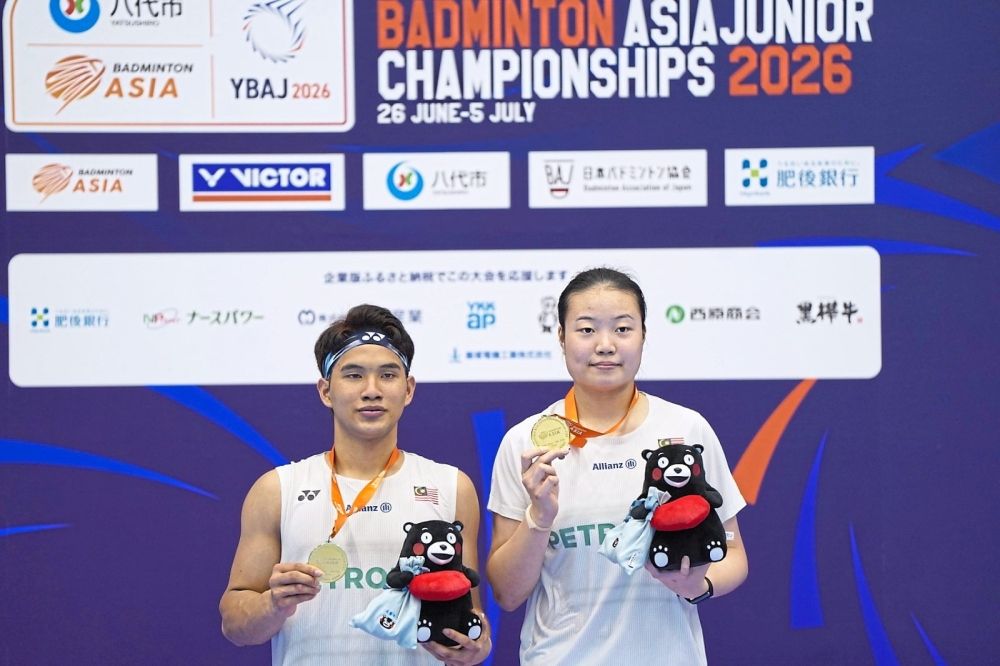
The Malaysian badminton contingent has finally broken through a two-decade barrier at the continental junior level. Ahmad Redzuan Zulwaqqarizal-Low Zi Yu clinched the mixed doubles crown at the Asian Junior Championships in Yatsushiro, Japan, denying Malaysia's lengthy title drought in this category that stretched back to 2007. Their composed 21-15, 22-20 victory over China's Zheng Weigang-Li Menghan in 43 minutes on the court marks a significant milestone for the nation's junior badminton programme and represents the kind of breakthrough success that development programmes strive to achieve at regional competitions.
The triumph carries particular resonance given the intensity of the championship encounter. The Malaysian pair found themselves positioned on the cusp of victory, needing merely two points to clinch the title before the Chinese combination mounted a spirited comeback that forced the match into a decisive third game. Rather than wilting under the mounting pressure of a swiftly evaporating advantage, Redzuan and Zi Yu demonstrated the mental fortitude required at this competitive level, regaining their focus when it mattered most and securing the decisive points when stakes were highest. This capacity to remain composed during critical junctures of a match distinguishes champions from runners-up, particularly in the high-pressure environment of international junior competitions.
Zi Yu credited patience as the defining element in their successful campaign, a quality that may seem counterintuitive in a sport demanding explosive athleticism and quick reflexes. However, badminton at the elite level increasingly demands strategic patience—understanding court positioning, rallying discipline, and the psychological battle of wearing down opponents through consistency. The 15-year-old Malaysian player observed that during the tense moments of the final, particularly at 20-20 when both teams locked in a desperate struggle, her pairing managed to channel greater mental clarity than their opponents. She also highlighted the psychological boost derived from teammates who had already exited the tournament continuing to provide vocal encouragement from the sidelines, demonstrating how team cohesion extends beyond individual matches and creates an environment where junior players draw strength from collective support.
For Redzuan, this championship represents vindication after a series of setbacks that would have tested the resolve of any young athlete. The Terengganu-born shuttler made his debut at the Asian Junior Championships in Yogyakarta in 2023, competing in both the boys' doubles and mixed doubles categories, only to experience early elimination from both events. Rather than improving his fortunes, he encountered similar disappointment the following year when the championships returned to Yogyakarta in 2024. His third consecutive attempt at the tournament took place in Surakarta in 2025, where he again failed to advance beyond the preliminary stages. This pattern of three consecutive failed campaigns would understandably challenge the commitment of developing players, yet Redzuan persisted and ultimately transformed those experiences into the foundation for his breakthrough success.
Redzuan's assessment of his performance demonstrated the maturity expected of championship-winning athletes. He expressed satisfaction with his technical execution, noting that his on-court movement and decision-making reflected the specific tactical work completed during training sessions. Nevertheless, he avoided the trap of complacency that can follow sudden success, immediately pivoting toward future improvement and acknowledging that the demands of the next level of international competition require substantial additional preparation. This balance between recognising achievement and maintaining perspective on developmental trajectories suggests that his coaching team has cultivated appropriate competitive attitudes in the young shuttler.
Zi Yu's championship run extended beyond the mixed doubles category, as she simultaneously competed in the women's doubles event alongside Genevie Lim. The Malaysian combination reached the semi-finals stage before encountering Japan's second-seeded pairing of Aoi Banno-Yuzu Ueno, who prevailed 21-16, 17-21, 17-21 to claim their spot in the final. Despite the semi-final loss, Zi Yu's bronze medal in the women's doubles category underscores her emerging status as a player capable of contending across multiple formats. Securing medal success while managing the substantial physical and mental demands of competing in two separate events simultaneously represents an impressive achievement for a player of her age and experience level.
Zi Yu provided insight into how she manages the logistical and psychological complexities of competing in two events with different partners. Rather than perceiving the dual-event format as a hindrance to her performance, she framed it as a manageable responsibility given the quality of her partners in both categories. She emphasised that both Redzuan in mixed doubles and Lim in women's doubles possessed the skill and composure to navigate challenging matches independently, allowing her to concentrate on her own positioning and shot selection rather than assuming the burden of rally initiation or tactical direction. This distribution of responsibility appears to have benefited her overall performance, as evidenced by her medal haul from the championship.
The last Malaysian combination to achieve victory in the Asian Junior Championships mixed doubles category were Tan Wee Kiong and Woon Khe Wei, whose triumph in Kuala Lumpur in 2007 established the 19-year gap now closed by Redzuan and Zi Yu. The passage of nearly two decades between Malaysia's mixed doubles titles at this level raises questions about the development pathway and competitive depth in this particular category within Malaysian badminton. The drought suggests either difficulty in producing consistently high-performing pairs or the challenges posed by rising standards among rival Asian nations, particularly China and Japan, who have established strong production pipelines of junior talent. Redzuan and Zi Yu's breakthrough therefore represents not merely an individual achievement but potentially signals a revitalisation of Malaysian mixed doubles competitiveness at the junior international level.
The broader competitive landscape at the Asian Junior Championships reflects the dominance of established badminton powers in the region. China's Zheng Weigang-Li Menghan, despite their final loss, demonstrated sufficient quality to reach the mixed doubles championship match. China also secured victories across other categories during the championships, illustrating their continued strength in junior development. Japan's success in women's doubles, with both top seeds Aoi Banno-Yuzu Ueno and runners-up Ria Haga-Rio Yamakita reaching the final, demonstrates Japanese badminton's substantial depth of female talent. Taiwan's dominance in men's doubles, where Huang Tzu-yuan-Lin Sheng-ming comprehensively defeated fellow Taiwanese combination Chen Ping-hsuan-Lee Wei-ting, indicates the importance of strong domestic competition in fostering elite junior players.
For Malaysian badminton development officials, Redzuan and Zi Yu's success provides concrete evidence that Malaysia's junior training infrastructure remains capable of producing champions despite the competitive intensity of regional competition. The pair's triumph can serve as motivation for younger age group players currently progressing through the development system, demonstrating that patience, persistence, and technical excellence can ultimately overcome setbacks and rival competition. Their championship victory may prompt increased investment in mixed doubles pathways and renewed focus on identifying and nurturing talent in this category, which has historically represented Malaysia's weaker point compared to men's and women's singles categories.
The implications of this championship victory for Malaysian badminton extend beyond immediate celebrations. Success at the junior international level frequently presages career trajectories at senior elite competitions, and Redzuan and Zi Yu's ability to perform under pressure in a major final suggests promising potential for future contributions to Malaysian badminton on the world stage. Their victory also provides valuable experience managing international travel, adapting to different court conditions, and competing against the world's best junior players—experience that typically separates eventually successful professionals from those who plateau at developmental levels. As both players continue their competitive journeys, this Asian junior mixed doubles title represents both an endpoint to Malaysia's lengthy drought and potentially a beginning for what could become a productive era of mixed doubles excellence.

