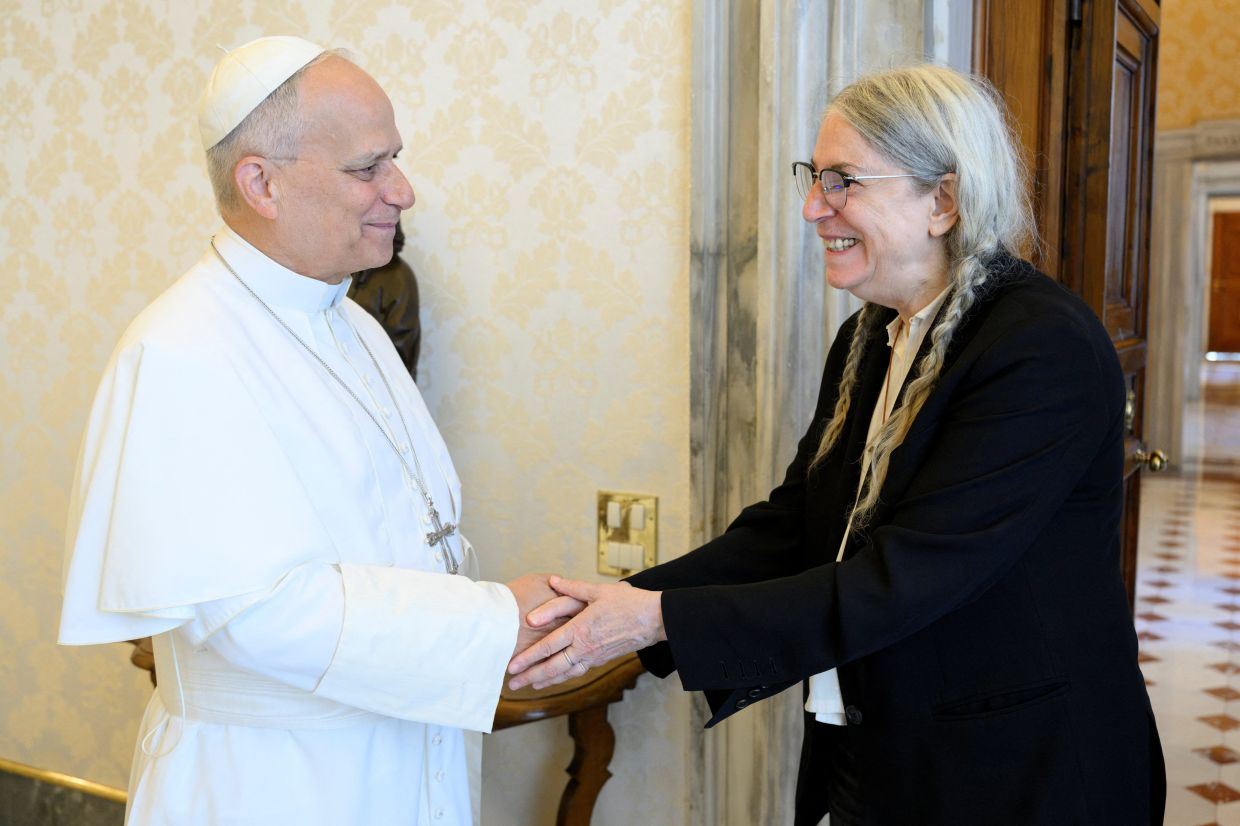
Rock and roll icon Patti Smith found herself momentarily unable to articulate the profound emotions of the encounter when she sat down with Pope Leo XIV at the Apostolic Palace on Friday, managing only a soft "Hi" as she took her seat across from the pontiff's desk. The exchange, though brief in words, carried the weight of years of spiritual connection and mutual admiration between the acclaimed musician and the head of the Roman Catholic Church.
Smith's increasingly regular appearances within Vatican walls owe much to her established friendship with Rev Antonio Spadaro, a senior figure in the Vatican's culture ministry serving as undersecretary. This institutional connection has allowed the famously independent artist—who has stated she does not practise Catholicism—to engage meaningfully with the Church's leadership and participate in its cultural initiatives. Her presence at the Vatican represents a broader phenomenon of contemporary artists finding common purpose with religious institutions around questions of humanity, spirituality, and artistic expression.
The 78-year-old musician has spoken eloquently about what draws her to the Vatican's leadership, particularly her profound admiration for Pope Francis, whose predecessor Leo now follows. She has described being captivated by Francis's "gentle, open, and steadfast sense of humanity," a characterisation that reveals Smith's own spiritual priorities transcend denominational boundaries. For Smith, the appeal lies not in doctrinal adherence but in witnessing leadership that embodies compassion and openness to the complexity of human experience—values that resonate throughout her own artistic output.
Smith's relationship with the papacy extends back decades. Her 1979 composition connected her emotionally to Pope John Paul I, and when Pope Francis passed away on April 21, 2025, Smith memorialised him through a poem shared across social media. In that tribute, she compared the late pontiff to a dandelion—a humble yet resilient plant—capturing Francis's distinctive spiritual approach with characteristic poetic economy. "Nature and poetry and the suffering shall miss their champion," she wrote, demonstrating how her artistic sensibilities and spiritual convictions have become increasingly intertwined.
The Friday audience lasted approximately 40 minutes, according to Spadaro, who accompanied Smith throughout the meeting. Far from a formal ceremonial encounter, Spadaro characterised the exchange as an intimate conversation between two individuals discovering unexpected kinship. His description captured something beyond protocol: "It felt more like a conversation between two people discovering they were old friends, sharing memories woven from words and music, dreams, visions, and hopes—both from yesterday and for today." This characterisation suggests the two Chicago natives connected on a level that transcended the formal structures of a papal audience.
Smith's Vatican engagement intensified notably in May 2025 when she performed during the inauguration of the Holy See's pavilion at the Venice Biennale, one of the world's most prestigious contemporary art exhibitions. That May 8 date held particular significance: it marked the anniversary of Leo's election to the papacy. The performance positioned Smith as a cultural ambassador of sorts, bringing her artistic voice to bear on the Vatican's contemporary art presence at one of Europe's most important cultural events. This high-profile collaboration underscored the institution's deliberate cultivation of relationships with respected artists and intellectuals.
Smith's journey with the modern papacy began more than a decade ago when she first met Pope Francis in 2013. The connection deepened when she performed for him in 2014, establishing a pattern of artistic engagement with the Church. Rather than viewing her interactions with the Vatican as contradictory to her well-established countercultural identity, Smith appears to have integrated them as extensions of her lifelong commitment to bearing witness to beauty, suffering, and human dignity. Her willingness to engage with the papacy reflects her understanding that spiritual questioning and artistic integrity need not remain confined to secular spaces.
For Malaysian and Southeast Asian observers, Smith's Vatican engagements offer insight into how respected cultural figures navigate relationships with large institutions. In our region, where religious and cultural tensions sometimes create rigid boundaries, Smith's model of respectful engagement across theological difference presents an alternative possibility. Her refusal to undergo religious conversion while maintaining genuine spiritual dialogue demonstrates that interfaith and intra-spiritual relationships need not require wholesale ideological alignment.
The papal audience also reflects Leo XIV's own openness to contemporary culture. Earlier in the same week, on July 29, the pope attended a concert honouring him performed by celebrated tenor Andrea Bocelli, suggesting a pontificate attuned to music's power as a form of spiritual and cultural expression. By engaging with artists of Smith's and Bocelli's stature, Leo signals that the Vatican sees contemporary culture not as something to be resisted but as a legitimate arena for encountering transcendence and human connection.
Smith's presence at the Vatican ultimately speaks to broader questions about faith, art, and public witness in the contemporary world. Here is a woman whose life's work has centred on uncompromising artistic expression and spiritual searching, finding meaningful exchange with the most hierarchical institution in Christendom. That "Hi" exchanged across the papal desk represented not a surrender of independent thought but rather an affirmation that genuine human connection and the pursuit of truth can flourish even across the deepest institutional divides.

