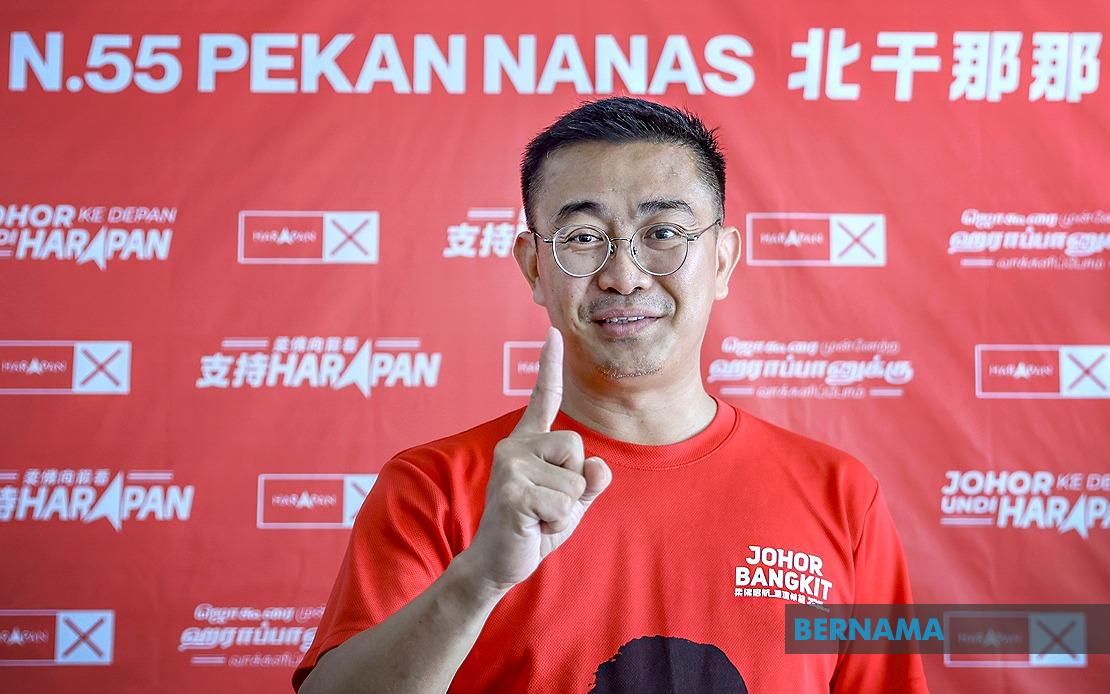
Yeo Tung Siong, the Pakatan Harapan contender for Pekan Nanas in the latest Johor state election, has anchored his campaign on the tangible outcomes of his two consecutive terms representing the constituency from 2013 to 2022. The former assemblyman believes his track record of constituent engagement and local problem-solving positions him well to recapture a seat now held by Barisan Nasional's Tan Eng Meng, setting up a direct contest between the two camps in this industrial and residential pocket of Pontian.
Campaign momentum appears to favour Yeo's momentum-building strategy. During the lead-up to election day, he claims to have connected with approximately 60 per cent of the electorate through a comprehensive grassroots effort spanning residential walkabouts, community forums, small-group discussions, door-to-door canvassing, and visits to markets and eateries. The consistent feedback he reports receiving suggests receptiveness among voters evaluating his candidacy, a crucial indicator in tight electoral contests where ground sentiment can shift outcomes.
The former vice-principal and discipline teacher has positioned himself as an accessible, results-oriented representative unencumbered by bureaucratic formality. His messaging emphasises personal availability and direct problem-solving, framing his approach as a contrast to what he implicitly suggests is a more distant or protocol-conscious style of governance. This accessibility narrative carries particular weight in constituencies where residents often feel neglected by distant government machinery.
Yeo's tenure produced concrete infrastructure interventions addressing chronic local grievances. Most notably, he secured RM500,000 in government allocation specifically for the Pulai River straightening project, a long-overdue solution to the recurring flooding that has plagued the area. Additionally, he collaborated with private enterprises to construct drainage infrastructure around Kampung Melayu Raya, demonstrating an ability to mobilise resources beyond direct government funding and work across public-private boundaries to deliver community benefit.
Transportation infrastructure emerges as a defining campaign plank. Voters repeatedly raised congestion frustrations during his campaigning, particularly concerning the arduous commute between Pontian and Johor Bahru. Yeo has identified two specific shortcut corridor projects as election priorities: a new route linking Ulu Pulai to Pekan Nanas, and a junction improvement connecting Pulai to Sri Bunian. These targeted interventions address the daily mobility challenges that metropolitan fringe constituencies typically face, where residents commute to urban employment hubs but lack efficient transit corridors.
Employment generation represents the second pillar of his platform. The assembly member intends to resurrect the career fairs he previously organised, partnering with major employers operating in the Pekan Nanas vicinity to expand job opportunities for local residents. This initiative acknowledges that despite being on Johor's industrial periphery, the constituency faces underemployment challenges and skills mismatches requiring proactive intervention.
Social safety-net advocacy completes his policy trinity. Yeo commits to enhancing access to assistance programmes administered through the Social Welfare Department (JKM) and the Social Security Organisation (SOCSO), indicating attentiveness to vulnerable populations who depend on these institutional frameworks. This focus reflects his background in educational discipline and student welfare, suggesting genuine concern for marginalised constituents rather than perfunctory electoral positioning.
The Pekan Nanas contest itself sits within broader Johor electoral dynamics. As a one-on-one competition between PH and BN, it serves as a microcosm of the larger coalition contest unfolding across the state. Peninsular Malaysia's southern industrial anchor, Johor has emerged as strategically important to both major coalitions seeking to consolidate support ahead of potential federal realignment. PH's efforts to recapture previously held seats like Pekan Nanas reflect broader ambitions to rebuild electoral presence after the 2023 federal election setback, while BN's defence of such seats underscores its effort to prevent further territorial losses.
Yeo's candidacy also illustrates the recurring Malaysian political pattern of comeback campaigns by former legislators. The two-term incumbency window from 2013-2022 provides sufficient tenure to accumulate demonstrable achievements while remaining recent enough that institutional memory of his service persists. This temporal sweet spot allows him to claim continuity without appearing as a stale political fixture, a crucial balance in Malaysian electoral contests increasingly sensitive to fresh representation.
The campaign's apparent success in reaching 60 per cent of voters, should that figure prove accurate, suggests effective ground organisation and genuine constituent interest in the contest. In state-level elections where turnout and engagement patterns often diverge from federal contests, such comprehensive voter contact can prove decisive, particularly in constituencies where election margins historically narrow during polling.
Looking forward, Yeo's pitch essentially invites Pekan Nanas voters to assess whether his previous tenure justified continued representation, a backward-looking appeal that only succeeds if voters perceive his prior service as genuinely beneficial. The infrastructure projects he cites provide measurable evidence beyond rhetorical claims, strengthening his narrative credibility. Conversely, Tan Eng Meng's incumbent status and whatever developmental initiatives his tenure produced during 2022-present will determine whether the BN incumbent can convince voters that continuity under new management outweighs returning to tested leadership.
The outcome in Pekan Nanas will carry implications beyond this single constituency. Should PH successfully recapture previously held seats throughout Johor, it signals renewed organisational capacity and voter willingness to reconsider the coalition after recent electoral disappointments. Conversely, BN successes in defending such seats would confirm the coalition's consolidation of support gained during the 2023 federal election cycle. For Malaysian political observers monitoring coalitional realignment and state-level factional contests, Pekan Nanas exemplifies the granular electoral competition determining national political direction.

