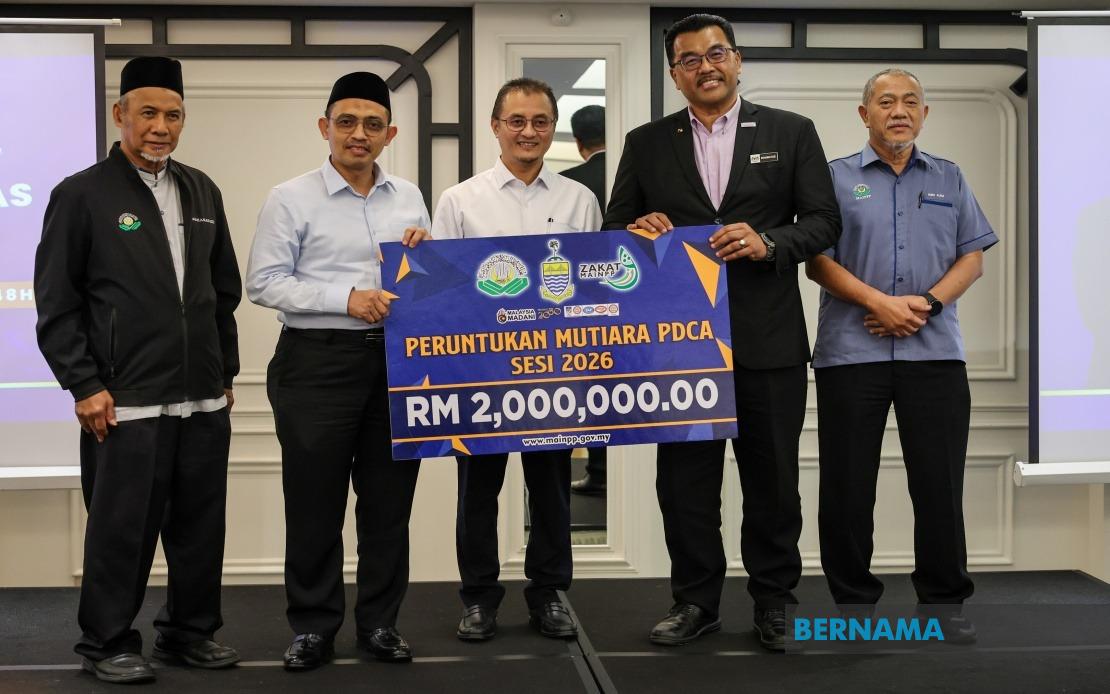
The Penang State Islamic Religious Council (MAINPP) has committed RM2 million to fund the Mutiara Didik Cemerlang Akademik (MPDCA) Programme during 2026, extending academic support to nearly 7,500 Bumiputera pupils and students throughout the state. The funding announcement, made by Penang Deputy Chief Minister I Datuk Dr Mohamad Abdul Hamid, underscores the council's continuing effort to provide quality educational access to economically disadvantaged students who might otherwise lack resources for supplementary learning.
The MPDCA initiative represents a coordinated approach involving multiple stakeholders in Penang's educational ecosystem. Beyond MAINPP's direct involvement, the programme draws collaboration from the Penang State Education Department (JPNPP), the Penang Bumiputera Participation Coordination Division under the Prime Minister's Department Implementation Coordination Unit, and the Penang Regional Development Authority (PERDA). This multi-agency framework suggests recognition that student academic achievement requires intervention across institutional boundaries rather than relying on any single educational entity.
Under the 2026 iteration, the RM2 million allocation will finance diverse learning interventions tailored to different educational stages and needs. Tuition classes, customised learning modules, academic seminars and examination technique workshops constitute the primary components through which funds will be deployed. For primary school students preparing for end-of-year assessments, the focus narrows to four foundational subjects—Bahasa Melayu, English, Mathematics and Science—reflecting consensus that mastery of these disciplines forms the bedrock for subsequent educational progression.
The scope of the programme expands considerably for secondary students, particularly those preparing for the Sijil Pelajaran Malaysia (SPM) examination. Thirteen subjects are offered at this level, spanning sciences, humanities, languages and specialised religious education courses. This breadth indicates an attempt to support students across diverse academic pathways rather than channelling all participants toward identical outcomes, acknowledging that Bumiputera students harbour varied aptitudes and career aspirations requiring tailored guidance.
The programme's infrastructure involves 698 coordinating teachers drawn from 71 primary schools and 38 secondary schools, suggesting substantial embedding of the initiative within Penang's formal education system. By integrating MPDCA through existing school structures rather than establishing parallel tutoring institutions, the council appears to leverage existing pedagogical relationships and institutional knowledge. Teachers functioning as programme coordinators can better assess student needs, identify high-potential individuals requiring additional challenge, and ensure continuity between supplementary and mainstream instruction.
Since its inception in 2006, MPDCA has generated documented improvements in student academic outcomes according to JPNPP data referenced by Datuk Dr Mohamad Abdul Hamid. Nearly two decades of implementation history suggests the programme has successfully navigated successive education system reforms and curriculum iterations, indicating resilience and adaptability rather than static design. For Malaysian policymakers contemplating long-term educational interventions, the longevity of this initiative offers useful evidence regarding programme sustainability and effectiveness timescales.
The RM2 million MPDCA allocation forms part of a substantially larger educational investment portfolio deployed by MAINPP during 2026. An additional RM22.36 million has been earmarked for higher education bursaries, while RM6.3 million supports the Permulaan IPT (entry to higher learning institutions) scheme. Early schooling assistance and school uniform grants each received RM3 million allocations. Collectively, these commitments totalling approximately RM36.66 million demonstrate institutional prioritisation of human capital development as a pathway toward improving the socio-economic circumstances of Muslim communities in Penang.
Feedback from participating educators reveals tangible mechanisms through which the programme generates benefit. Hartina Arjan, a Bahasa Melayu instructor at Sekolah Kebangsaan Permai Indah in Bukit Minyak, emphasised how systematically structured learning modules enable students from varying academic backgrounds to progress through materials at accessible paces. Her observation regarding enhanced preparation for Classroom-Based Assessment (PBD) processes and end-of-session evaluations suggests the programme successfully bridges gaps between conventional classroom instruction and formal assessment demands that often disadvantage students lacking supplementary tutoring.
Perhaps most significantly, educators highlight MPDCA's particular impact on students from economically disadvantaged families unable to access private tuition. Sadiah Roslan, teaching at Sekolah Rendah Islam Al-Masriyah Halimatun in Bukit Mertajam, noted that free programme participation removes financial barriers that otherwise stratify academic opportunity. Her observation regarding enhanced student engagement through interactive methodologies and quiz-based activities suggests that high-quality pedagogy, rather than mere additional instructional hours, drives the programme's effectiveness. This distinction matters for Malaysian education policymakers considering how best to deploy limited resources toward equitable academic outcomes.
The emphasis on Bumiputera students reflects constitutional provisions and longstanding federal policy frameworks regarding affirmative action for indigenous Malaysians. However, the geographic concentration of this significant investment in Penang alone raises questions about comparable provision throughout other Malaysian states. Whether similar programmes operate with equivalent funding and institutional support in Selangor, Johor, or Sabah remains unclear from available information, suggesting potential disparities in educational resource distribution across the federation.
For Southeast Asian regional observers, the MPDCA model demonstrates how municipal-level religious institutions can operationalise educational equity commitments through sustained funding and institutional partnerships. The programme's success in maintaining relevance across curriculum reforms and demographic shifts offers lessons for other Muslim-majority nations throughout Asia grappling with balancing religious educational values against contemporary skill requirements in increasingly competitive labour markets.
Moving forward, the MPDCA framework appears poised for continued expansion if current trajectory persists. The 2026 allocation of RM2 million supporting 7,403 students translates to approximately RM270 per student annually—a modest per-capita investment that nonetheless yields documented academic improvements when combined with structured pedagogical approaches. Whether Penang can sustain this trajectory amid competing budget pressures and whether other states might replicate the model constitute crucial questions for Malaysia's educational equity agenda over the next decade.

