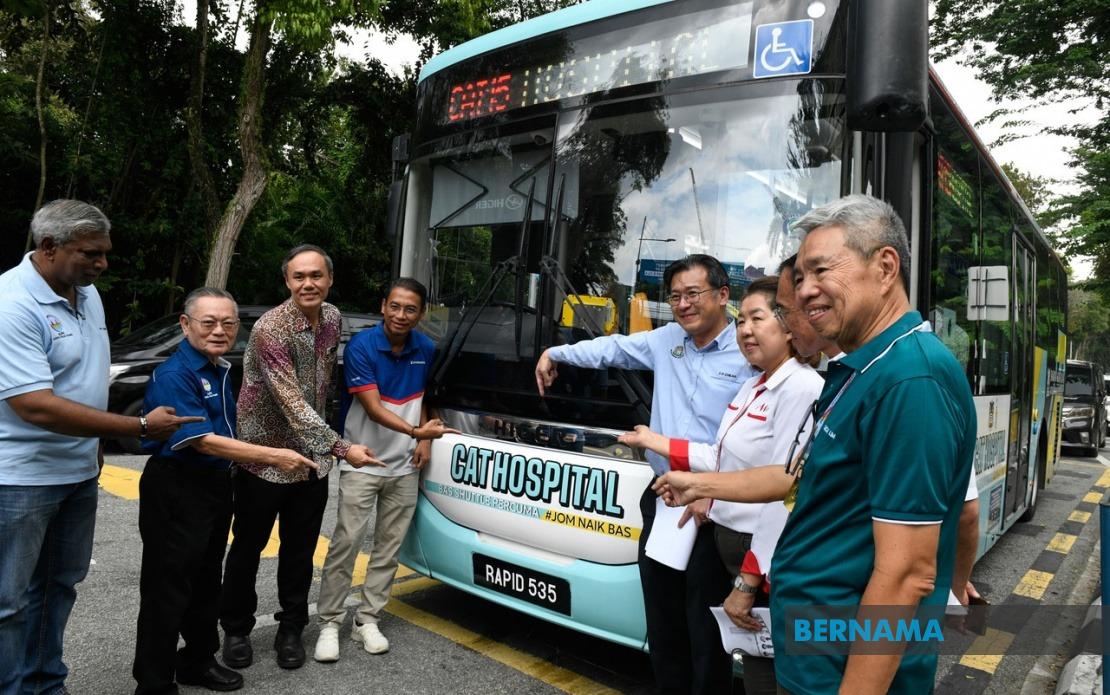
Penang Island City Council (MBPP) has committed substantial resources to a new public transport initiative, allocating RM900,000 annually to sustain a free shuttle bus service that began operations at the start of the year. The Central Area Transit (CAT) service provides connectivity between Komtar, Penang Hospital (HPP) and surrounding private medical facilities in the city centre, representing a significant municipal investment in healthcare accessibility and traffic management.
The initiative emerged from practical necessity rather than administrative whim. Following the expansion of Penang Hospital, MBPP commissioned a detailed survey that identified acute parking shortages and inadequate public transport options as critical constraints threatening patient access and visitor convenience. The council's response demonstrates how infrastructure planning at one facility can cascade across the broader urban system, forcing municipal authorities to coordinate solutions across multiple stakeholders. Engineering Director Cheah Chin Kooi emphasised that the service targets three complementary objectives: normalising public transport usage among city residents, reducing private vehicle dependency that exacerbates congestion, and addressing the persistent parking crisis around the hospital precinct.
Operationally, the service functions with deliberate simplicity and frequency. Three Rapid Penang buses traverse an eight-kilometre route with consistent scheduling, departing every twenty minutes between 6 am and 8 pm daily, accumulating thirty-six trips throughout operating hours. This design prioritises reliability and accessibility for elderly patients, caregivers and individuals with mobility constraints, demographics particularly vulnerable to transport barriers. The elimination of fares removes economic obstacles that might discourage discretionary public transport adoption among lower-income hospital visitors.
Early performance metrics validate the council's investment thesis. Since launching on January 1, the service has witnessed ridership approximately doubling from an initial three hundred daily passengers to approximately six hundred currently. This trajectory suggests growing user confidence and habit formation, phenomena that typically accelerate as awareness spreads and commuting patterns stabilise. For municipal planners, such momentum validates subsidy allocation and justifies continued funding commitments, particularly when public health accessibility depends on reliable transport infrastructure.
The coordination required to launch this service illustrates the interconnected nature of contemporary urban governance. Rapid Bus Sdn Bhd provided operational expertise and vehicle resources, Penang Hospital administration contributed venue knowledge and user insights, while MBPP assumed financial responsibility and service coordination. Datuk Ong Bee Leng's involvement through the Penang Women's Development Corporation reflects recognition that transport accessibility carries particular significance for female caregivers, who disproportionately shoulder responsibility for accompanying elderly and child dependents to medical appointments.
Complementary infrastructure improvements strengthen the service's effectiveness. Hospital management has upgraded pedestrian walkways along Jalan Residensi to eliminate transfer friction between bus stops and medical facilities. Ongoing enhancement works at the main entrance on Jalan Utama further optimise the journey experience for patients with reduced mobility or health conditions exacerbated by unnecessary walking. These incremental improvements demonstrate how transport policy intersects with environmental design, recognising that seamless connectivity requires attention to physical movement as much as vehicle scheduling.
For Malaysian regional context, this initiative reflects broader Southeast Asian urbanisation challenges. As cities expand and medical infrastructure centralises around flagship hospitals, transport accessibility becomes a social equity issue, not merely a convenience factor. Residents in sprawling suburban areas or informal settlements face mounting difficulties reaching tertiary healthcare, whilst congestion pricing and parking restrictions increasingly penalise private vehicle users. Subsidised public transport targeting healthcare facilities offers policymakers a demonstrated model for reconciling accessibility with sustainability objectives.
The RM900,000 annual commitment merits contextualisation within broader municipal budgeting. For a city council serving a major urban centre with substantial commercial activity and tourism, this allocation represents meaningful but not exceptional investment. However, the visible public benefit—six hundred daily trips subsidised entirely through council revenue—generates political goodwill and demonstrates tangible responsiveness to constituent needs. In an era where municipal governance frequently appears distant or bureaucratic, such targeted interventions that visibly improve daily life can meaningfully influence public perception of local administration.
Longer-term implications extend beyond immediate congestion reduction. Successfully operating a high-frequency, permanently subsidised public transport route serving healthcare infrastructure establishes operational precedent for future network expansion. Municipal leaders can reference this service's viability when justifying investment in complementary routes, whether connecting to educational institutions, commercial districts or transportation hubs. Each successful implementation builds institutional capacity and political credibility for subsequent public transport initiatives.
The service also reflects evolving understanding of healthcare systems thinking. Transport barriers constitute genuine health determinants, preventing timely attendance at appointments and discouraging preventive care. By eliminating transport friction, MBPP contributes indirectly to improved health outcomes and reduced hospital overcrowding. This integrated approach—acknowledging that health policy extends beyond hospital walls to encompass urban infrastructure—aligns with contemporary public health thinking emphasising social determinants and systemic interventions.
Sustainability considerations merit attention as the service matures. RM900,000 annual expenditure assumes continued council revenue sufficiency and political commitment. Economic downturns, competing municipal priorities, or administrative transitions could jeopardise ongoing funding. Establishing this service as permanent infrastructure rather than discretionary subsidy requires embedding it within council's baseline operations and demonstrating indispensable value to multiple stakeholder constituencies, ensuring political protection transcends individual administrations.

