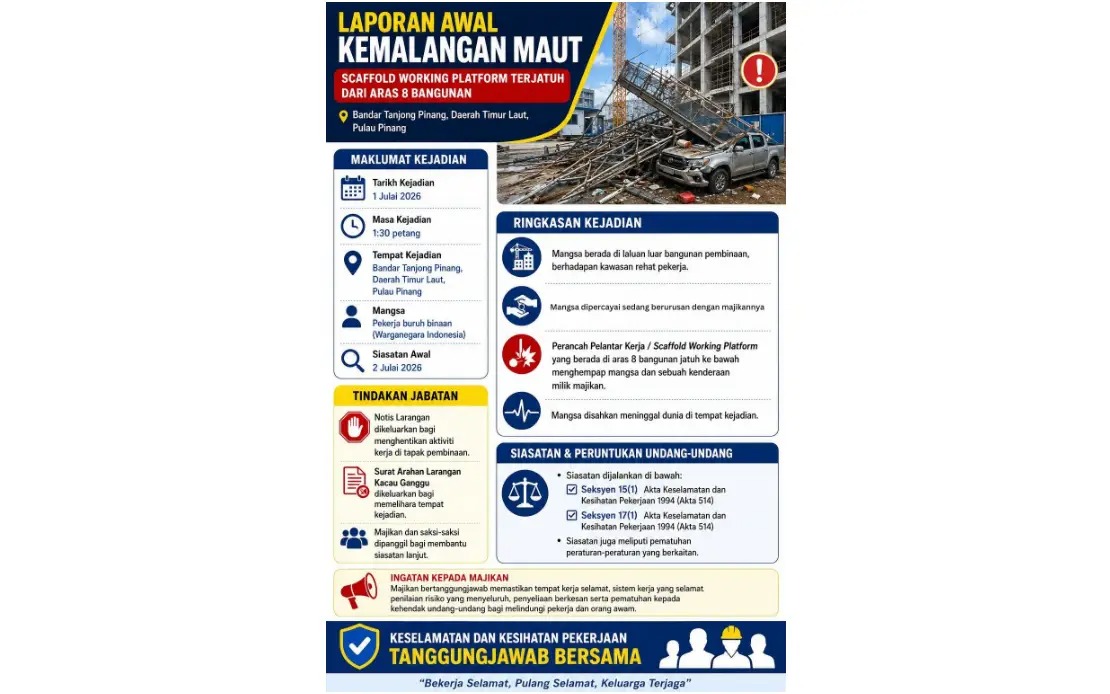
The Penang branch of the Department of Occupational Safety and Health (DOSH) has moved swiftly to suspend all construction activities at a Bandar Tanjong Pinang development following a fatal accident that claimed the life of an Indonesian migrant worker. The prohibition notice was issued in the aftermath of the July 1 incident, which left both the victim and an employer's vehicle struck by falling scaffolding equipment from a significant height. This action underscores the regulatory authorities' commitment to investigating workplace tragedies and preventing further loss of life on Malaysia's construction sites.
According to DOSH officials, the fatal incident occurred at 1.30 pm when a working platform and associated scaffolding system detached from the eighth floor of an under-construction building. The victim was positioned on a lower-level external walkway adjacent to the workers' rest area at the time of the collapse. He had been engaged in a discussion with his employer when the cascading metal structure struck him with force, resulting in injuries that proved fatal. The exact circumstances surrounding the structural failure remain the subject of ongoing investigation.
Beyond the immediate stop-work directive, DOSH has implemented a non-disturbance order to preserve the accident scene in its original state. This preservation protocol is essential for forensic investigation and reconstruction of the events leading to the platform's failure. Investigators are collecting evidence, interviewing witnesses, and documenting the condition of the scaffolding system, its installation methods, and maintenance records. The meticulous approach reflects lessons learned from previous construction accidents across Malaysia and international best practices in workplace fatality investigations.
The regulatory focus centres squarely on potential breaches of the Occupational Safety and Health Act 1994, specifically Sections 15(1) and 17(1), which establish employers' fundamental duties to provide safe working environments and systems of work. These provisions require employers to assess risks, implement control measures, provide adequate training, and ensure competent supervision on construction sites. Initial findings suggesting the victim was in an unprotected area when the scaffolding collapsed raise questions about site planning, exclusion zone management, and whether adequate barriers or warnings were in place.
Construction sites across Malaysia face persistent challenges in implementing rigorous safety protocols, particularly on high-rise projects where multiple hazards converge. Scaffolding collapses, while preventable, continue to represent a significant cause of worker fatalities in Southeast Asia. The incident in Penang adds to a troubling pattern where migrant workers—who form the backbone of Malaysia's construction labour force—experience disproportionate accident rates. Language barriers, inadequate induction training, and sometimes exploitative working conditions contribute to elevated vulnerability among foreign workers on Malaysian sites.
Penang's construction sector has experienced robust growth driven by infrastructure development and property expansion in recent years. However, this expansion has not been uniformly matched by corresponding investments in safety culture and regulatory enforcement capacity. The DOSH intervention demonstrates that authorities are prepared to employ enforcement tools available under Malaysian law, including work cessation orders and potential prosecution of responsible parties. Enforcement action will proceed if investigations confirm violations of statutory duties, a prospect that industry stakeholders closely monitor.
The employer and associated contractors now face intensive scrutiny regarding their compliance with safety regulations and industry standards. DOSH will examine documentation including risk assessments, method statements, competency certificates of supervisory personnel, scaffolding design specifications, and inspection records. The agency will also investigate whether adequate communication systems existed to alert workers to potential hazards and whether site induction procedures adequately covered the risks associated with working near suspended loads and elevated structures.
For Malaysia's broader construction industry, this incident serves as a sobering reminder that negligence in safety matters carries severe consequences. Professional engineers and project managers bear responsibility for translating regulatory requirements into practical site systems that protect workers. Developers and principal contractors cannot delegate safety accountability to subcontractors; they retain ultimate liability for unsafe conditions on their projects. The industry must view safety not as an administrative burden but as integral to project success and corporate reputation.
The tragedy also highlights the vulnerability of migrant workers within Malaysia's employment ecosystem. Many Indonesian workers lack robust knowledge of their legal rights under Malaysian labour and safety law or confidence in reporting unsafe conditions without fear of retaliation or deportation. Government agencies, industry associations, and civil society organisations have advocated for enhanced protections, including safety training delivered in workers' native languages and accessible complaint mechanisms that do not jeopardise employment status.
DOSH's statement emphasising that all workplace accidents, particularly fatalities, are treated with appropriate gravity signals a commitment to rigorous investigation rather than perfunctory compliance. The agency explicitly reminded developers, main contractors, and subcontractors that work activities must be comprehensively planned and executed with safety embedded at every operational stage. This messaging aims to instil the understanding that safety planning occurs before work commences, not retrospectively after incidents occur.
Pending completion of investigations, the Bandar Tanjong Pinang site remains closed to construction activity. Once DOSH concludes its probe and determines that corrective measures have been implemented to address identified deficiencies, the prohibition notice may be lifted. However, potential enforcement action—including fines, prosecution, or orders to implement remedial safety upgrades—could extend the cessation period and impose significant costs on project timelines and budgets. This consequence creates powerful incentives for industry stakeholders to embed stronger safety cultures in construction operations across Malaysia.

