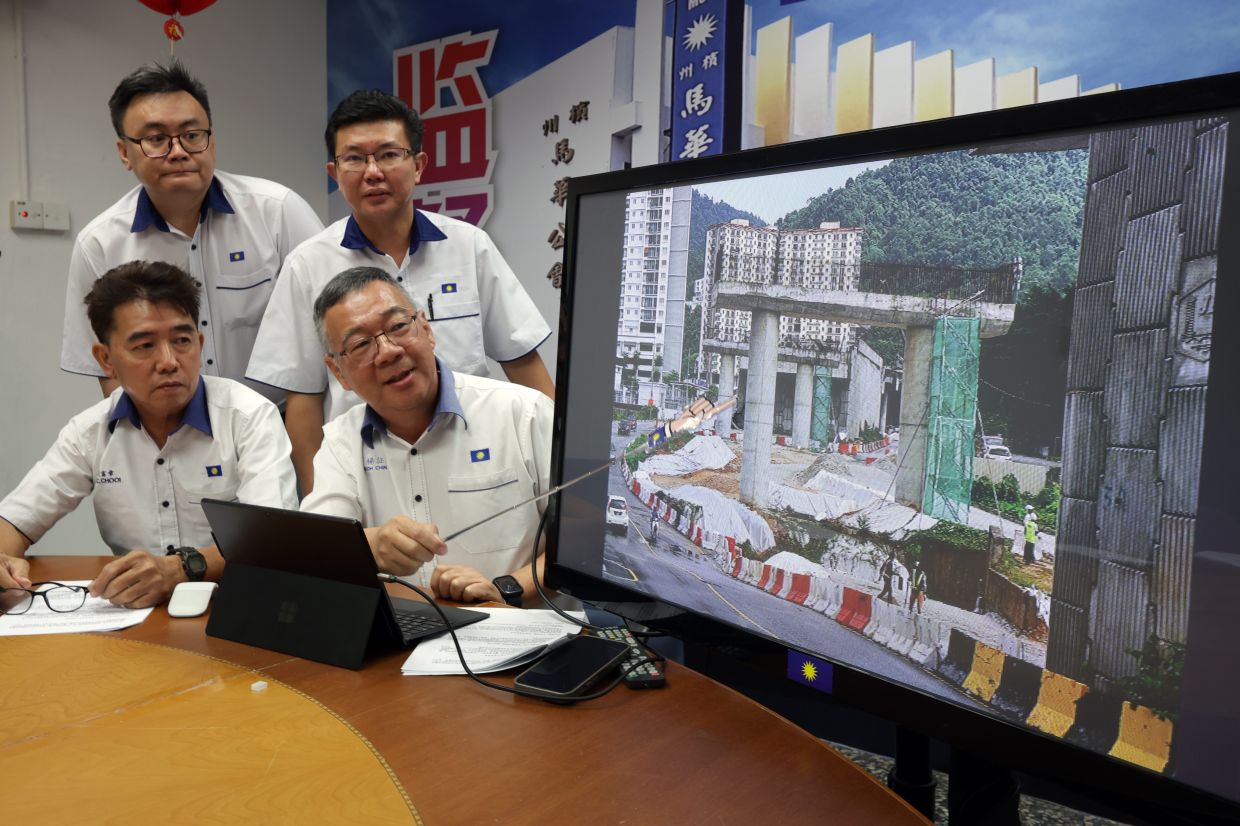
The Penang MCA has intensified scrutiny over the Air Itam-Tun Dr Lim Chong Eu Expressway bypass project, challenging the state government's characterisation of its progress and demanding immediate disclosure of critical documentation to restore public confidence in the infrastructure initiative. Party secretary Yeoh Chin Kah framed the controversy not merely as a matter of construction delays, but as a question of institutional accountability and transparency that directly affects the credibility of government commitments to constituents across Penang.
Yeoh's position reflects growing frustration within the coalition party over disparities between official completion percentages and observable conditions on the ground. The state government had previously described the undertaking as entering its "final sprint", yet Yeoh highlighted that completion figures rose modestly from 80 percent in May to 89 percent in December, a trajectory inconsistent with such characterisations. These modest gains over an extended period suggest either unrealistic initial assessments or significant unaccounted challenges, raising questions about project management competence and the reliability of progress reporting.
A site inspection conducted by Penang MCA representatives on July 1 revealed substantial gaps between official progress claims and construction realities. Key sections including Valley Road, Changkat Tembaga and Jalan Thean Teik exhibited incomplete work across multiple fronts. Critically, the delegation observed bridge piers in place but found no corresponding bridge beams or deck structures, indicating that essential structural components remain absent despite the supposedly high completion percentage. Road surfacing was incomplete, while guardrails, noise barriers, mechanical and electrical systems, and connecting infrastructure had yet to be installed across numerous sections. This divergence between reported progress and field conditions raises legitimate questions about how completion percentages are being calculated and whether they bear genuine correlation to functional project delivery.
Recognising the broader implications of such discrepancies, Yeoh issued a seven-day ultimatum for the state government to produce payment records, consultant certification reports and comprehensive project assessment documents. The MCA secretary indicated that failure to comply would trigger escalation mechanisms, with the party prepared to lodge formal reports with the National Audit Department and the Malaysian Anti-Corruption Commission. Additionally, Penang MCA committed to establishing a dedicated monitoring committee to oversee reported progress metrics and payment compliance, signalling the party's intention to maintain sustained oversight over project execution moving forward.
The expressway bypass forms a critical component of Penang's infrastructure modernisation strategy, representing the second package of the broader undersea tunnel and three paired roads initiative. This six-kilometre toll-free corridor connects Lebuhraya Thean Teik in Bandar Baru Air Itam with the Tun Dr Lim Chong Eu Expressway through an integrated network of elevated viaducts, tunnels and ground-level roads. The project's strategic importance derives from its potential to serve approximately 300,000 residents across Air Itam, Bandar Baru Air Itam and Paya Terubong, offering anticipated congestion relief and reduced travel times across densely populated communities. For Malaysia's second-largest city, addressing traffic bottlenecks remains essential to maintaining economic competitiveness and quality of life for urban and suburban populations.
The project timeline has experienced considerable slippage, with the original 2024 completion target already superseded by two extensions. The current contractual deadline stands at April 12, 2027, placing the undertaking substantially behind initial schedules. Such delays carry significant financial implications, potentially triggering additional cost obligations and compounding inefficiencies that accumulate when construction activities extend across longer periods. For residents in affected areas, delays translate to continued congestion and reduced mobility, postponing anticipated quality-of-life improvements that have been promised for extended periods.
Contesting the MCA's characterisation, Paya Terubong assemblyman Wong Hon Wai asserted that the project has achieved 91 percent completion and remains aligned with the April 2027 deadline. Wong, who attended a construction coordination meeting on June 30, pointed to imminent bridge beam launching operations scheduled for the coming months. Specifically, twelve beams on the Gelugor side are planned for deployment between the current period and August, with the remaining six scheduled for the fourth quarter of the year. Wong's account represents the state government's position that work is progressing substantially, though this narrative conflicts with the MCA's field observations regarding incomplete structural and finishing work.
Wong provided further technical detail regarding construction phases yet to commence or currently underway. Bridge beams on the Bandar Baru Air Itam side have been fully launched, but Wong cautioned that roadway opening would not occur immediately upon structural completion. Remaining operations encompass deck slab and parapet installation, followed by mandated Road Safety Audits conducted by relevant government agencies. The Public Works Department will subsequently determine the actual opening date based on audit findings, indicating that several procedural steps remain between construction completion and public accessibility. This staged approach, while appropriate from a safety perspective, extends the timeline between construction conclusion and operational readiness.
The gap between MCA claims and state government assertions exposes fundamental questions about project governance and information asymmetry. When independent party assessments conflict sharply with contractor and government representations, public confidence inevitably erodes, regardless of which account proves ultimately accurate. The transparency mechanisms Yeoh demands—payment records, consultant certifications and assessment documents—represent standard accountability instruments that should accompany any major public infrastructure undertaking. Their apparent unavailability or reluctant disclosure suggests governance practices inconsistent with contemporary standards for transparency and public accountability that Malaysian constituents increasingly expect from elected representatives and government agencies.
For Southeast Asian observers and Malaysian stakeholders, the Penang bypass controversy illustrates broader infrastructure governance challenges affecting the region. Cost overruns, timeline extensions and disputed completion metrics characterise major projects across multiple countries, suggesting systemic issues in initial planning, contractor selection, oversight mechanisms and reporting standards. Penang's experience offers instructive lessons regarding the necessity of robust independent monitoring, transparent documentation practices, and accountability frameworks that operate across political party lines. The outcome of the MCA's escalation efforts may establish precedents for how Malaysian institutions address governance disputes surrounding high-value infrastructure investments, potentially influencing oversight practices for future projects across the nation.

