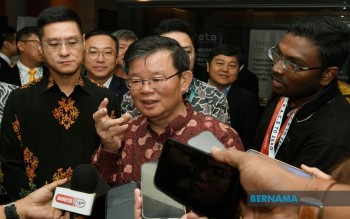
Penang is positioning itself as a centre for environmentally conscious manufacturing, with Chief Minister Chow Kon Yeow revealing that 25 enterprises have indicated keen interest in tapping the state's newly established Climate Mitigation Fund. Five of these applications are currently being evaluated, signalling strong momentum for the initiative as businesses respond to mounting pressures from global supply chains demanding lower carbon footprints. The fund, launched under the Penang Green Industry Programme in partnership with Alliance Bank, represents a significant commitment to helping local manufacturers transition their operations towards sustainability without bearing prohibitive upfront costs.
The financial architecture of this initiative reflects careful collaboration between the public and private sectors. The fund's initial RM20 million allocation comprises RM5 million contributed by the Penang state government and RM15 million from Alliance Bank, though the partnership framework allows for potential expansion to RM100 million depending on uptake and performance. This dual-funding approach demonstrates how regional governments can leverage banking partnerships to amplify their climate ambitions without stretching state budgets to breaking point. For small and medium enterprises and mid-tier companies meeting eligibility criteria, the programme extends financing of up to RM500,000 on preferential terms, complemented by grants covering sustainability assessments and access to expert consulting services. This holistic support structure addresses a critical barrier to green transition: the technical knowledge gap that often prevents smaller manufacturers from understanding how to meaningfully reduce their environmental impact.
Chow's articulation of the competitive imperative underlying Penang's climate strategy reveals a sophisticated understanding of how environmental performance has become embedded in global business decision-making. Manufacturing decisions are no longer driven solely by traditional factors such as labour availability, infrastructure quality, or logistics efficiency. Leading multinational corporations increasingly scrutinise the carbon credentials of their suppliers, setting firm emissions reduction targets across their entire value chains and preferencing suppliers who can demonstrate access to renewable energy and measurable progress on Scope 2 emissions reduction. For Penang, this represents both urgency and opportunity. The state accounted for RM436.9 billion in electrical and electronics exports last year, representing approximately 68 per cent of Malaysia's total E&E sector exports. This commanding market position makes Penang disproportionately vulnerable to shifting buyer preferences, but simultaneously positions the state to capture disproportionate gains by moving decisively ahead of competitors.
The Penang Energy Framework, formally launched in November 2024, provides the policy scaffolding upon which these financing initiatives rest. The framework sets two principal targets: reducing energy intensity by 25 per cent by 2030 and increasing renewable energy's share in the state's energy mix to at least 10 per cent over the same timeframe. These targets are ambitious yet grounded in pragmatic acknowledgment of Penang's geographical constraints. The state's limited landmass and high population density rule out utility-scale solar farms as a primary solution. Instead, rooftop solar installations on existing commercial and industrial buildings emerge as the most viable pathway to rapid renewable energy expansion. Under revised building guidelines, new commercial and industrial structures are now expected to utilise at least 75 per cent of their roof area for solar panels, or alternatively meet renewable energy sourcing targets calibrated to their Tenaga Nasional Berhad tariff classification.
Beyond rooftop installations, Penang is exploring complementary renewable energy solutions that reflect both innovation and resource efficiency. The Penang Water Supply Corporation is conducting detailed feasibility studies on floating solar installations across its reservoir network, a technology increasingly adopted across Southeast Asia that maximises energy generation from existing water infrastructure while potentially reducing evaporative losses. Silicon Island, a major industrial development project, will integrate renewable energy generation from its inception, including the establishment of a Green Tech Park powered substantially by on-site solar capacity. These initiatives collectively demonstrate how Penang is embedding renewable energy into economic development planning rather than treating it as a parallel or competing objective.
Energy efficiency constitutes the second pillar of Penang's energy transition strategy, and arguably represents the most immediate opportunity for impact. The state is implementing energy intensity standards that enable systematic measurement, benchmarking, and improvement of consumption patterns across the manufacturing sector. Government buildings and facilities managed by local authorities are being comprehensively assessed for their renewable energy and efficiency potential. For newly constructed government and local authority facilities, the state has established a target requiring at least five per cent of total energy consumption to derive from renewable sources, with existing government properties encouraged to move towards similar targets. This internal commitment serves multiple purposes: it demonstrates government credibility on climate issues, creates a domestic demand base for renewable energy solutions, and provides a testbed for technologies and approaches that can subsequently be scaled across the private sector.
Penang's decentralised climate policies are explicitly aligned with federal-level initiatives, ensuring coherence across Malaysia's governance structures. The National Energy Efficiency Action Plan 2.0, led by the federal government, targets an 11 per cent reduction in national energy demand by 2035. By anchoring Penang's targets to this federal framework, the state positions itself as an implementer of national policy rather than pursuing a purely provincial agenda. This alignment strengthens Penang's hand when advocating for complementary federal support, whether through enhanced tax incentives for renewable energy investment, accelerated depreciation allowances for clean technology, or grants supporting industrial energy audits. For Malaysian investors and multinational firms evaluating regional expansion, this coherence between state and federal climate ambitions provides reassurance that policy commitments will persist across electoral cycles and governance transitions.
The involvement of the Malaysian Photovoltaic and Sustainable Energy Industry Association in the R.A.C.E To Zero forum where these announcements were made underscores the ecosystem dimension of Penang's strategy. Successful industrial transition requires not merely financing and regulatory support, but also access to quality technology providers, skilled installers, and maintenance services. By actively engaging industry associations representing renewable energy and photovoltaic specialists, Penang is building networks that connect capital supply with technology expertise and installation capacity. This ecosystem approach contrasts with purely top-down green financing mechanisms that sometimes struggle to connect willing borrowers with competent service providers.
The Infrastructure, Transport and Digital Committee's chair, Zairil Khir Johari, was present at the announcement, signalling that climate mitigation is being integrated into Penang's broader infrastructure and economic planning. Energy transition cannot be sequestered as a narrow environmental issue but must be woven throughout transportation networks, digital infrastructure development, and industrial zoning decisions. Public transport systems powered by electricity, logistical facilities designed for energy efficiency, and smart grid technologies enabling demand-side management all interact with manufacturing climate ambitions. By locating climate financing announcements within a broader infrastructure governance framework, Penang indicates that it understands industrial decarbonisation as inseparable from urban planning and economic development strategy.
For Malaysian policymakers beyond Penang observing this initiative, several lessons emerge regarding scaling green industrial financing. The combination of modest public-sector seed capital with substantially larger private banking commitments creates a sustainable financial model that does not overwhelm state budgets while leveraging market discipline to ensure loan quality and repayment discipline. The integration of technical advisory services alongside financing addresses the knowledge barriers that often prevent smaller enterprises from accessing available support. The explicit linkage between environmental performance and competitive advantage resonates with manufacturing sectors globally, suggesting that appeals to climate responsibility alone may be insufficient without demonstrating concrete business case improvements in market access, supply chain security, and long-term viability.
Penang's strategy reflects a sophisticated understanding that industrial decarbonisation, though operationally complex, offers a pathway to enhanced competitiveness rather than constraining economic development. By positioning renewable energy adoption and energy efficiency as responses to buyer demands and market opportunities rather than regulatory burdens, the state has framed green transition as economically rational. The Climate Mitigation Fund, coupled with the Energy Framework and building guidelines, creates a comprehensive ecosystem encouraging companies to voluntarily invest in cleaner operations. As global supply chains increasingly integrate carbon considerations into purchasing decisions, Malaysian states that proactively support their manufacturers' transition will capture disproportionate investment and growth compared to laggards. Penang's early moves suggest it recognises this calculus and is acting accordingly.

