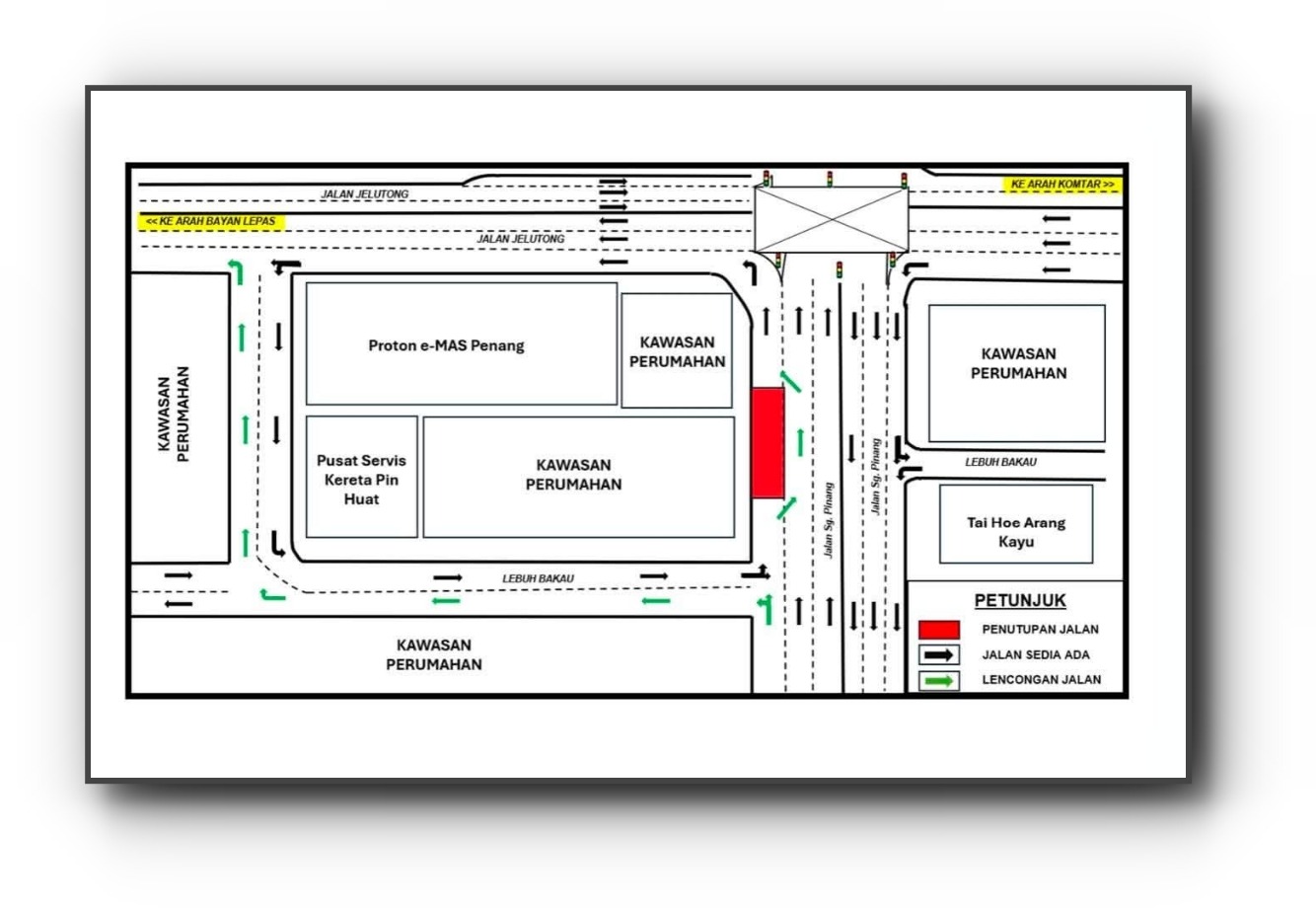
A major arterial route in George Town will experience partial traffic disruption over the next ten days as Malaysia's national power utility company executes essential infrastructure work. Beginning at 9 am on August 28 and concluding at 11.59 pm on September 6, Tenaga Nasional Bhd (TNB) will occupy the leftmost lane of Jalan Sungai Pinang in its approach toward Jalan Jelutong to relocate utility lines, according to an announcement by Sungai Pinang state assemblywoman Lim Siew Khim.
The affected corridor stretches between the Lebuh Bakau junction and the traffic light intersection where Jalan Sungai Pinang meets Jalan Jelutong. This segment experiences considerable daily traffic from commuters navigating central Penang, particularly those traveling between residential areas and the commercial zones adjacent to the city center. The leftmost lane designation means that while through-traffic will be substantially constrained, other lanes will remain operational, permitting vehicles to proceed in reduced capacity during the closure period.
Lim, who serves simultaneously as chairman of the state Social Development, Welfare and Non-Islamic Religious Affairs Committee, stressed that the 24-hour nature of the closure warrants advance planning by affected motorists. The comprehensive roadwork necessitates complete lane occupation throughout each day to enable TNB crews to access underground and overhead utility infrastructure safely and efficiently. Drivers and commuters familiar with this corridor should anticipate longer transit times and possible congestion, particularly during peak morning and evening periods when vehicle volumes typically surge.
To mitigate traffic flow disruption, authorities have identified Lebuh Bakau as a viable alternative route for vehicles intending to reach Jalan Jelutong. This parallel corridor, while requiring a slight detour from the direct path via Jalan Sungai Pinang, offers an uninterrupted transit option during the closure window. Motorists should note that implementing this alternative may add several minutes to journey times, contingent upon prevailing traffic conditions on Lebuh Bakau itself. The state assemblywoman's recommendation underscores the importance of route planning, particularly for those with time-sensitive appointments or regular commutes through the affected area.
Utility relocation projects of this magnitude typically involve moving electrical conduits, water mains, telecommunications cables, or other essential services to accommodate infrastructure development, road widening, or maintenance activities. In Penang's increasingly congested urban landscape, such works are becoming more frequent as the state grapples with aging utility networks and the demands of population growth. TNB's decision to execute the relocation during a defined ten-day window reflects efforts to concentrate the disruption rather than extending it across a prolonged period, though this intensified approach necessitates complete lane closure rather than alternating arrangements.
To ensure public safety and facilitate orderly traffic movement through the construction zone, authorities will deploy comprehensive traffic management infrastructure. Safety signboards will inform approaching drivers of lane closures and directional guidance, while traffic cones will physically demarcate work areas and maintain boundaries between active construction spaces and remaining traffic lanes. Flagmen stationed throughout the affected section will provide real-time traffic direction, particularly during complex maneuvers or when congestion develops, helping to prevent accidents and maintain smooth flow of the reduced vehicle capacity.
The Sungai Pinang assemblywoman has advised all road users to exercise heightened caution when transiting the closure zone. Construction sites inherently present hazards including moving vehicles, personnel working at or near traffic levels, and unpredictable equipment operations. Drivers should anticipate sudden changes in traffic patterns, reduced visibility in some areas, and the presence of workers who may unexpectedly move into traffic lanes. Slower speeds, increased vigilance, and patience with fellow motorists constitute essential safety behaviors during the ten-day window.
This closure comes at a time when Penang's road infrastructure faces sustained pressure from continuous development and population expansion. George Town, as the state's primary commercial and administrative hub, experiences perpetual traffic challenges, and any reduction in road capacity ripples across the broader network. Residents and frequent users of this corridor should consider flexible scheduling where possible, potentially adjusting departure times to avoid peak periods or utilizing the Lebuh Bakau alternative during the most congested hours.
The utility relocation work itself represents a necessary investment in Penang's underlying infrastructure, even as it imposes temporary inconvenience. Well-maintained and modernized utility networks support economic development, provide reliable services to residents and businesses, and enhance public safety. The temporary disruption, while frustrating for those directly affected, facilitates the maintenance and upgrading of systems that ultimately benefit the broader community.
Motoristes should remain alert to any updates regarding the closure, as construction work occasionally encounters unforeseen complications that might extend timelines or alter traffic management arrangements. Local authorities and TNB will likely issue notifications should such changes occur. For those regularly using this route, downloading navigation applications that integrate real-time traffic data may provide valuable alternatives and routing options throughout the ten-day period.

