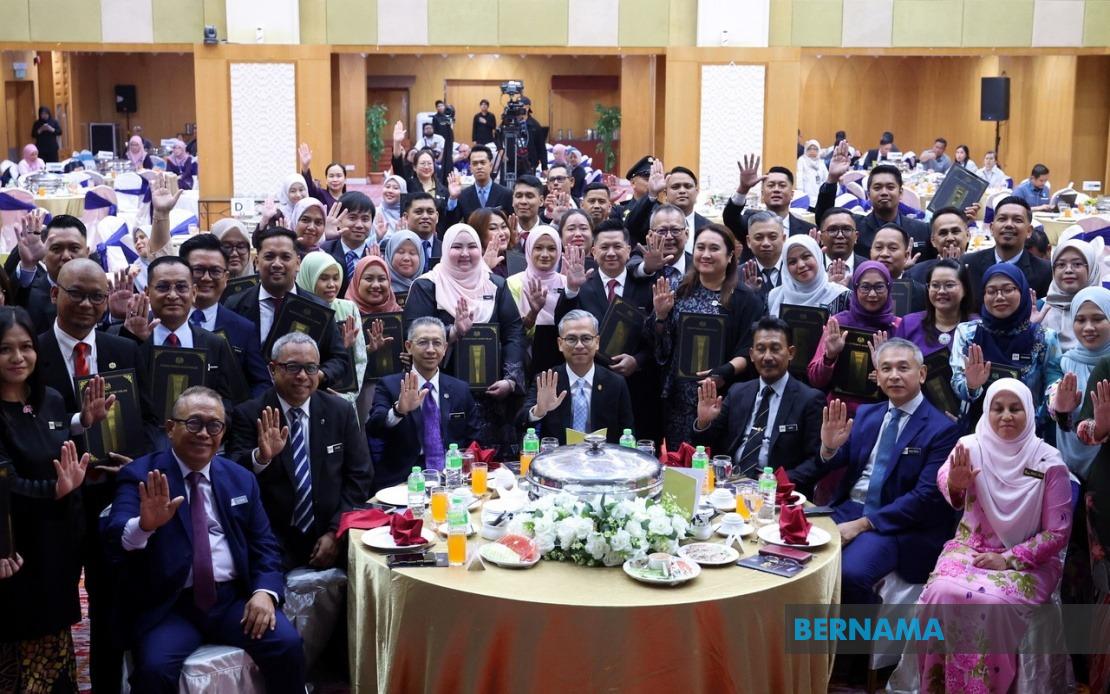
The federal government remains determined to ensure that Malaysia's robust economic performance directly benefits ordinary Malaysians, Communications Minister Datuk Seri Fahmi Fadzil said during an official visit to Sabah on Friday. Speaking at a service excellence awards ceremony in Kota Kinabalu, Fahmi emphasized that while national economic metrics paint an encouraging picture, the true measure of government success lies in whether these gains reach into the pockets and wallets of ordinary citizens.
Fahmi's remarks reflect a deliberate shift in how the MADANI administration frames economic policy, moving beyond abstract macroeconomic indicators toward tangible household-level improvements. The government has observed impressive growth across multiple economic fronts, including investment inflows, revenue collection, foreign reserves, gross domestic product expansion, and international trade figures. Yet the minister stressed that statistics alone tell an incomplete story if they fail to materially improve how ordinary Malaysians live, work, and spend their money.
Central to this philosophy is what government officials now call the "people's economy"—a concept that prioritizes direct, felt improvements in individual circumstances over broad-brush national statistics. Fahmi illustrated this through the government's targeted diesel subsidy programme, known as BUDI MADANI, which represents a conscious attempt to deliver support in ways that address real-world challenges faced by specific communities. The programme demonstrates how policy implementation must account for geographical and situational differences across the country.
Sabah and Sarawak feature prominently in this discussion because of their unique logistical realities. Unlike peninsular Malaysia, these East Malaysian states have significant distances between towns and districts, meaning that fuel costs disproportionately affect local residents and commerce. The BUDI MADANI scheme recognizes that a blanket subsidy approach may not adequately serve communities spread across vast territories, and that effective policy requires tailoring to regional circumstances. Prime Minister Datuk Seri Anwar Ibrahim and his Cabinet have made these geographical realities a priority consideration in policy formulation.
Fahmi's emphasis on translating high-level economic success into individual benefits carries implications for how the government measures policy effectiveness. Rather than relying solely on quarterly GDP reports or investment statistics, officials now recognize they must demonstrate how growth manifests in lower living costs, better employment opportunities, improved purchasing power, and enhanced service delivery at the grassroots level. This reframing becomes particularly important in a political context where opposition parties have criticized the government for prioritizing abstract economic figures while household budgets remain tight.
The minister also highlighted an often-overlooked responsibility: government agencies and ministries must communicate policies clearly and comprehensively to prevent public confusion or misinterpretation. When citizens misunderstand how targeted subsidies work or fail to grasp the rationale behind policy changes, the intended benefits may not translate into genuine public confidence or satisfaction. This communication challenge is especially acute in more remote areas where residents may have limited access to official information channels and may rely instead on social media or word-of-mouth accounts that sometimes distort policy details.
The government's focus on the people's economy represents a strategic pivot toward populist-oriented governance that acknowledges the gap between headline economic performance and household sentiment. Malaysians have experienced inflation pressures, rising property costs, and education expenses over recent years, creating a sense that national economic growth has not proportionately benefited middle and lower-income households. By explicitly committing to policies that address these concerns—through targeted subsidies, improved service delivery, and region-specific support programmes—the MADANI administration hopes to rebuild public confidence in its economic stewardship.
Fahmi's statements also implicitly signal that the government will evaluate ministry and agency performance partly on their effectiveness in delivering people-centred outcomes rather than purely administrative metrics. The Sabah and Labuan Zone Excellent Service Awards ceremony at which he spoke reflects this philosophy, recognizing frontline workers and government units that demonstrate responsiveness to public needs. Such recognition programmes reinforce organizational cultures where citizen satisfaction becomes a core performance measure alongside traditional bureaucratic efficiency indicators.
Looking forward, the challenge for the MADANI Government lies in execution. Crafting policies that address regional differences while maintaining financial sustainability requires sophisticated administrative capacity and political will. Sabah and Sarawak, as resource-rich states with significant distances and dispersed populations, serve as important test cases for whether targeted subsidies and localized programmes can genuinely improve living standards without creating unsustainable fiscal burdens. Success in these states could provide a model for similar initiatives elsewhere, while failure might undermine the government's broader people's economy agenda.
The emphasis on people's economy also reflects acknowledgment that Southeast Asian governments increasingly face pressure to demonstrate concrete improvements in citizen welfare rather than rely on growth statistics alone. Regional neighbours like Indonesia and the Philippines have witnessed strong economic growth that failed to meaningfully reduce poverty or improve living standards for vulnerable populations, creating political instability. Malaysia's leadership appears determined to avoid this disconnect, recognizing that sustained political support requires that economic policies visibly enhance ordinary Malaysians' financial security and quality of life.
For Malaysia's diverse population across Peninsular Malaysia, Sabah, and Sarawak, the government's people's economy approach potentially offers more responsive and contextually appropriate policy responses than one-size-fits-all national programmes. However, success will ultimately depend on whether government agencies at federal, state, and local levels coordinate effectively to translate these principles into tangible service improvements and cost-of-living relief that citizens can directly observe and experience in their communities.

