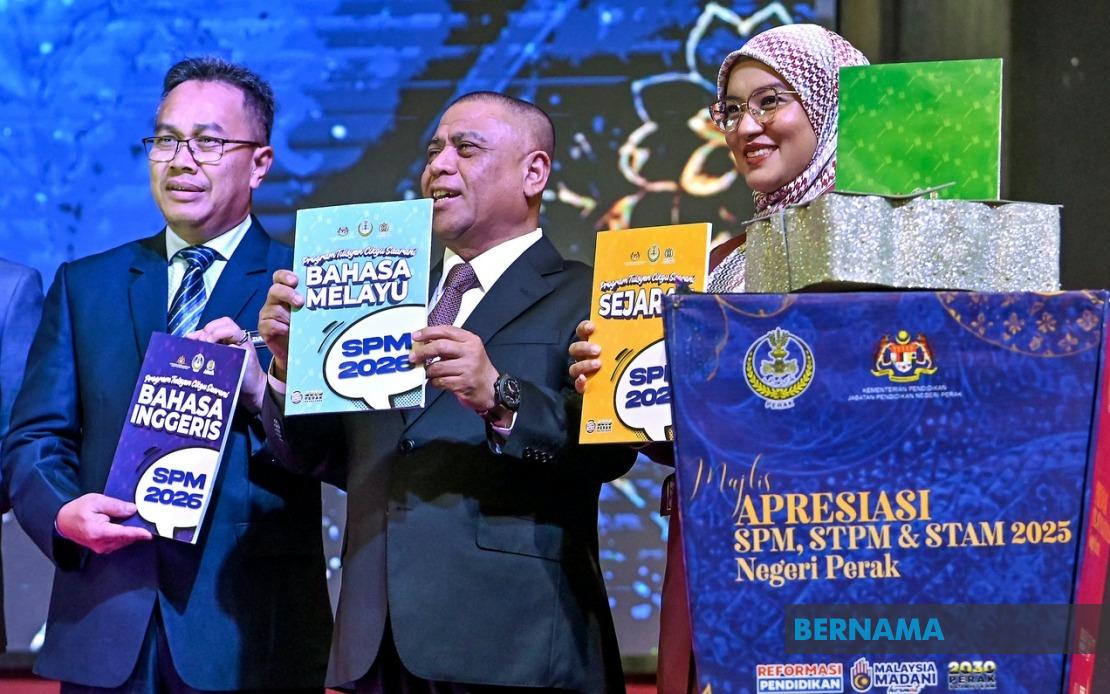
Perak has achieved its strongest Sijil Pelajaran Malaysia (SPM) examination results in 13 years, marking a notable milestone in the state's education journey. The 2025 cohort attained a State Average Grade (GPN) of 4.49, building on momentum established over the previous three years of consistent improvement. This performance underscores an education system gaining strength across multiple indicators, suggesting that policy interventions and teacher development initiatives are yielding measurable returns for Malaysia's second-largest state by area.
Menteri Besar Datuk Seri Saarani Mohamad highlighted the achievement during the 2025 Appreciation Ceremony for examination recipients in Ipoh, framing the results as validation of coordinated efforts by educators, administrators, and policymakers. He noted that the turnaround reflects sustained commitment to quality assurance and curriculum delivery, signalling that Perak's education sector has successfully navigated challenges that have affected learning outcomes nationally in recent years. The timing of this announcement—during a formal recognition ceremony—emphasises the state government's investment in celebrating and incentivising educational excellence.
Particularly striking is Perak's success in closing the achievement gap between candidates in urban and rural settings. The differential of just 0.04 grade points between these two cohorts represents a significant narrowing of historical disparities that have long characterised education systems across Southeast Asia. Rural students in Perak now enjoy near-parity with their urban counterparts in examination performance, suggesting that infrastructure investment, teacher deployment, and digital learning resources have begun equalising opportunities across different communities. This development carries implications beyond state boundaries, as other Malaysian states and regional neighbours grapple with entrenched urban-rural educational divides.
Perak's performance extended beyond the secondary school examinations to pre-university qualifications. The state recorded a Cumulative Grade Point Average (CGPA) of 2.91 in the Sijil Tinggi Persekolahan Malaysia (STPM), surpassing the national average of 2.88. This suggests that students who progress beyond the secondary level in Perak are developing stronger foundational knowledge and analytical skills, which bodes well for university entry and ultimately graduate-level achievement. The fact that 116 Perak STPM candidates achieved the perfect CGPA of 4.00—out of 1,336 nationally—indicates that the state's secondary system is producing intellectually capable students capable of pursuing rigorous tertiary study.
Results in religious examinations also reflected strength across Perak's education ecosystem. The Sijil Tinggi Agama Malaysia (STAM) examination saw the state achieve a GPN of 3.03, with 36 candidates attaining the Mumtaz (excellent) grade. This performance suggests balanced investment across secular and religious educational streams, a consideration of significance in Malaysian education policy where religious schools have sometimes faced resource constraints relative to national schools. Perak's results indicate that Islamic education programmes are maturing and delivering outcomes comparable to mainstream national curriculum tracks.
The Menteri Besar's comments during the ceremony revealed nuanced thinking about educational success that extends beyond examination scores. Saarani emphasised that student achievement represents shared accomplishment involving teachers, parents, school administrators, and broader community support networks. This framing aligns with contemporary understanding of educational effectiveness, which demonstrates that examination results are downstream products of systemic factors including classroom culture, parental engagement, and institutional resilience. His remarks suggest awareness that sustainable improvement requires attention to human and social dimensions alongside curriculum content.
The 266 recipients recognised during the ceremony—comprising individual students, educators, entire schools, and district education offices—reflect a deliberate strategy to build institutional pride and distribute recognition widely. This approach contrasts with systems that celebrate only top-performing individuals, instead creating incentive structures that reward improvement, innovation in teaching methodology, and district-level coordination efforts. For Malaysian educators watching peer achievements across states, such comprehensive recognition systems provide models for sustaining momentum in education reform.
Perak's three-year upward trajectory in SPM performance warrants examination in the context of broader Malaysian education challenges. The country's examination-driven education system has faced criticism for prioritising rote learning over critical thinking, and for creating mental health pressures among students. That Perak has improved outcomes while presumably maintaining educational quality standards suggests the state may have implemented balanced reforms. If the state can maintain growth while broadening curriculum to include skills development, creative problem-solving, and wellbeing initiatives, Perak could position itself as a model for education systems across Malaysia and the region.
The achievement gap closure between urban and rural areas has particular significance for Southeast Asian policymakers. Many regional economies struggle with educational inequality that reflects and perpetuates economic disparities between metropolitan and peripheral regions. Perak's success in narrowing this gap through infrastructure and resource allocation offers lessons for Indonesia, Thailand, and the Philippines, where similar challenges persist. The relatively modest achievement differential of 0.04 points suggests that targeted investment, possibly including teacher incentives for rural posting and digital resource access, can substantially shift outcomes.
Looking forward, Perak's examination results create expectations for sustained or improved performance in 2026 and beyond. The state government will face pressure to maintain momentum while addressing emerging challenges in education, including curriculum relevance to labour market demands, technology integration in classrooms, and student mental health. International research on education systems shows that plateaus commonly emerge after initial improvement phases, particularly if underlying systemic issues remain unaddressed. Perak's policymakers will need to diagnose which specific interventions drove recent gains and determine how to deepen and sustain them.
The 2025 SPM results ultimately demonstrate that Malaysian education, despite persistent structural challenges, remains capable of significant improvement when state governments commit resources and attention to the sector. Perak's achievement validates investment in teacher professional development, curriculum quality assurance, and equitable resource distribution. For students and families across the state, these results signal that academic excellence remains within reach regardless of whether they study in cities or remote communities—a message that extends hope to millions of young Malaysians navigating educational systems that historically sorted students by geography and circumstance rather than potential.

