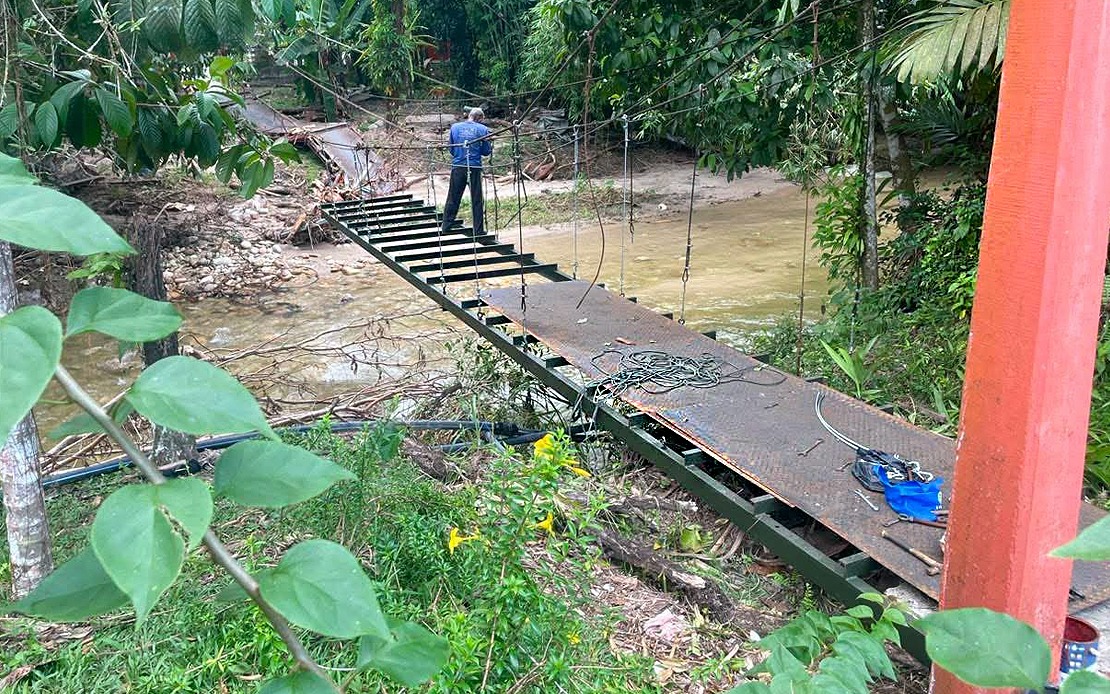
The Perak state government has committed RM500,000 towards constructing a permanent concrete bridge to replace the damaged main crossing in Kampung Ulu Geruntum, Gopeng, addressing the aftermath of a devastating water surge that struck the rural settlement on June 19. The allocation represents a substantial investment in restoring full connectivity and normalcy to the isolated village, which had its sole access route severed when the original bridge collapsed under the force of rapidly rising waters.
State Housing and Local Government Committee chairman Sandrea Ng Shy Ching announced the fund approval and outlined the government's multi-pronged approach to resolving the infrastructure crisis. According to Ng, construction work on the permanent bridge will commence only after all interim remedial measures currently underway have been finalised, ensuring a smooth transition from temporary solutions to lasting infrastructure improvements. This phased approach reflects careful planning aimed at minimizing further disruption to residents while accelerating the return to normal operations.
The June 19 water surge forced an immediate evacuation of more than 50 residents from the village, who sought refuge at the Gopeng Town Hall relief centre. The powerful currents destroyed the main bridge linking the settlement to the outside world, leaving the community entirely cut off from essential services, markets, and medical facilities. The incident highlighted the vulnerability of rural communities to sudden flooding events and the critical importance of robust infrastructure in remote areas.
In addition to the RM500,000 concrete bridge allocation, the state administration has deployed RM150,000 as emergency funding for the construction of a temporary suspension bridge. This interim solution is being built with the explicit goal of restoring immediate access to the village and is projected to become operational by mid-July. The suspension bridge serves as a crucial lifeline while construction crews prepare for the longer-term concrete bridge project, enabling residents to resume essential daily activities and economic functions.
Ng also drew upon her personal allocation as Teja assemblyman to provide additional relief, earmarking RM45,000 from her constituency funds specifically for repairing water pipes and restoring the supply system that had been disrupted by the flooding event. This targeted intervention addresses one of the immediate post-disaster infrastructure challenges faced by residents, acknowledging that communities require functioning utilities alongside physical connectivity. The combined state and constituency allocations total RM695,000, representing a substantial commitment to comprehensive disaster recovery.
The response from state authorities underscores the interconnected nature of rural development challenges in Malaysia. Villages such as Kampung Ulu Geruntum often lack the redundancy in infrastructure that characterizes urban centres, meaning a single bridge collapse translates directly into complete isolation. The approval of emergency and permanent funding signals recognition that one-off disasters in remote areas can have cascading effects on residents' livelihoods, health access, and social cohesion if not addressed promptly and comprehensively.
Ng's public statement emphasizing gratitude toward agencies and personnel involved in ground-level response efforts reflects the coordinated disaster management approach that has become increasingly familiar in Malaysian emergency response. The acknowledgment suggests that multiple government bodies, from civil defence to public works departments, have been mobilized to manage the immediate crisis while planning for restoration. This inter-agency coordination is essential in Perak, where geographic dispersion and challenging terrain often complicate emergency response efforts.
The allocation of substantial government funds within days of the incident contrasts sharply with patterns in some neighbouring nations, where rural infrastructure recovery often languishes for months or years. The swift approval indicates that Perak's state administration has internalized lessons from previous flooding events and maintains resources earmarked for rapid disaster response. However, the allocation also raises questions about the underlying resilience of bridge infrastructure in flood-prone areas and whether existing design standards adequately account for extreme weather events intensified by climate variability.
For Malaysian residents in flood-vulnerable regions, the Kampung Ulu Geruntum case offers both reassurance and a cautionary reminder. The commitment of half a million ringgit for a replacement structure demonstrates that state governments can mobilize resources for rural recovery, yet the necessity for emergency funding equally illustrates how inadequately prepared infrastructure has become for increasingly severe weather phenomena. The incident occurred during the monsoon season, when water levels in rural catchments can surge dramatically, and similar vulnerabilities likely exist in other isolated communities across Perak and neighbouring states.
The temporary suspension bridge becomes a focal point of the recovery timeline. With mid-July as the expected completion date, residents will have immediate access within approximately two weeks of the funding announcement. This rapid interim solution, supported by the RM150,000 emergency allocation, demonstrates practical problem-solving but also highlights the resource constraints that rural infrastructure planning typically faces. The permanent concrete bridge, though significantly more durable and capable of handling projected long-term traffic demands, will require substantially longer to design, tender, and construct.
For observers of Malaysian development policy, the case illustrates both the responsiveness and the reactive nature of disaster funding mechanisms. While the state quickly mobilised resources following the collapse, proactive investment in upgrading vulnerable bridges before catastrophic failure occurs remains constrained by competing budget priorities across multiple sectors. The incident thus serves as a reminder that rural infrastructure planning must balance immediate fiscal pressures against the imperative to reduce disaster vulnerability before the next crisis occurs.

