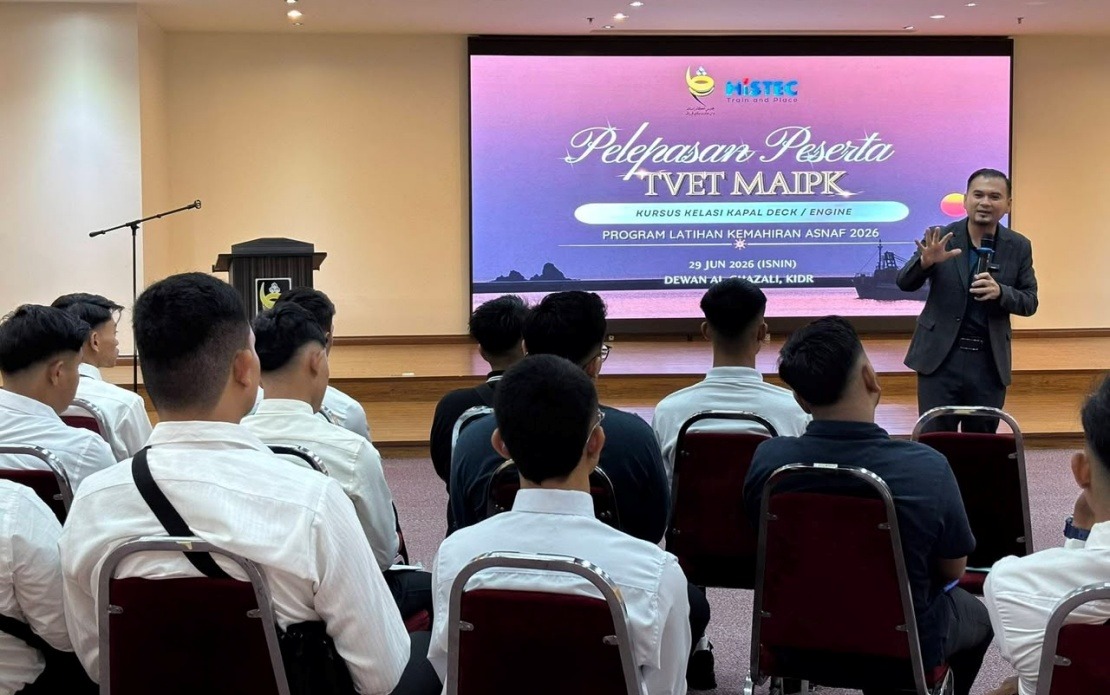
The Perak Islamic Religious and Malay Customs Council (MAIPk) has demonstrated substantial commitment to workforce development by channelling RM470,000 towards maritime vocational training for economically disadvantaged young people. The initiative targets 25 asnaf participants selected for a specialised deck and engine crew programme, with each trainee receiving sponsorship worth RM18,800. This investment signals MAIPk's strategic pivot towards technical vocational pathways as a mechanism for socio-economic mobility among vulnerable communities in the state.
The three-month training programme will be delivered through the Ranaco Education and Training Institute located in Chukai, Terengganu. Participants will engage in a comprehensive curriculum combining classroom instruction with hands-on maritime operations training. Upon successful completion, trainees will obtain professional certification and a seaman's licence—credentials essential for formal entry into commercial shipping and maritime logistics roles. This structured pathway addresses a documented gap between Malaysia's maritime industry demand and the availability of certified local personnel.
The scheme reflects evolving recognition among Islamic religious institutions that Technical and Vocational Education and Training (TVET) serves dual purposes: building tangible technical competencies while simultaneously creating dignified pathways out of poverty for marginalised populations. Rather than relying exclusively on conventional academic routes, MAIPk's approach acknowledges that vocational mastery in high-demand sectors like maritime operations can generate stable income and career progression opportunities. The maritime industry particularly suits this development model, given chronic shortages of trained crew members across Southeast Asian shipping routes.
Placement outcomes appear built into the programme structure. MAIPk has committed to facilitating employment within the maritime sector immediately following graduation, ensuring that training translates directly into job placement rather than remaining a credential without practical application. This employment assurance distinguishes the initiative from many standalone vocational courses and substantially improves the likelihood of sustained income generation for programme alumni. The ability to transition from training facility to active maritime workforce demonstrates coordinated planning between the religious council and industry stakeholders.
The financial commitment—nearly half a million ringgit for a single cohort—positions this intervention within MAIPk's broader institutional mandate to uplift underprivileged communities. The per-capita investment of RM18,800 reflects realistic costings for maritime certification programmes, which necessarily include expensive practical components involving vessel operations simulators and offshore safety protocols. This transparency around programme costs builds confidence that funds are being deployed substantively rather than absorbed by administrative overhead.
From a Malaysian policy perspective, MAIPk's initiative complements national strategies promoting TVET expansion as an alternative to academic tertiary education. With Malaysia facing persistent skills mismatches in technical sectors and youth unemployment concentrated among those without tertiary qualifications, private and religious sector sponsorships expand access to quality vocational pathways. The programme simultaneously demonstrates how Islamic religious institutions can interpret their developmental mandates to address contemporary labour market challenges affecting their communities.
The send-off ceremony held at Kompleks Islam Darul Ridzuan in Ipoh, officiated by MAIPk Asnaf Empowerment Division General Manager Amirudin Osman, underscores institutional commitment to shepherding participants through their training journey. Such formal inaugural events serve psychological and social functions, publicly validating the participants' potential and signalling community backing for their professional aspirations. This ceremonial dimension proves particularly valuable for young people from disadvantaged backgrounds, who may otherwise internalise societal assumptions about their limited prospects.
The maritime sector's strategic importance to Malaysia's economy adds another dimension to this initiative's significance. As a major Southeast Asian port economy and shipping hub, Malaysia requires continuous replenishment of qualified maritime personnel. Local shortage of certified crew members creates dependency on foreign labour, a situation that the MAIPk programme directly addresses by developing domestic talent pipelines. These trained Malaysians will enhance the competitiveness and sovereignty of national maritime industries while improving individual earning capacity.
For similar religious councils and community organisations across Malaysia, MAIPk's model offers a replicable template for meaningful asnaf empowerment. Rather than distributing assistance as temporary charity, investing in technical skills development creates permanent changes in earning trajectories and social positioning. The programme's explicit framing of TVET as a catalyst for socio-economic transformation, rather than merely a training course, reflects sophisticated understanding that structural poverty requires structural solutions—not individual interventions alone.
The three-month duration appears calibrated to industry standards for competency-based maritime certification, suggesting MAIPk collaborated with recognised training standards bodies rather than designing a custom curriculum. This alignment with international maritime conventions strengthens the portability and recognition of participants' credentials across regional and global shipping industries. Malaysian graduates holding standard seaman's licences can seek employment across multiple jurisdictions, potentially accessing higher-wage opportunities in developed maritime economies if domestic positions prove insufficient.
Looking forward, the success metrics for this cohort will likely shape MAIPk's future investment decisions. Should participants achieve consistent employment at competitive wages, the council may expand the programme's scale, potentially sponsoring additional cohorts annually. Conversely, poor employment outcomes would necessitate programme redesign or reorientation. The commitment to post-graduation employment placement suggests MAIPk has already secured industry partnerships, reducing placement risk compared to training initiatives lacking such employer connections.
Ultimately, MAIPk's RM470,000 allocation represents strategic institutional positioning at the intersection of religious charitable obligation and pragmatic economic development. By investing in maritime skills for asnaf youth, the council simultaneously fulfils Islamic principles of community support while addressing demonstrable labour market gaps affecting Malaysia's competitive position in global shipping. This alignment of moral purpose with economic necessity exemplifies how faith-based institutions can contribute meaningfully to national workforce development and inclusive prosperity.

