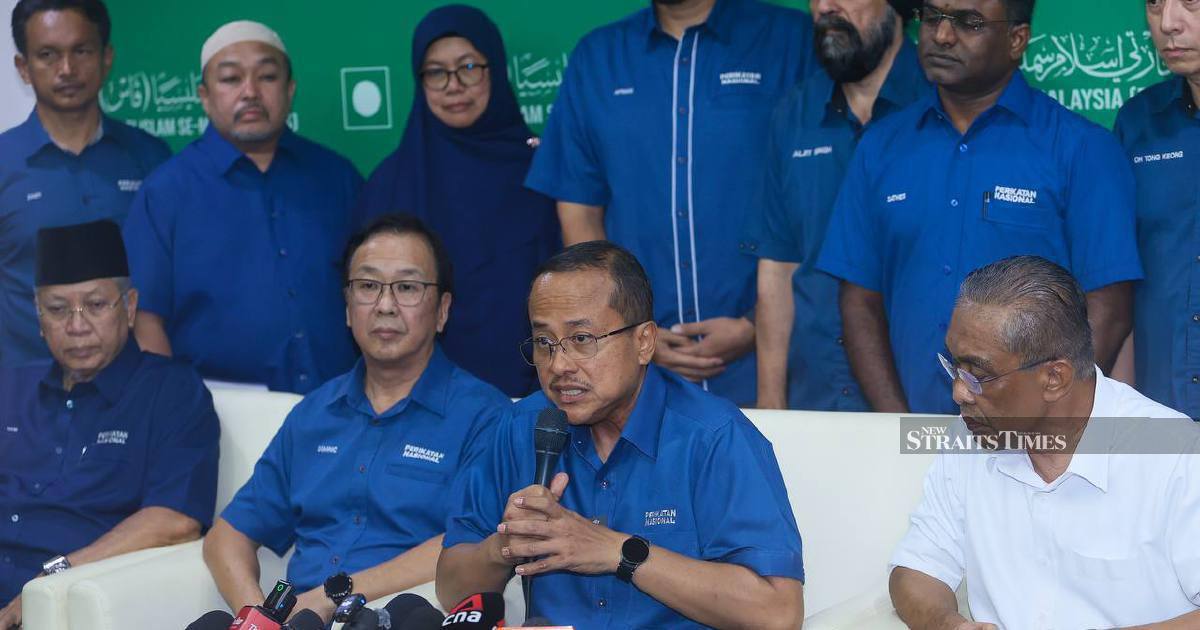
The Perikatan Nasional coalition has admitted two additional political parties into its ranks following a late-night emergency Supreme Council meeting in Kuala Lumpur. PN chairman Datuk Seri Dr Ahmad Samsuri Mokhtar announced the decision, signalling continued efforts by the opposition alliance to broaden its political foundation ahead of anticipated electoral contests and parliamentary manoeuvres.
The expansion of PN's membership reflects an ongoing strategic repositioning within Malaysia's fragmented opposition landscape. Since its formation in 2020, Perikatan Nasional has sought to consolidate non-Barisan Nasional and non-Pakatan Harapan political forces into a coherent electoral bloc. The admission of these two new parties suggests the coalition remains attractive to smaller political entities seeking relevance and platform within a competitive multiparty system. However, the specific identities of the two incoming parties were not immediately disclosed in detail, leaving observers to speculate about the coalition's intended strategic direction and which segments of the electorate it seeks to represent.
The timing of the emergency meeting points to the increasing tempo of coalition-building activities at the national level. Opposition movements frequently resort to closed-door summits to negotiate sensitive matters affecting party unity and strategic alignment. The secrecy surrounding specific discussions indicates that internal consensus-building remains essential, even as PN moves toward public expansion. This pattern reflects the delicate balance opposition alliances must maintain between appearing unified to voters while managing divergent interests among constituent parties.
Datuk Seri Dr Ahmad Samsuri Mokhtar's announcement notably skirted discussion of two contentious issues: the coalition's overall vision statement, designated as Wawasan, and the design of PN's official logo. These omissions are significant, as they suggest ongoing disagreements among coalition members regarding symbolic representation and ideological direction. The failure to address these matters during the emergency meeting indicates that despite tactical progress on membership expansion, fundamental questions about PN's identity and long-term purpose remain unresolved. Such unresolved issues can complicate efforts to present a cohesive political alternative to both Barisan Nasional and Pakatan Harapan governments.
The logo question is particularly revealing about the coalition's internal dynamics. Political symbols carry substantial weight in electoral competition, as they encapsulate party identity and messaging to voters. Disagreement over logo design typically reflects deeper divisions about coalition positioning—whether PN emphasises religious-based politics, Malay-Muslim interests, anti-corruption positioning, or economic nationalism. The absence of logo consensus after the coalition's several years of operation suggests that member parties have not achieved genuine agreement on fundamental political orientation, a potential vulnerability if Perikatan Nasional hopes to mount a credible national challenge.
The Wawasan issue similarly reveals philosophical differences within the coalition. A Wawasan, or collective vision statement, typically articulates a coalition's aspirations, principles, and policy priorities. Failure to harmonise such a statement suggests constituent parties harbour different programmatic objectives. Whether PN members disagree over socioeconomic policies, federal-state relations, religious governance, or institutional reform remains unclear, but the postponement of these discussions indicates that finding common ground is proving difficult despite shared opposition to incumbent governments.
For Malaysian observers and political analysts, the coalition's trajectory carries implications beyond internal mechanics. A stronger, more unified opposition coalition could theoretically provide voters with a clearer alternative at general elections. Conversely, a coalition that expands numerically while remaining divided on fundamental questions may struggle to articulate a compelling platform capable of unseating established governing coalitions. The experience of similar opposition alliances in other democracies suggests that numerical strength without ideological coherence often proves insufficient for political breakthrough.
Regionally, PN's development reflects broader patterns of opposition coalition fragmentation and reconsolidation across Southeast Asia. Malaysia's multi-ethnic, multi-religious composition creates unique challenges for opposition unity that countries with more homogeneous populations may not experience. The difficulty in achieving consensus on symbols and visions underscores how Malaysia's political diversity simultaneously enables and complicates coalition politics. Parties representing different ethnic, religious, or ideological constituencies inevitably bring competing demands that must somehow be reconciled.
The decision to accept two new parties while postponing discussion of core identity questions suggests a pragmatic but potentially unsustainable approach to coalition management. Expansion may increase PN's parliamentary seat count and electoral reach, but without agreement on fundamental vision and symbols, the coalition may struggle to communicate coherently to voters about what it represents and why they should support it. Political movements that cannot articulate clear purpose often dissipate during electoral campaigns or when facing unified opposition.
Moving forward, Perikatan Nasional faces pressure to resolve the outstanding questions of Wawasan and logo design. These are not merely technical or administrative matters; they represent the coalition's opportunity to establish genuine political identity. Whether PN leadership can broker compromises acceptable to all member parties while still producing meaningful differentiation from rival coalitions remains uncertain. The coalition's effectiveness ultimately depends not on numerical strength alone but on its ability to cohere around shared purposes and present unified messaging to an electorate increasingly weary of political fragmentation.